Cluster overview
Status: Post-operations
Launch date: 16 July and 9 August 2000
Mission end: 8 September 2024
Spacecraft names: Rumba, Salsa, Samba and Tango
Objectives
Studying how the solar wind affects Earth, Cluster spacecraft passed in and out of our planet's magnetic field to make the most detailed investigation yet of how the Sun and Earth interact.
Mission
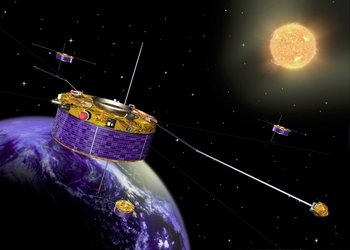
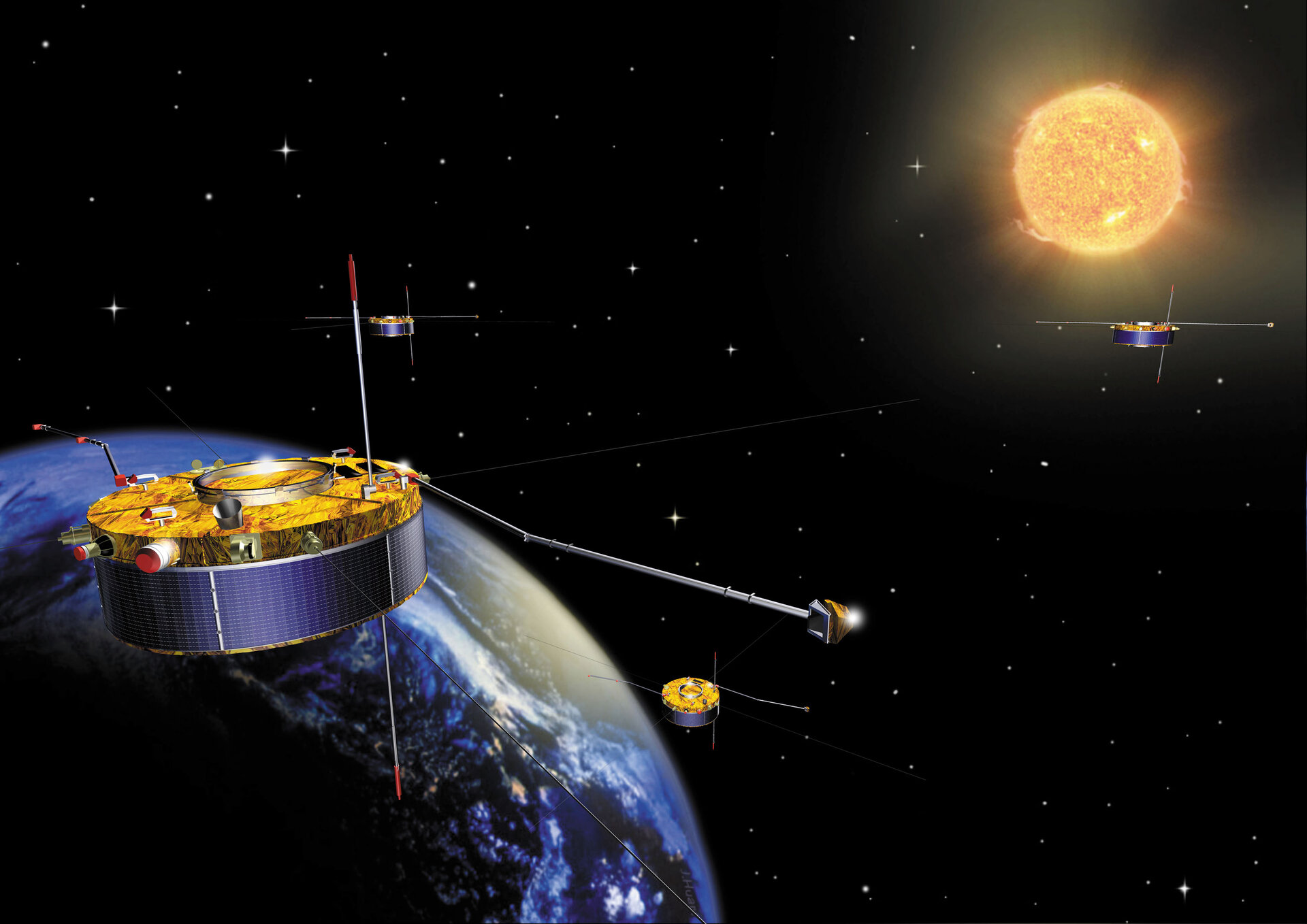
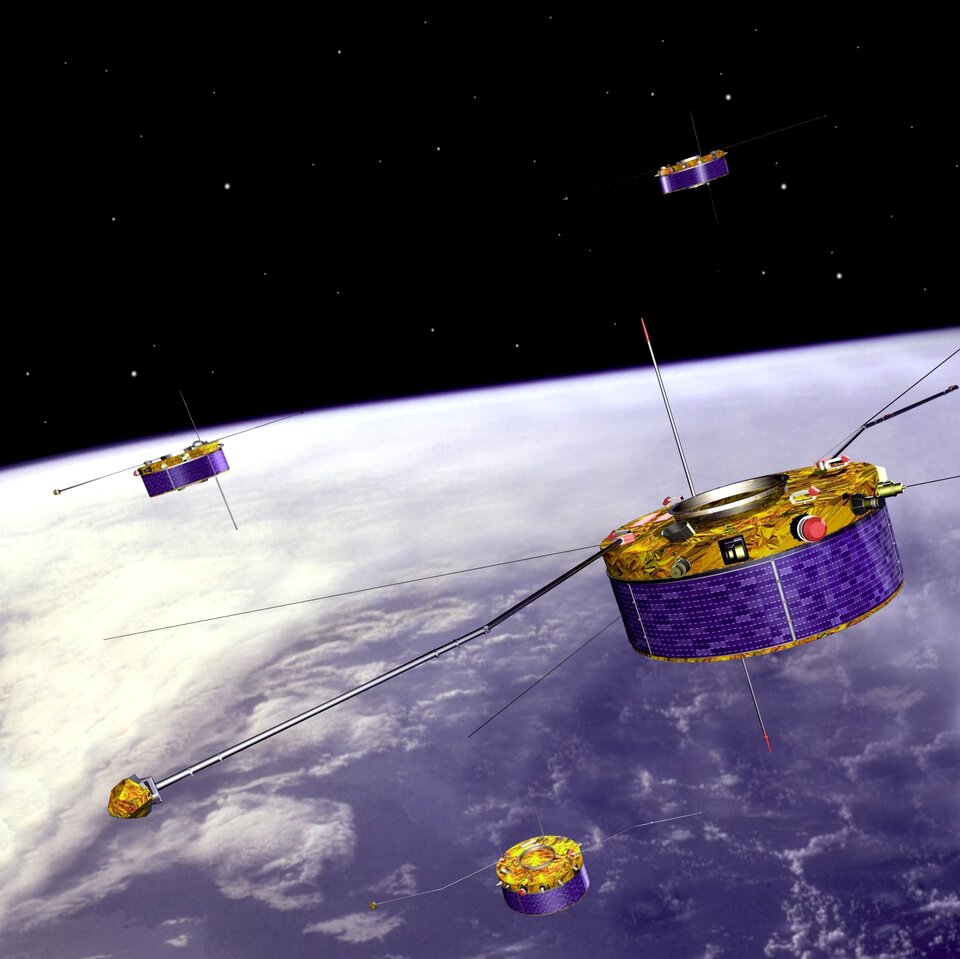
Cluster was a constellation of four spacecraft flying in formation around Earth. They relayed the most detailed information ever about how the solar wind affects our planet in three dimensions. The solar wind (the perpetual stream of subatomic particles given out by the Sun) can damage communications satellites and power stations on Earth. The original operation lifetime of the Cluster mission ran from February 2001 to January 2003. The mission finally ended with the reentry of the Salsa satellite on 8 September 2024.
What's special?
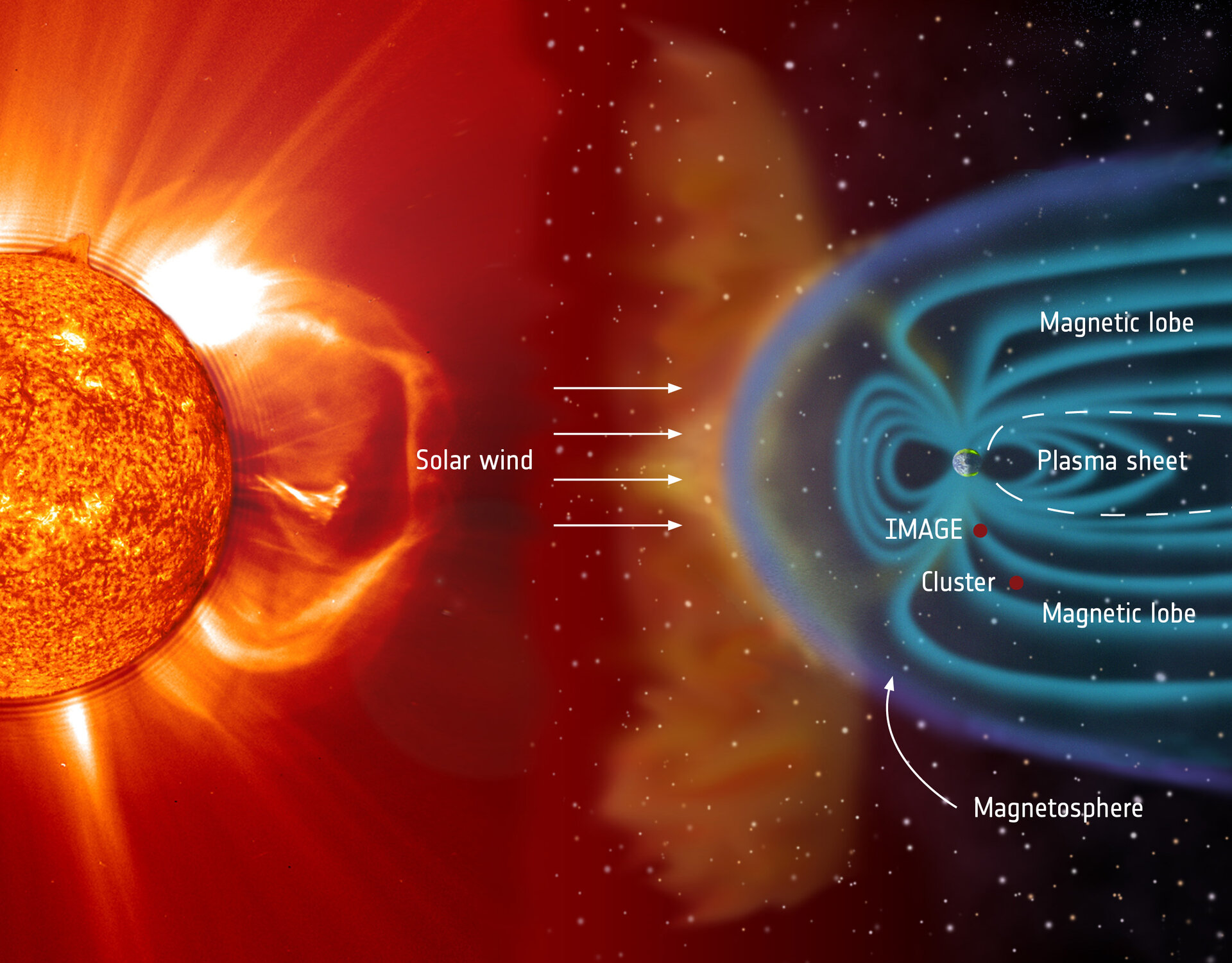
The Sun emits the solar wind, which is a thin, hot, charged gas that carries particles and magnetic fields outward from the Sun.
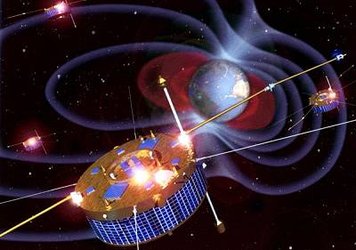
The Earth is shielded from the full blast by its magnetosphere, the region around our planet controlled by its magnetic field. Some solar wind descends into Earth's upper atmosphere through the polar cusps, funnel-like openings in the magnetosphere at the poles. These energetic particles excite atoms and molecules in the upper atmosphere to create the northern and southern lights (the auroras). The part of a planetary magnetosphere that is pushed in the direction of the solar wind is known as the magnetotail.
Cluster sought to determine the physical processes involved in the interaction between the solar wind and the magnetosphere by visiting key regions like the polar cusps and the magnetotail. The four Cluster spacecraft mapped the plasma structures contained in these regions in three dimensions. The simultaneous four-point measurements also allowed close studies of plasma quantities in both space and time.
During periods of high solar activity (which cycles every 11 years), the solar wind can be particularly energetic. This can have a dramatic effect on human activities, disrupting electrical power and telecommunications or causing serious problems in the operation of satellites, especially those in geostationary orbit. Subtle changes to the weather on Earth also occur during these times. Watching the effects of this increased activity during these periods was one of Cluster's main tasks.
Understanding the interaction between the solar wind and the magnetosphere and how the plasma levels of the magnetosphere are affected is important. The data collected by Cluster helps us prepare for the effects of sudden bursts of solar energy here on Earth.
Spacecraft

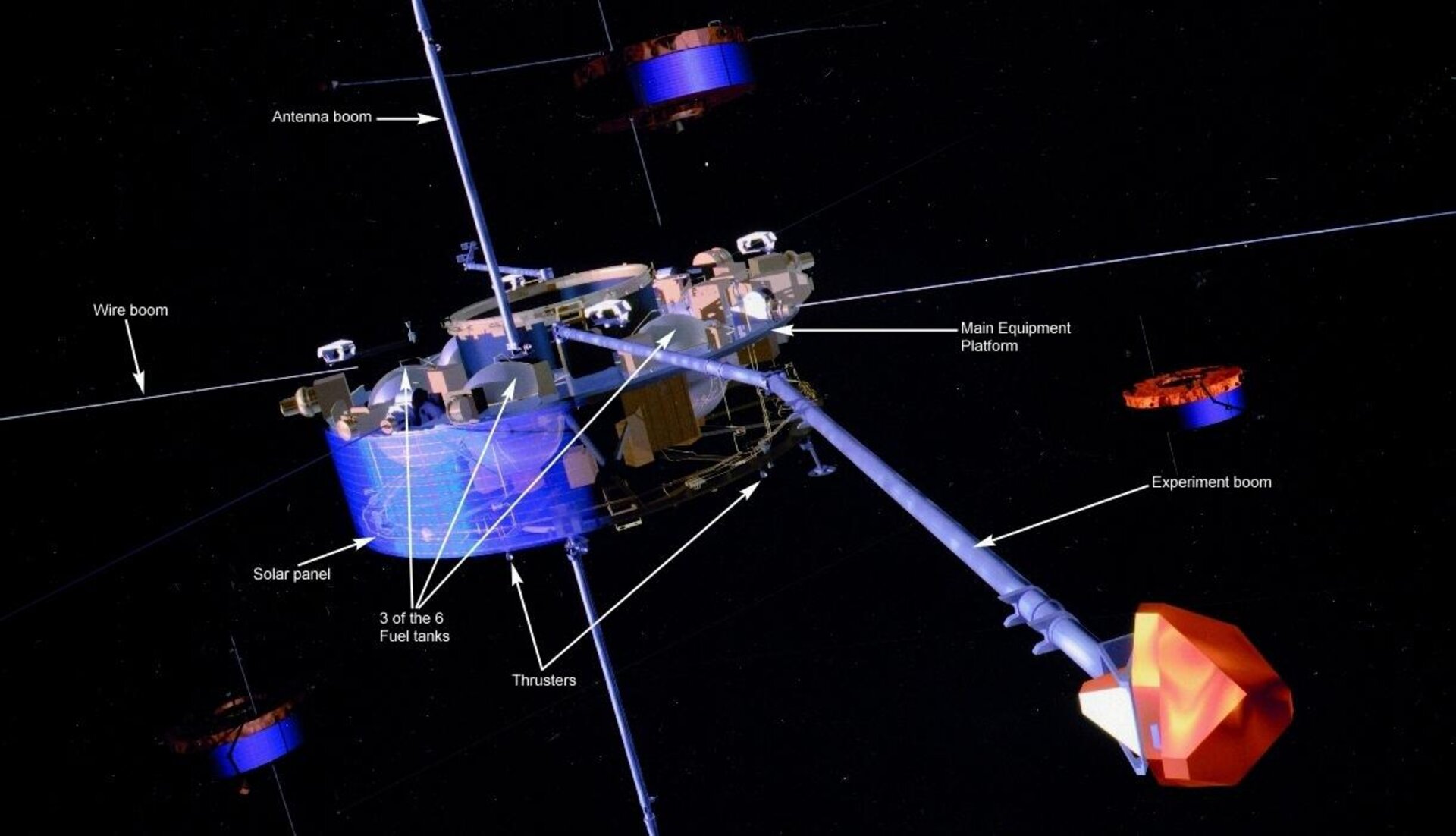
The Cluster spacecraft resembled giant 'Lego' sets, assembled from thousands of individual blocks. Each one was shaped like a giant disc, 1.3 m high and 2.9 m wide, with a cylinder in the centre.
Six spherical fuel tanks were attached to the outside of this central cylinder. The fuel they carried accounted for more than half the launch weight of each spacecraft. Most of the fuel was consumed soon after launch and in complex manoeuvres to reach their operational orbits. Each spacecraft also carried eight thrusters for smaller changes of orbit.
Around the central cylinder was the main equipment platform. Electrical power came from six curved solar panels attached around the outside of the platform. Five batteries were used for power supply during the four-hour-long eclipses when the spacecraft entered Earth's shadow.
Rod-shaped booms opened out once Cluster reached orbit. There were two antennae for communications, two sensors, and four wire booms that operated when the spacecraft began to spin. These measured changing electrical and magnetic fields around each spacecraft.
Journey
At each launch, two Cluster satellites were placed in an elliptical orbit whose height varied from 200 to 18 000 km above Earth. The two satellites of each launch were then released, one after the other and used their own on-board propulsion systems to reach the final operational orbit (19 000 to 119 000 km from the planet).
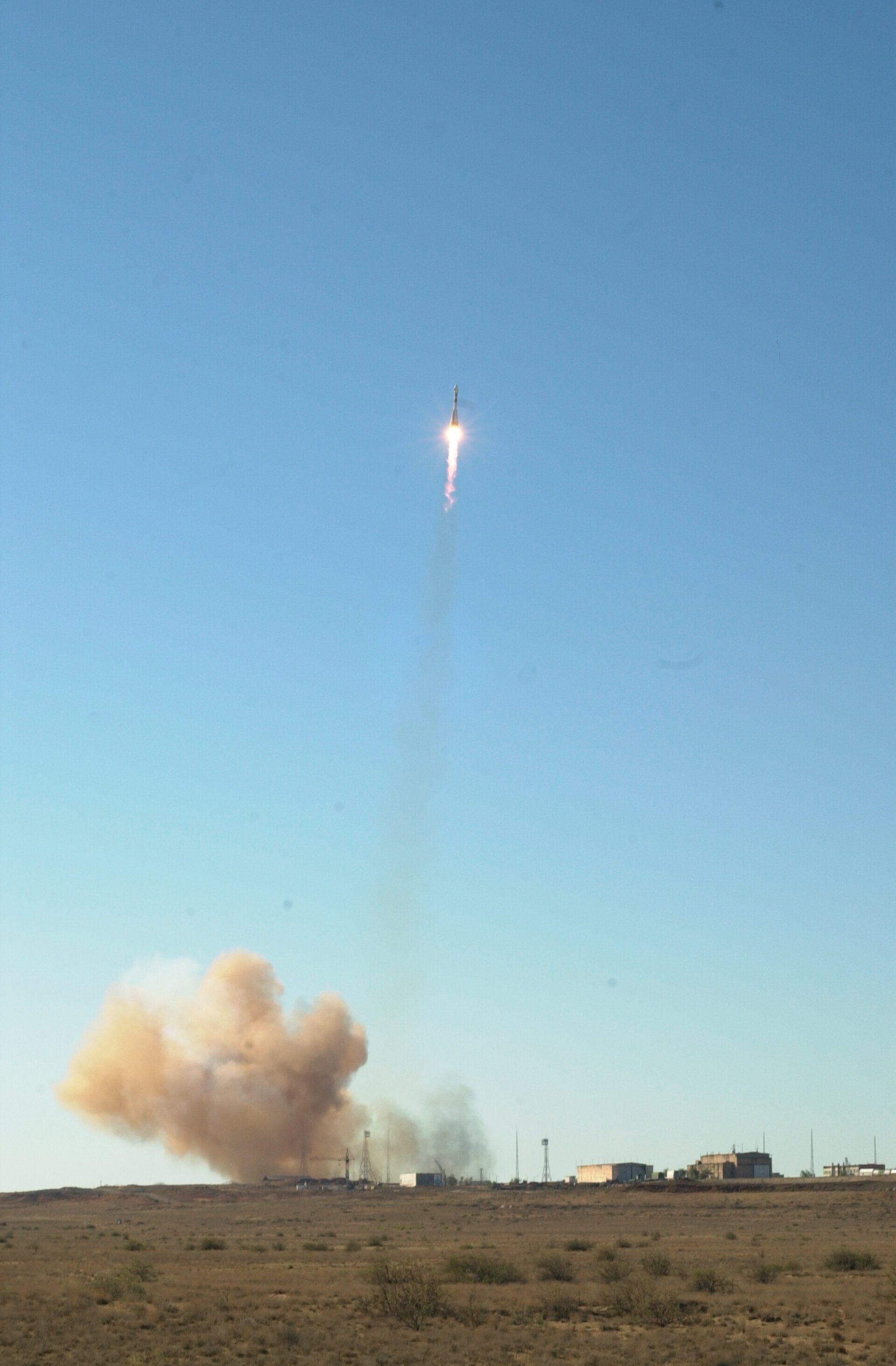
The first pair of Cluster satellites lifted off on 16 July 2000, the second pair one month later. This gap allowed fewer people to be used for mission control in the European Space Operations Centre (ESOC) in Darmstadt (Germany).
Once the booster reached the correct altitude after liftoff, the Fregat payload assist module and its two Cluster spacecraft were released. The Fregat main engine fired almost immediately to achieve a circular orbit of approximately 200 km high. About an hour later, the Fregat engine fired again to inject the spacecraft into an elliptical orbit.
The two satellites were released, one after the other. Each Cluster spacecraft main engine performed six major manoeuvres, using the large amount of onboard fuel (about half of each satellite's launch mass).
History
The Cluster mission was first proposed in November 1982. The idea was developed into a proposal to study the 'cusp' and the ‘magnetotail’ regions of the Earth's magnetosphere with a polar orbiting mission. The Cluster idea developed into a proposal and then a mission. In 1996, Cluster was ready for launch.
Cluster was expected to benefit from a 'free' launch on the first test flight of the newly developed Ariane 5 booster. After several minor delays, Ariane-501 lifted off from Kourou, French Guiana on 4 June 1996, carrying its payload of four Cluster satellites. Unfortunately, intense aerodynamic loads resulted in its break-up and initiation of the automatic destruct system.
To recover some of the unique science from the mission, ESA decided to build a fifth Cluster satellite (named 'Phoenix'). It would be equipped with flight spares of the experiments and subsystems prepared for the Cluster mission. Phoenix was expected to be fully integrated and tested by mid-1997, opening the way for a launch later that year. However, awareness grew that the scientific objectives of the Cluster mission could not be met by a single spacecraft. There were proposals to rebuild three or four full-size Cluster spacecraft alongside Phoenix.
After a preliminary study, it was decided that a Soyuz rocket could launch a pair of Cluster spacecraft. However, the very eccentric orbit required a new upper stage. Two flights were successfully done at the beginning of 2000 and about six months later, Cluster was launched by a Soyuz-Fregat launcher from Baikonur Cosmodrome, Kazakhstan.
On 8 February 2002, the ESA Science Programme Committee unanimously approved the extension of the Cluster mission, pushing back the end date from 1 February 2003 to 31 December 2005. This extension allowed the first measurements of space plasmas at both small and large scales simultaneously and the sampling of geospace regions never crossed before by four spacecraft flying in close formation. In January 2005 the mission was extended from 1 January 2006 to 31 December 2009. The mission finally ended with the reentry of the Salsa satellite in September 2024.
Partnerships
The prime contractor for the original (lost) Cluster and replacement Cluster satellites was Dornier Satellitensysteme GmbH (later Astrium, now incorporated into Airbus Defence and Space), Friedrichshafen, Germany, the leader of an industrial consortium involving 35 major contractors from all of the ESA Member States and the United States.
Each spacecraft carried an identical set of 11 instruments to investigate charged particles, electrical, and magnetic fields. These were built by European and American instrument teams led by Principal Investigators.
The Cluster scientific community includes the ESA Project Scientist, 11 Principal Investigators, and more than 250 Co-Investigators from ESA Member States, the United States, Canada, China, the Czech Republic, Hungary, India, Israel, Japan, and Russia.