• → European Space Agency

      • Space for Europe
      • Space News
      • Space in Images
      • Space in Videos
    • About Us

      • Welcome to ESA
      • DG's News and Views
      • For Member State Delegations
      • Business with ESA
      • ESA Exhibitions
      • ESA Publications
      • Careers at ESA
    • Our Activities

      • Space News
      • Observing the Earth
      • Human Spaceflight
      • Launchers
      • Navigation
      • Space Science
      • Space Engineering
      • Operations
      • Technology
      • Telecommunications & Integrated Applications
    • For Public

    • For Media

      • Media
      • ESA TV
      • Videos for professionals
      • Photos
    • For Educators

    • For Kids

    • ESA

    • Space Science

    • Our Universe
    • About Space Science
    • ESA's 'Cosmic Vision'
    • Science missions
    • Mission navigator
    • Target groups
    • For Media
    • For Scientists
    • For Kids
    • Multimedia
    • Science images
    • Science videos
    • Animations
    • Downloads
    • Sounds from space
    • Resources
    • Reference section
    • Services
    • FAQs
    • Glossary
    • Help
    • Portal terms of use
    • Comments
    • Follow us
    • RSS feeds
    • ESA Sci on Twitter
    • ESA Space Science Images on Flickr
    • ESA 3D on Flickr

    ESA > Our Activities > Space Science

    Exoplanet hunt update

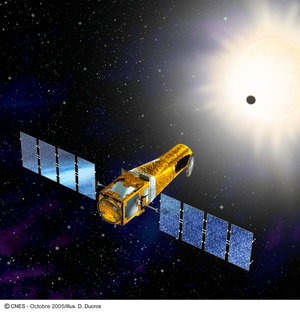
    Artist's impression of COROT
    21 May 2008

    Two new exoplanets and an unknown celestial object are the latest findings of the COROT mission. These discoveries mean that the mission has now found a total of four new exoplanets.

    These results were presented this week at the IAU symposium 253 in Massachusetts, USA.

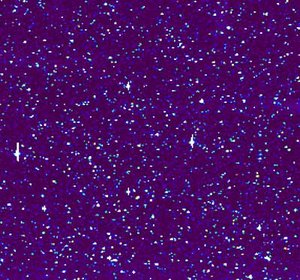
    COROT has now been operating for 510 days, and the mission started observations of its sixth star field at the beginning of May this year. During this observation phase, which will last 5 months, the spacecraft will simultaneously observe 12 000 stars.

    The two new planets are gas giants of the hot Jupiter type, which orbit very close to their parent star and tend to have extensive atmospheres because heat from the nearby star gives them energy to expand.

    Scientists suspect that with the detection of COROT-exo-3b, they might just have discovered the missing link between stars and planets.

    In addition, an oddity dubbed ‘COROT-exo-3b’ has raised particular interest among astronomers. It appears to be something between a brown dwarf, a sub-stellar object without nuclear fusion at its core but with some stellar characteristics, and a planet. Its radius is too small for it to be a super-planet.

    If it is a star, it would be among the smallest ever detected. Follow-up observations from the ground have pinned it at 20 Jupiter massses. This makes it twice as dense as the metal Platinum.

    Scientists suspect that with the detection of COROT-exo-3b, they might just have discovered the missing link between stars and planets.


    COROT has also detected extremely faint signals that, if confirmed, could indicate the existence of another exoplanet, as small as 1.7 times Earth’s radius.

    COROT has also detected extremely faint signals that, if confirmed, could indicate the existence of another exoplanet, as small as 1.7 times Earth’s radius.

    This is an encouraging sign in the delicate and difficult search for small, rocky exoplanets that COROT has been designed for.

    Note for editors:

    COROT was launched atop the Soyuz from the Baikonour cosmodrome in Kazakhstan on 27 December 2006. Settled in its almost-circular polar orbit ranging between 895 and 906 km above Earth's surface, the spacecraft was first powered on 2 January 2007 and started its science observations on 3 February of the same year.

    COROT is a CNES project with ESA participation. The other major partners in this mission are Austria, Belgium, Brazil, Germany and Spain.

    For more information:

    Malcolm Fridlund, ESA COROT Project Scientist
    Malcolm.Fridlund @ esa.int

    Rate this

    Views

    Share

    • Currently 0 out of 5 Stars.
    • 1
    • 2
    • 3
    • 4
    • 5
    Rating: 0/5 (0 votes cast)

    Thank you for rating!

    You have already rated this page, you can only rate it once!

    Your rating has been changed, thanks for rating!

    219
    Tweet
    • COROT will dig into stellar interiors
      COROT will dig into stellar interiors
      Searching for exoplanets
    • Related ESApod
    • COROT (vodcast)
    • COROT (podcast)
    • Related articles
      • COROT surprises a year after launch
        • COROT discovers its first exoplanet and catches scientists by surprise
          • COROT started its science mission
            • COROT enters fine-pointing mode
              • COROT sees first light!
                • The European dimension of COROT: An interview with Fabio Favata
                  • COROT and the new chapter of planetary searches
                    • Europe goes searching for rocky planets
                    • Read more
                      • How many planets are outside our Solar System?
                        • How to find an extrasolar planet
                          • Planet discoverer: An interview with Didier Queloz
                          • Related links
                          • COROT in depth
                          • COROT at CNES
                          • Extrasolar Planets Encyclopedia

    Connect with us

    • RSS
    • Youtube
    • Twitter
    • Flickr
    • G+
    • Facebook
    • Livestream
    • Subscribe
    • App Store
    • ESA Science Twitter

    Follow ESA science

    • LATEST ARTICLES
    • · Rare merger reveals secrets of gal…
    • · Watching for hazards: ESA opens as…
    • · ESA astronaut Timothy Peake set fo…
    • · Space drives e-mobility
    • · Proba-V opens its eyes
    • FAQ

    • Jobs at ESA

    • Site Map

    • Contacts

    • Terms and conditions