• → European Space Agency

      • Space for Europe
      • Space News
      • Space in Images
      • Space in Videos
    • About Us

      • Welcome to ESA
      • Director General
      • For Member State Delegations
      • Business with ESA
      • Law at ESA
      • ESA Exhibitions
      • ESA Publications
      • Careers at ESA
    • Our Activities

      • Space News
      • Observing the Earth
      • Human Spaceflight
      • Launchers
      • Navigation
      • Space Science
      • Space Engineering & Technology
      • Operations
      • Telecommunications & Integrated Applications
      • Preparing for the Future
    • Connect with Us

    • For Media

      • Media
      • ESA TV
      • Videos for professionals
      • Photos
    • For Educators

    • For Kids

    • ESA

    • Space Science

    • Our Universe
    • About Space Science
    • ESA's 'Cosmic Vision'
    • Science missions
    • Mission navigator
    • Target groups
    • For Media
    • For Scientists
    • For Kids
    • Multimedia
    • Science images
    • Science videos
    • Animations
    • Downloads
    • Sounds from space
    • Resources
    • Reference section
    • Services
    • FAQs
    • Glossary
    • Help
    • Comments
    • Follow us
    • RSS feeds
    • ESA Sci on Twitter
    • ESA Space Science Images on Flickr
    • ESA 3D on Flickr
    • Terms and conditions

    ESA > Our Activities > Space Science > Exploring space

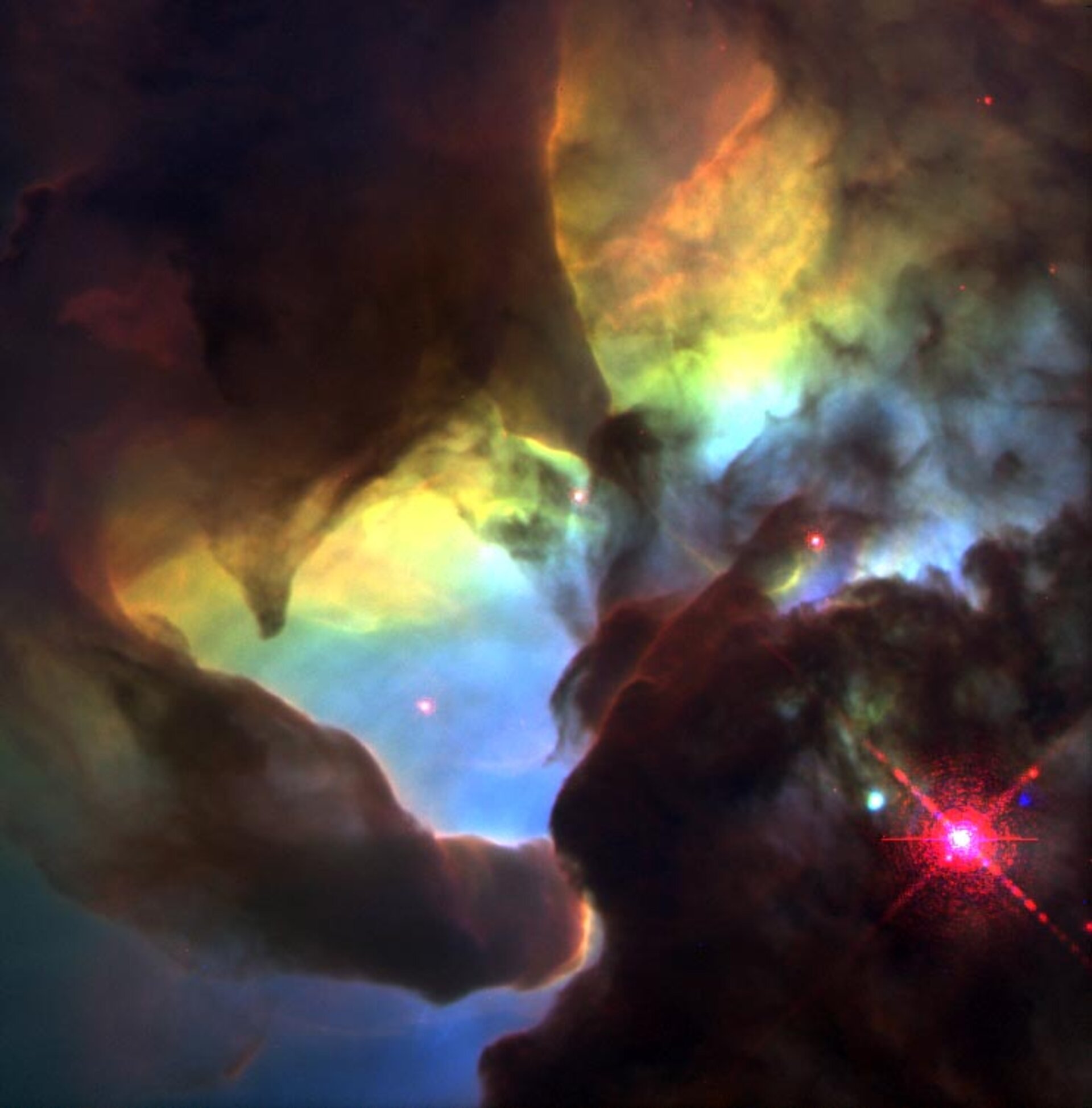
    NGC 6523, Lagoon Nebula

    Lagoon Nebula (NGC 6523 or M8)

    This NASA/ESA Hubble Space Telescope image reveals a pair of half a light-year long interstellar 'twisters', eerie twisted funnel structures, in the heart of the Lagoon Nebula (M8).

    The central hot star, O Herschel 36 (shown here on left, red), is the primary source of the ionising radiation for the brightest region in the nebula, called the 'Hourglass'. Other hot stars, also present in the nebula, are ionising the outer visible parts of the nebulous material.

    This ionising radiation heats up and 'evaporates' the surfaces of the clouds (seen as a blue 'mist' at the right of the image), and drives violent stellar winds which tear into the cool clouds.

    Analogous to the phenomena of tornadoes on Earth, the large difference in temperature between the hot surface and cold interior of the clouds, combined with the pressure of starlight, may produce strong horizontal 'windshear' to twist the clouds into their tornado-like appearance.

    The Lagoon Nebula and nebulae in other galaxies are sites where new stars are being born from dusty molecular clouds. These regions are the 'space laboratories' for astronomers to study how stars form and the interactions between the winds from stars and the gas nearby. By studying the wealth of data revealed by Hubble, astronomers will understand better how stars form in the nebulae.

    These colour-coded images are the combination of individual exposures taken in 1995 with Hubble's Wide Field and Planetary Camera 2 (WFPC2).

    Last update: 3 August 2004

    Rate this

    Views

    Share

    • Currently 4 out of 5 Stars.
    • 1
    • 2
    • 3
    • 4
    • 5
    Rating: 4/5 (1 votes cast)

    Thank you for rating!

    You have already rated this page, you can only rate it once!

    Your rating has been changed, thanks for rating!

    1416
    Tweet
    • More about...
      • Hubble overview
      • Related articles
        • Why are things in space the shape that they are?
          • Saturn Nebula (NGC 7009)
            • Cone Nebula (NGC 2264)
              • Spirograph Nebula (IC 418)
                • The Hourglass Nebula (MyCn-18)
                  • Lagoon Nebula (NGC 6523 or M8)
    • App Store
    • Subscribe
    • App Store
    • LATEST ARTICLES
    • · Chameleon satellite to revolutioni…
    • · Cutting through martian history
    • · ESA teams ready for Europe’s next …
    • · Astronomers use cosmic gravity to …
    • · Luca Parmitano: this year’s Captai…
    • FAQ

    • Jobs at ESA

    • Site Map

    • Contacts

    • Terms and conditions