• → European Space Agency

      • Space for Europe
      • Space News
      • Space in Images
      • Space in Videos
    • About Us

      • Welcome to ESA
      • DG's News and Views
      • For Member State Delegations
      • Business with ESA
      • ESA Exhibitions
      • ESA Publications
      • Careers at ESA
    • Our Activities

      • Space News
      • Observing the Earth
      • Human Spaceflight
      • Launchers
      • Navigation
      • Space Science
      • Space Engineering
      • Operations
      • Technology
      • Telecommunications & Integrated Applications
    • For Public

    • For Media

    • For Educators

    • For Kids

    • ESA

    • Space Science

    • Our Universe
    • About Space Science
    • ESA's 'Cosmic Vision'
    • Science missions
    • Mission navigator
    • Target groups
    • For Media
    • For Scientists
    • For Kids
    • Multimedia
    • Science images
    • Science videos
    • Animations
    • Downloads
    • Sounds from space
    • Resources
    • Reference section
    • Services
    • FAQs
    • Glossary
    • Help
    • Portal terms of use
    • Comments
    • ESA Press Releases
    • Follow us
    • RSS feeds
    • ESA Sci on Twitter
    • ESA Space Science Images on Flickr
    • ESA 3D on Flickr

    ESA > Our Activities > Space Science

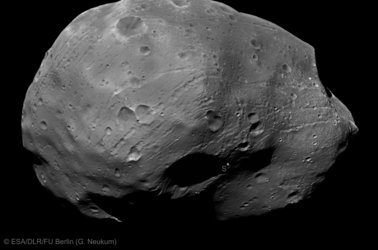
    Phobos in 3D

    Fantastic Phobos

    20 August 2012

    Some 135 years after its discovery, Mars’ largest moon Phobos is seen in fantastic detail – and in 3D – in an image taken by ESA’s Mars Express spacecraft as it passed just 100 km by.

    This view is much different to the faint object that astronomer Asaph Hall would have just been able to make out as he observed the Red Planet through the United States Naval Observatory’s 66 cm telescope in 1877. Through this telescope he discovered Mars’ smaller, outermost moon Deimos on 12 August and the larger, innermost moon Phobos on 18 August.

    More than a century later later, spacecraft in orbit around Mars are studying Phobos in unprecedented detail.

    In this image, a bite-sized chunk appears to be missing from the right edge of the irregular shaped moon – this is a side-on view of the rim of large impact crater Stickney, so-called after the maiden name of the discoverer’s wife.

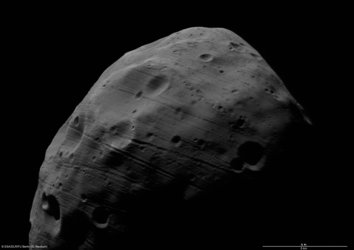
    Families of grooves appear to emanate from Stickney, carving channels across the approximately 27 km length of the moon. Initially thought to be associated with the Stickney impact crater, one recent theory suggests that they were instead formed when Phobos passed through debris clouds thrown up from the surface of Mars by asteroid impacts onto the planet’s surface.

    Orbiting Mars at just 6000 km from the planet’s surface, it is closer to its parent planet than any other known moon in our Solar System. The moon’s proximity means that it hurtles around Mars faster than the planet rotates: for an observer on the surface of Mars, Phobos would appear to rise and set twice a day.

    The moon’s orbit is decreasing and in some 50 million years time it will likely break up to form a debris ring around Mars, before colliding with the planet’s surface.

    Rate this

    Views

    Share

    • Currently 0 out of 5 Stars.
    • 1
    • 2
    • 3
    • 4
    • 5
    Rating: 0/5 (0 votes cast)

    Thank you for rating!

    You have already rated this page, you can only rate it once!

    Your rating has been changed, thanks for rating!

    265
    facebook
    twitter
    reddit
    google plus
    digg
    tumbler
    digg
    blogger
    myspace
    • Archive
      • Image of the week archive
      • Mars Express
      • Mars Express blog
      • See the Mars Webcam from ESA's Spacecraft Operations team
        See the Mars Webcam from ESA's Spacecraft Operations team
        Mars Webcam
      • More about
        • Phobos slips past Jupiter
          • Mars Express close flybys of martian moon Phobos
          • For the media
            • Phobos flyby images
              • Phobos flyby success
              • Related articles
                • Mars Express heading for closest flyby of Phobos
                  • Pioneering images of both martian moons
                    • Mars Express acquires sharpest images of martian moon Phobos
                    • Related links
                    • Build your own 3D glasses
                    • In depth
                    • Mars Express in depth
                    • Follow us
                    • ESA Space Science Image of the Week on Flickr
                    • ESA 3D on Flickr
                    • ESA Sci on Twitter

    Connect with us

    • RSS
    • Youtube
    • Twitter
    • Flickr
    • Google Buzz
    • Subscribe
    • App Store
    • ESA Science Twitter

    Follow ESA science

    • LATEST ARTICLES
    • · CryoSat hits land
    • · Ariane 5 completes seven launches …
    • · Measuring skull pressure without t…
    • · Malargüe station inauguration
    • · The solar wind is swirly
    • FAQ

    • Jobs at ESA

    • Site Map

    • Contacts

    • Terms and conditions