Gaia factsheet
Fast facts about ESA's Gaia mission
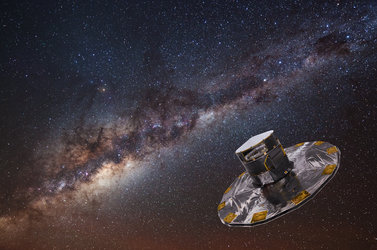
Name: Gaia
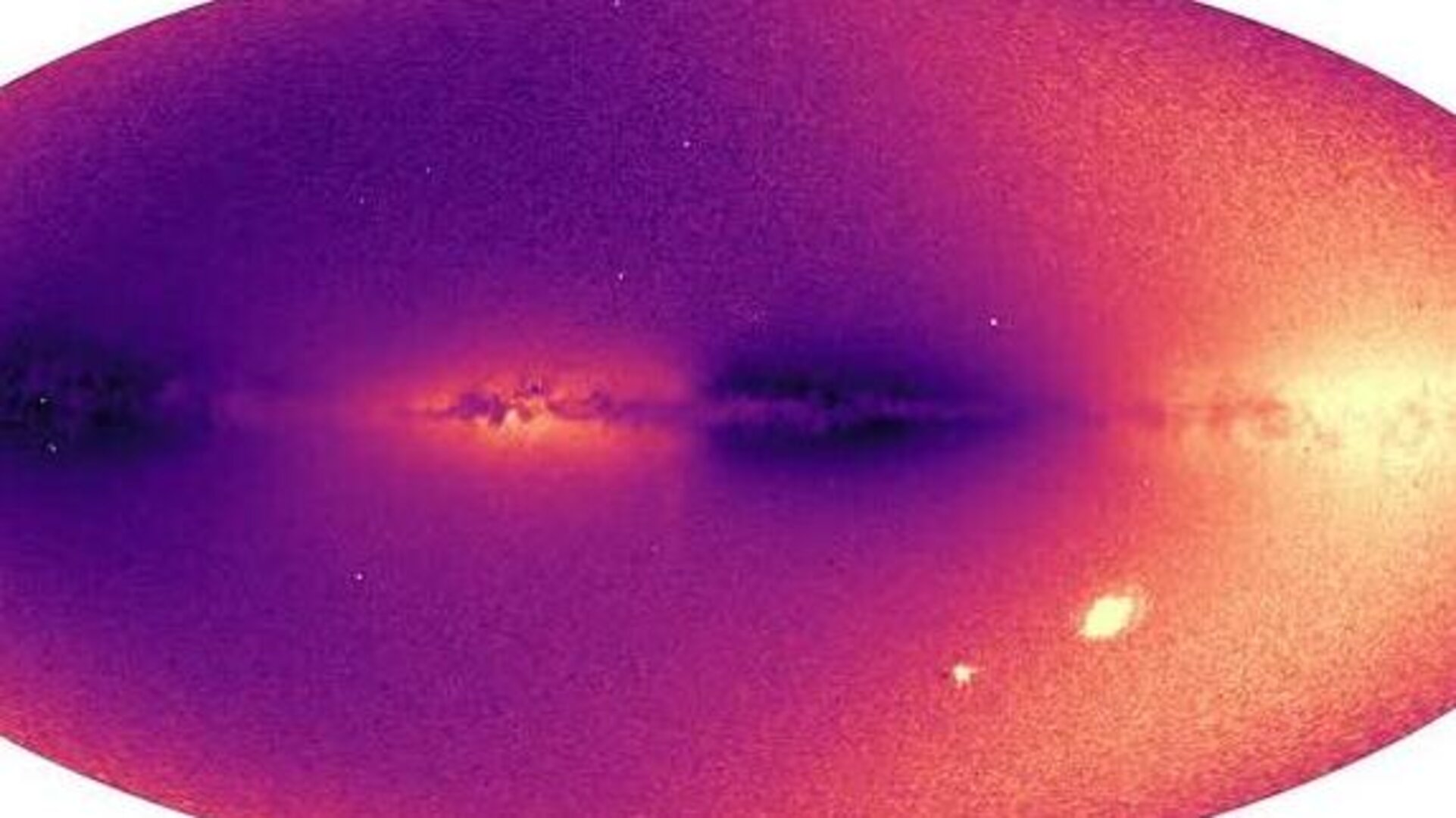
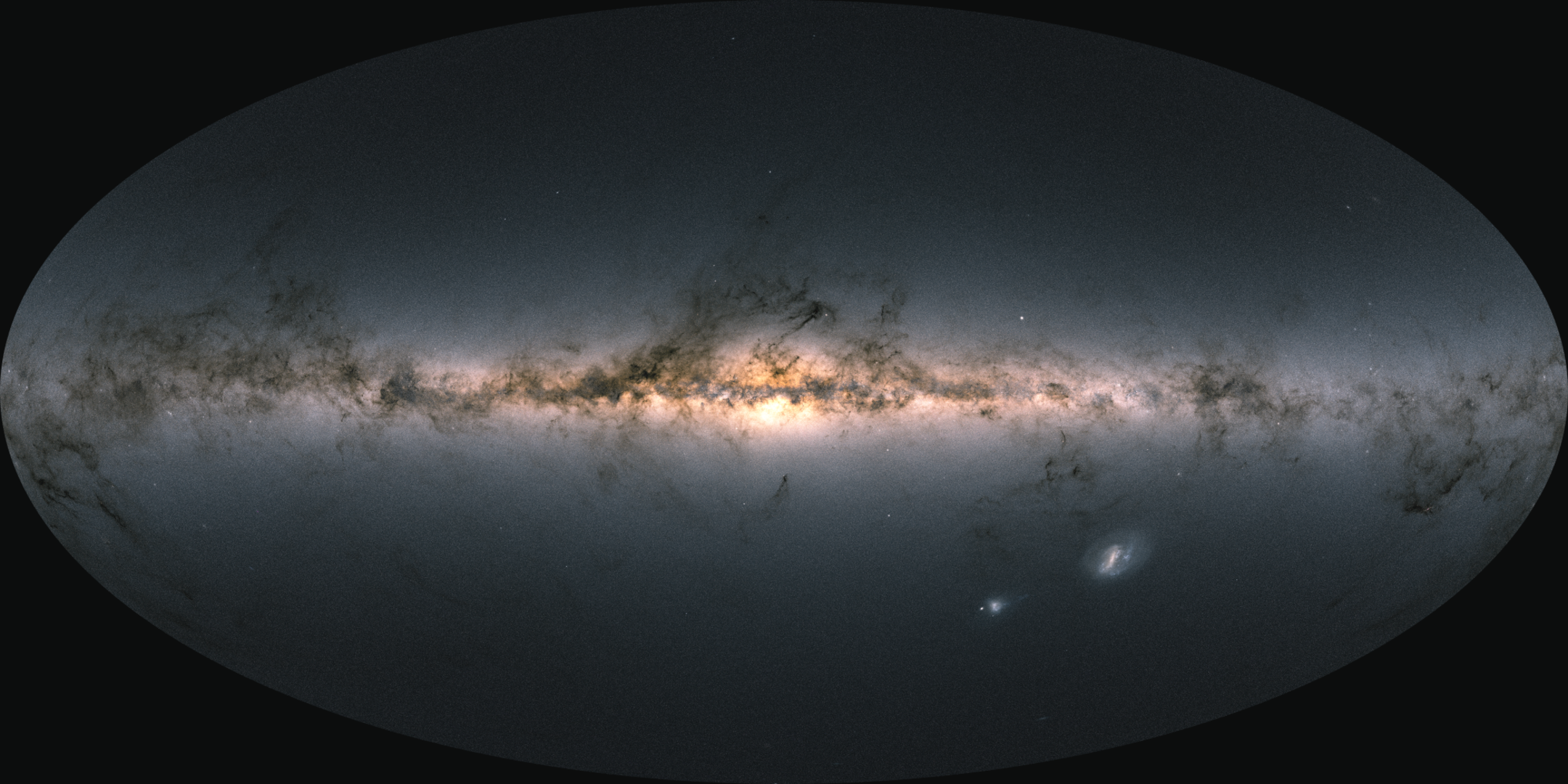
Mission: To determine the position of nearly two billion objects, creating the largest and most precise 3D map of the Milky Way
Launch date: 19 December 2013
Status: Post-operations
Launch vehicle: Soyuz-Fregat
Launch mass: 2030 kg, including 710 kg of payload, a 920 kg service module and 400 kg of propellant.
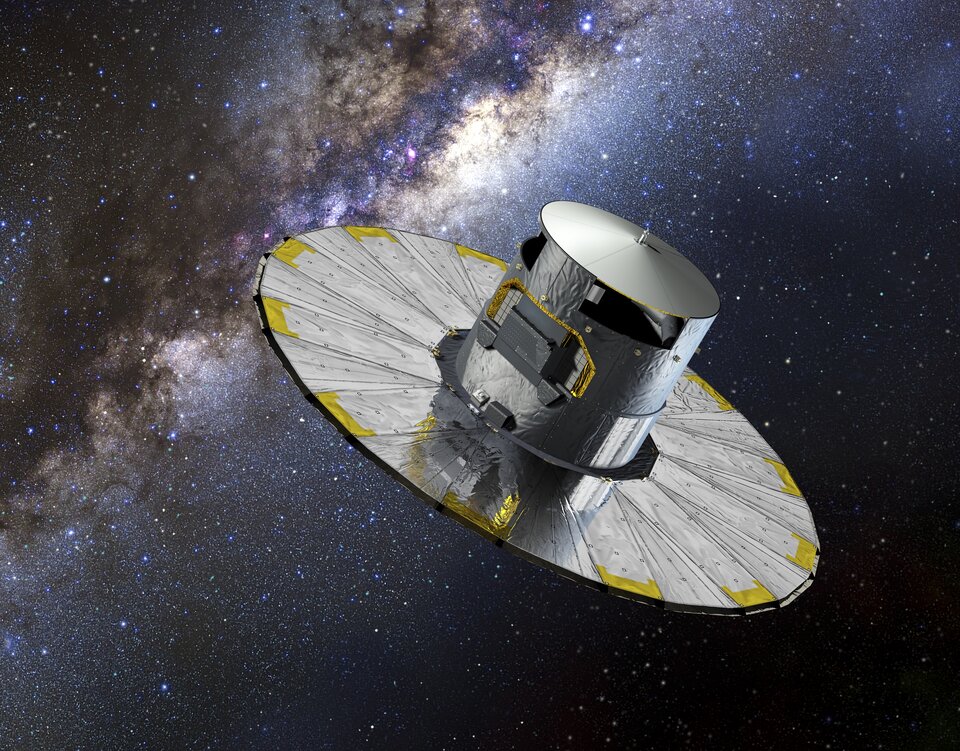
Dimensions: 10 m across, with solar array deployed
Orbit: Lissajous-type orbit around L2
Instruments: Two identical telescopes that feeded a common focal plane with CCD detectors. The focal plane had three scientific functions: sky mapper (SM) and astrometric field (AF), blue and red photometers (BP and RP), and a radial-velocity spectrometer (RVS).
Partnerships: Gaia is a European mission operated by ESA that has been designed and built by European industries.
Primary mission objectives
- To describe nearly two billion objects in our Milky Way regarding position, motion and properties that can be derived from their spectra, creating the largest and most precise multi-dimensional map of the Milky Way.
Data releases
- Data Release 1: 14 September 2016
- Data Release 2: 25 April 2018
- Early Data Release 3: 3 December 2020
- Full Data Release 3: 13 June 2022
- Focused Product Release: 10 October 2023
Science highlights to date

- Revelation that white dwarfs, the dead remnants of stars like our Sun, turn into solid spheres as the hot gas inside them cools down.
- Revelation that part of the Milky Way known as the ‘thick disc’ began forming 13 billion years ago, around 2 billion years earlier than expected, and just 0.8 billion years after the Big Bang.
- Detection of 'starquakes' – tiny motions on the surface of a star that change the shapes of stars, something the observatory was not originally built for.
- Revelation that instead of forming alone, our Galaxy merged with another large galaxy early in its life, around 10 billion years ago.
- Provision of the highest accuracy survey of asteroids combining their compositions with their orbits.
- Greater insight into how the Andromeda Galaxy rotates and moves through space.
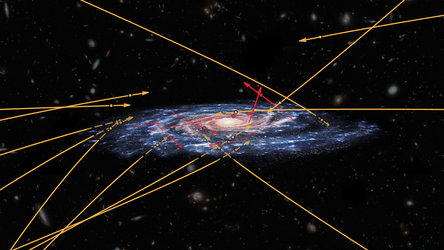
- Discovery of many new stellar streams and stellar clusters alongside the discovery of more known rare stars, new hypervelocity stars, new asteroids, new exoplanets, empty bubbles in space, and gaseous structures in space.
- Improved stellar occultation shadow track predictions, massively improving the chance to successfully observe stellar occultations from Earth.
- Improvement of the orbits of near-Earth asteroids.
- Measurement of the acceleration of our Solar System.
Gaia mission facts
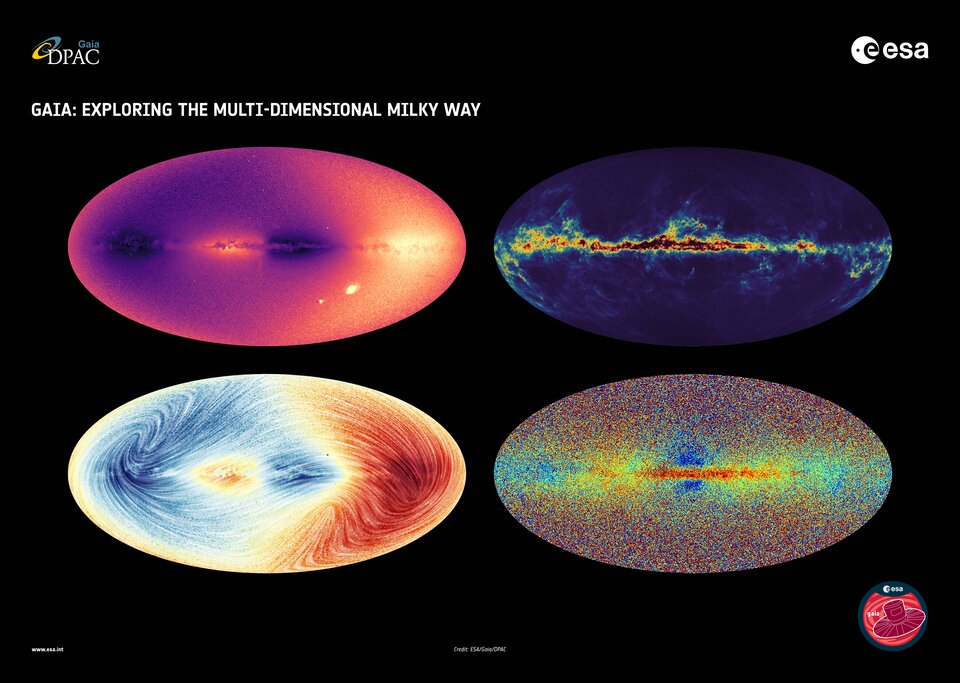
- From 27 July 2014 to 15 January 2025, Gaia has made more than three trillion observations of two billion stars and other objects throughout our Milky Way galaxy and beyond.
- Two billion stars amounts to about 1 percent of the stars populating the Milky Way.
- Of the objects that Gaia observed, more than 99.9% have never had their distances measured accurately.
- Gaia was equipped with the largest digital camera ever carried into space with nearly one billion pixels. By comparison, smart phone cameras have around 10 million pixels.
- Gaia detected celestial objects that are a million times fainter than the unaided human eye can see.
- For objects 4000 times fainter than the naked eye limit, Gaia measured their positions to an accuracy of 24 microarcseconds, comparable to measuring the diameter of a human hair at a distance of 1000 km. Gaia’s predecessor, Hipparcos, could have measured the diameter of a human hair at a distance of 20 km.
- The nearest stars will have their distances measured to the extraordinary accuracy of 0.001%. Even stars near the Galactic Centre, some 30 000 light-years away, will have their distances measured to within an accuracy of 20%.
- Gaia conducted the largest ever low-resolution spectroscopic survey, the largest ever radial velocity survey, the largest ever collection of astrophysical data for stars in the Milky Way and the largest ever survey for many classes of variable stars. Its binary star survey surpasses all the work on binary stars from the past two centuries and it carried out the first space-based all-sky survey of quasars and of the shape of galaxies in the local Universe.
- More than 400 individuals contribute their expertise to the Gaia data processing exercise as part of the Gaia Data Processing and Analysis Consortium (DPAC).
- By the end of the mission, the data archive will exceed 1 Petabyte (1 million Gigabytes). For comparison, a typical smartphone has a capacity of about 256 GB.