• → European Space Agency

      • Space for Europe
      • Space News
      • Space in Images
      • Space in Videos
    • About Us

      • Welcome to ESA
      • DG's News and Views
      • For Member State Delegations
      • Business with ESA
      • ESA Exhibitions
      • ESA Publications
      • Careers at ESA
    • Our Activities

      • Space News
      • Observing the Earth
      • Human Spaceflight
      • Launchers
      • Navigation
      • Space Science
      • Space Engineering
      • Operations
      • Technology
      • Telecommunications & Integrated Applications
    • For Public

    • For Media

    • For Educators

    • For Kids

    • ESA

    • Space Science

    • Our Universe
    • About Space Science
    • ESA's 'Cosmic Vision'
    • Science missions
    • Mission navigator
    • Target groups
    • For Media
    • For Scientists
    • For Kids
    • Multimedia
    • Science images
    • Science videos
    • Animations
    • Downloads
    • Sounds from space
    • Resources
    • Reference section
    • Services
    • FAQs
    • Glossary
    • Help
    • Portal terms of use
    • Comments
    • Follow us
    • RSS feeds
    • ESA Sci on Twitter
    • ESA Space Science Images on Flickr
    • ESA 3D on Flickr

    ESA > Our Activities > Space Science

    Planetary nebula ESO 456-67

    Glowing, fiery shells of gas

    25 February 2013

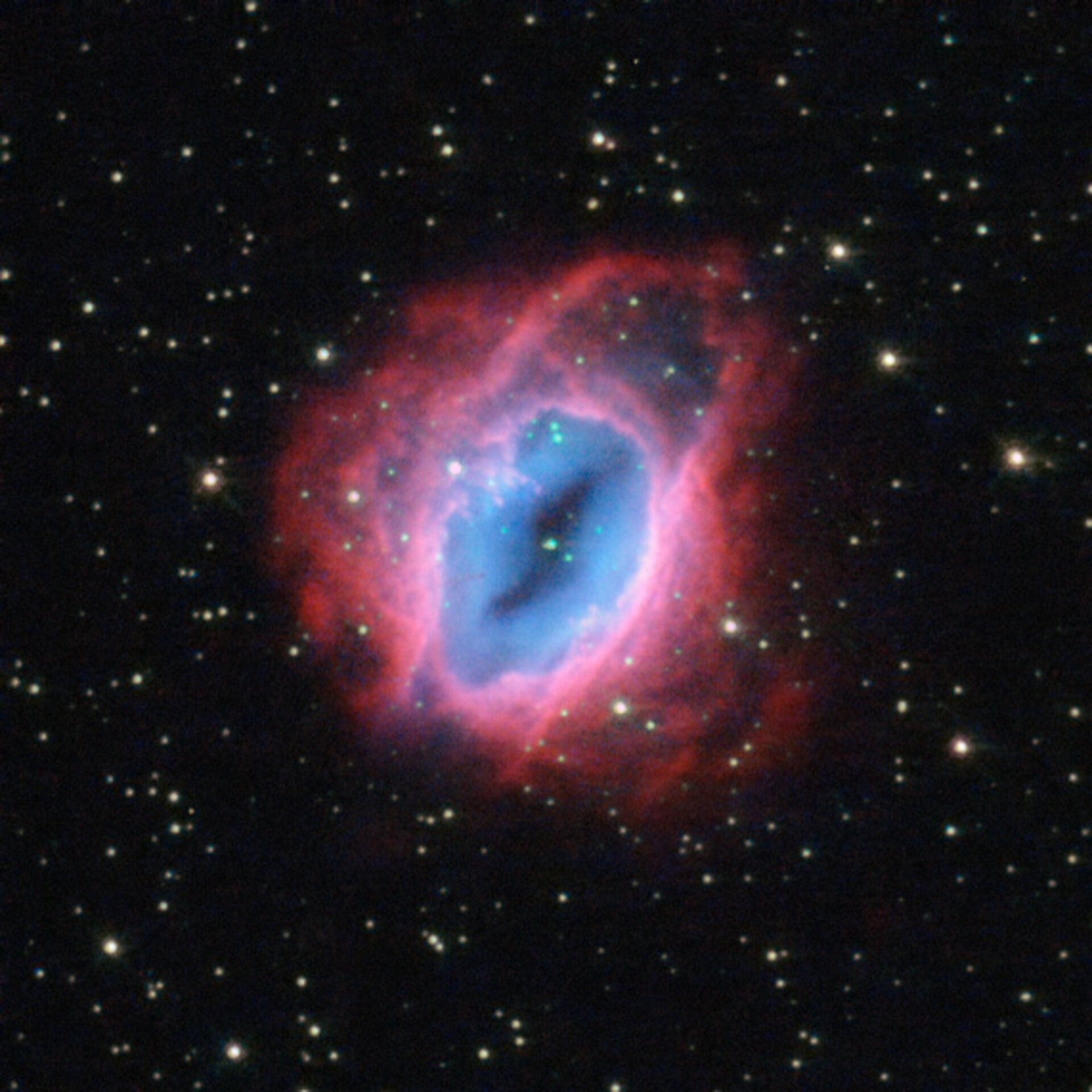
    It may look like something from The Lord of the Rings, but this fiery swirl is actually a planetary nebula known as ESO 456-67. Set against a backdrop of bright stars, the rust-coloured object lies in the constellation of Sagittarius (The Archer), in the southern sky.

    Despite the name, these ethereal objects have nothing at all to do with planets. The misnomer came about over a century ago, when the first astronomers to observe them only had small, poor-quality telescopes. Through these, the nebulae looked small, compact and planet-like.

    When a star like the Sun approaches the end of its life, it flings material out into space. Planetary nebulae are the intricate, glowing shells of dust and gas pushed outwards from such a star. At their centres lie the remnants of the original stars themselves – small, dense white dwarf stars.

    In this image of ESO 456-67 taken by the Hubble Space Telescope, it is possible to see the various layers of material expelled by the central star. Each appears in a different hue – red, orange, yellow and green-tinted bands of gas, with clear patches of space at the heart of the nebula.

    It is not fully understood how planetary nebulae form such a wide variety of shapes and structures. Some appear to be spherical, some elliptical, others shoot material in waves from their polar regions, some look like hourglasses or figures of eight, and others resemble large, messy stellar explosions – to describe but a few.

    A version of this image was entered into the Hubble’s Hidden Treasures image processing competition by contestant Jean-Christophe Lambry.
    Rate this

    Views

    Share

    • Currently 5 out of 5 Stars.
    • 1
    • 2
    • 3
    • 4
    • 5
    Rating: 4.96/5 (25 votes cast)

    Thank you for rating!

    You have already rated this page, you can only rate it once!

    Your rating has been changed, thanks for rating!

    5872
    Tweet

    Related articles

    X-raying the Eskimo11 February 2013

    X-raying the Eskimo11 February 2013 Peering inside the fur-lined hood of the Eskimo Nebula with ESA’s XMM-Newton space observatory reveals a hot face of X-ray-emitting gas blazing at 2 million degrees.

    Hubble view of star-forming region S106

    A Christmas snow angel21 December 2012

    Hubble view of star-forming region S106

    A Christmas snow angel21 December 2012

    Glitter galaxy03 December 2012

    Glitter galaxy03 December 2012 The brilliant cascade of stars through the middle of this image is the galaxy ESO 318-13 as seen by the NASA/ESA Hubble Space Telescope.

    Hubble portrays a dusty spiral galaxy

    Hubble portrays a dusty spiral galaxy24 September 2012

    Hubble portrays a dusty spiral galaxy

    Hubble portrays a dusty spiral galaxy24 September 2012

    Messier 68

    A ten billion-year stellar dance30 July 2012

    Messier 68

    A ten billion-year stellar dance30 July 2012 The NASA/ESA Hubble Space Telescope offers this delightful view of the crowded stellar encampment called Messier 68, a spherical, star-filled region of space known as a globular cluster.

    • Space Science Image of the Week Archive
    • Space Live
      Space Live
      Space science image gallery
    • Hubble's Universe
    • More about...
      • Hubble overview
      • In depth
      • Hubble in depth

    Connect with us

    • RSS
    • Youtube
    • Twitter
    • Flickr
    • G+
    • Facebook
    • Livestream
    • Subscribe
    • App Store
    • ESA Science Twitter

    Follow ESA science

    • LATEST ARTICLES
    • · ESA astronaut Timothy Peake set fo…
    • · Space drives e-mobility
    • · Proba-V opens its eyes
    • · First new Galileo satellite arrive…
    • · Next destination: space
    • FAQ

    • Jobs at ESA

    • Site Map

    • Contacts

    • Terms and conditions