

Hubble overview
Name: Hubble Space Telescope
Launch date: 24 April 1990
Status: In operation
Objective
Expanding the frontiers of the visible Universe, the Hubble Space Telescope looks deep into space with cameras that can see across the entire optical spectrum from infrared to ultraviolet.
Mission
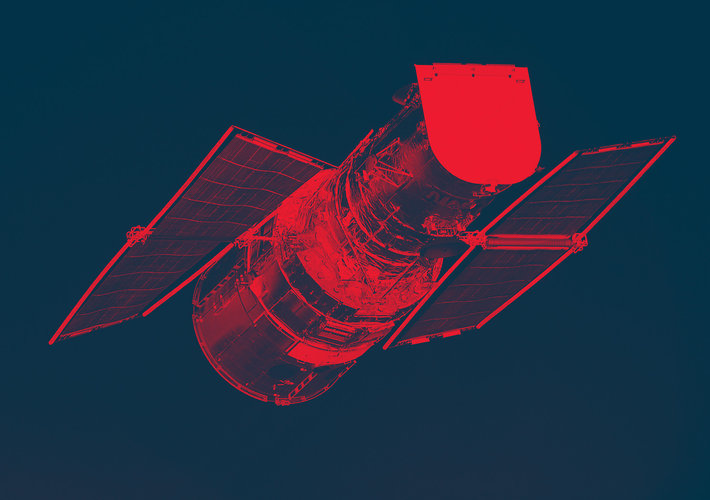
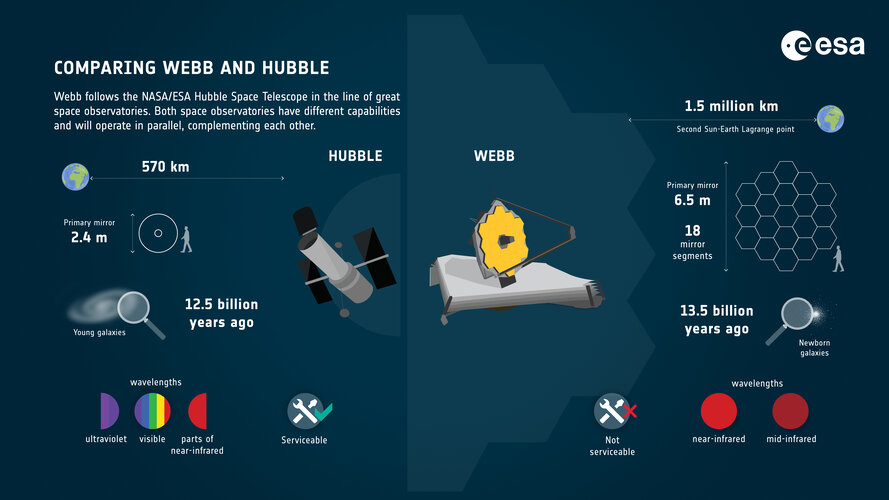
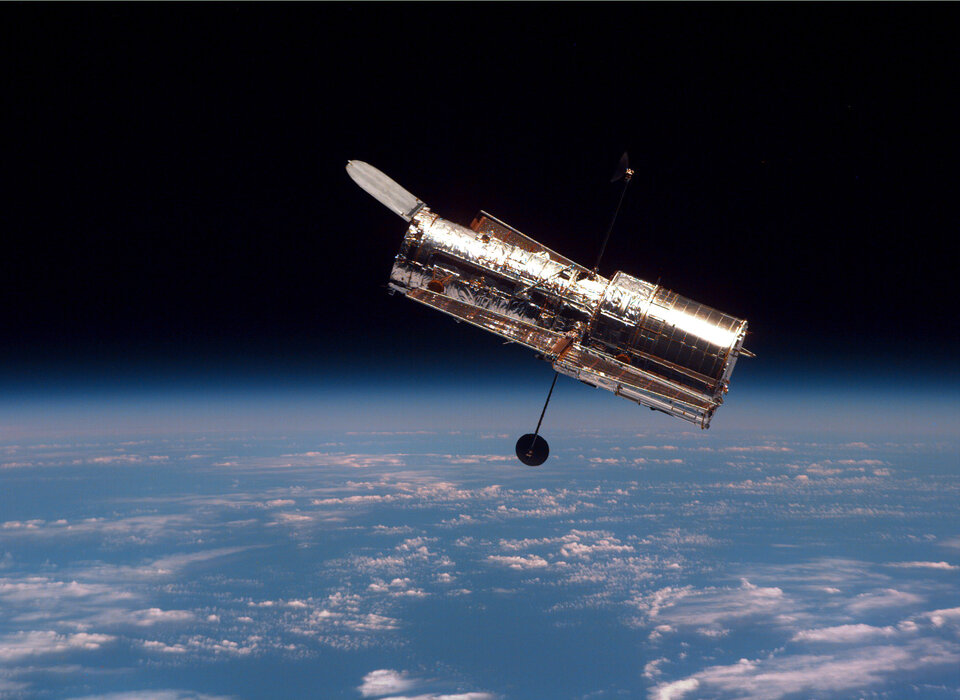
The Hubble Space Telescope (HST) is a 2.4 m-diameter space telescope optimised to observe from the ultraviolet to the infrared, collaborated between ESA and NASA. Launched in 1990 and designed for refurbishment by astronauts, Hubble is one of the greatest scientific projects. Opening our eyes to the wonders of our ‘planetary’ backyard and beyond, it has revolutionised modern astronomy by being an efficient tool for making new discoveries and changing the way research is done.

What's special?
Light can travel through the Universe virtually undisturbed for thousands of millions of years. However, before arriving at a telescope on Earth, it must travel through our turbulent atmosphere, which blurs out the fine cosmic details. Putting a telescope in space avoids this problem. High above the atmosphere, Hubble collects visible light and observes the infrared and ultraviolet wavelengths usually filtered out.
Hubble has made some dramatic discoveries. When it was launched, planets outside our Solar System (exoplanets) had not been observed. Hubble made measurements of a planet’s atmosphere around another star (HD 209458), finding evidence of sodium, carbon and oxygen, and methane in the atmosphere of another Jupiter-sized planet, HD 189733b.
It was also thought that expansion of the Universe would be slowing by now, as gravity acts to reduce the remnant velocity from the Big Bang. By studying ‘Type Ia supernovae’ – stars that explode at the end of their life – as distance indicators, Hubble found that the speed with which the Universe is presently expanding had been increasing for the last several billion years. This points to the existence of ‘dark energy’, a force that comes to exceed gravity and causes the Universe’s expansion to accelerate.
Prior to Hubble, the presence of dust discs around a small number of young stars had been inferred from observations by infrared satellites, but only one disc, around Beta Pictoris, had been directly imaged with a ground-based coronagraph. For centuries it has been believed that the Solar System began as a disc. Hubble showed at high resolution that about half of the young stars in the Orion Nebula are surrounded by gas and dust structures, many of them discs.
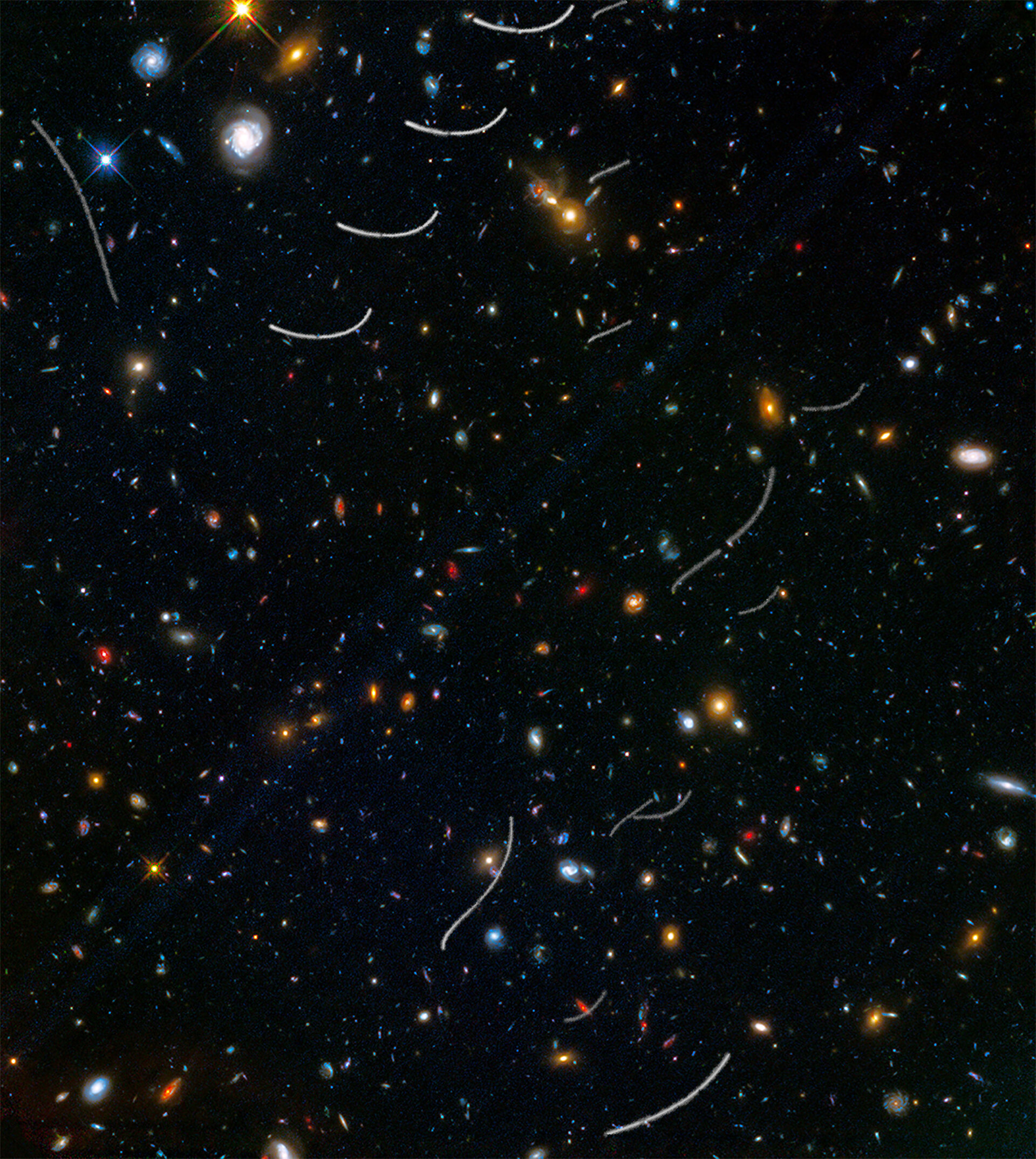
Hubble has pushed back the observational boundaries of the Universe. Coordinating with other observatories, Hubble has taken long exposures of small regions of sky, to bring out the most distant and most ancient galaxies. With the sensitive ‘WFC3’ panchromatic camera, Hubble has seen galaxies that formed just 600-800 million years after the Big Bang, which are showing signs of their origin from the first stars. They are so blue they must be deficient in heavy elements, thus representing a population with primordial characteristics.
Spacecraft
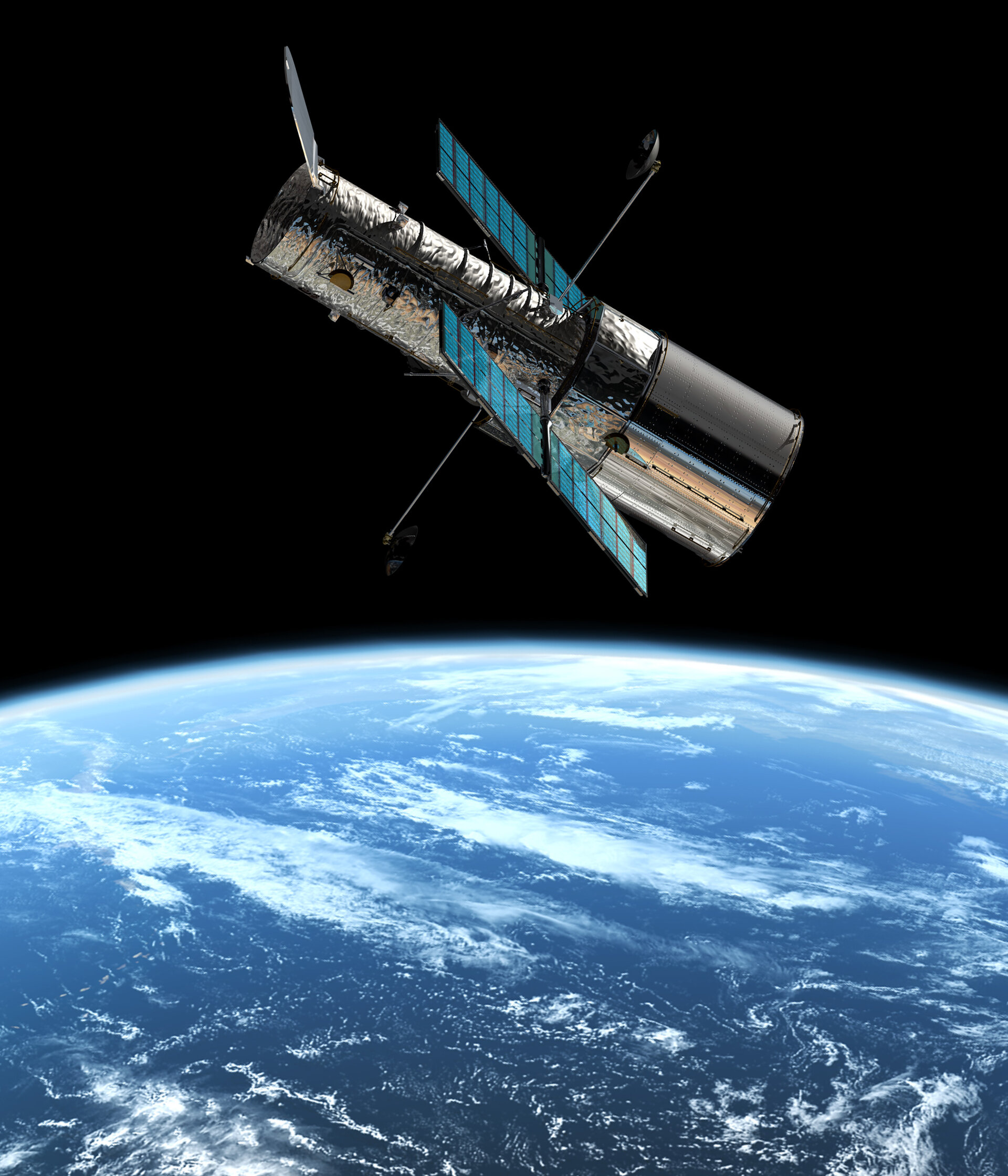
At the heart of HST is a 2.4 m-diameter primary mirror supplying light to four science instruments working across the entire optical spectrum: from infrared, through the visible, to ultraviolet light. It has two cameras, two spectrographs and a set of Fine Guidance Sensors that allow Hubble to accurately point to targets on the sky.
HST was placed in a low orbit, designed to be serviced in space by astronauts on the Space Shuttle, allowing instruments to be replaced as technology improved, and observatory subsystems to be repaired and modernised.
Two solar wings provide power for the computers and scientific instruments and charge six nickel-hydrogen batteries to power the spacecraft for about 25 minutes per orbit while it flies through Earth's shadow.
An elaborate system of attitude controls improves Hubble’s stability during observations. Reaction wheels manoeuvre the telescope into place, and gyroscopes monitor its position. Fine Guidance Sensor units lock onto guide stars ensuring the high pointing accuracy needed to make precise observations.
Journey
Hubble was deployed by the Space Shuttle Discovery (STS-31) into a circular orbit 575 km above the ground, inclined at 28.5° to the equator. The time taken for one orbit is between 96 and 97 minutes.
History
As early as 1923 German rocket scientist Herman Oberth suggested a space-bound telescope in his bookDie Rakete zu den Planeträumen. American Lyman Spitzer proposed a space telescope in 1946, lobbying for almost 30 years. In the 1970s, NASA and ESA took it up proposing a 3 m-diameter one. Funding began in 1977 and it was named after Edwin Hubble, who had discovered the expansion of the Universe in the 1920s. Although downsized to 2.4 m, the project started to attract significant attention from astronomers. The mirror was finished in 1981 and the assembly of the entire spacecraft was completed in 1985.
It launched in 1990 but the main mirror had a serious flaw: the edge was too flat by a mere fiftieth of the width of a human hair, preventing sharp images. Scientists and engineers from NASA and ESA worked together and came up with a corrective optics package, fitted during the first Hubble Servicing Mission (SM1) in December 1993.
Although subsequent servicing missions were at least as demanding in terms of complexity and workload, SM1 captured the attention of both astronomers and the public. Meticulously planned and brilliantly executed, it will go down in history as one of the highlights of human spaceflight. Hubble was back in business.
During SM2 in 1997 two new instruments were installed; many of Hubble’s crucial technical systems were exchanged in 1999 during SM3A; and in 2002 came SM3B, when Hubble again received new science instruments.
Scheduled for October 2008, SM4 was delayed to build a replacement Science Instrument Command and Data Handling unit. In May 2009 veteran astronaut Scott Altman, commanded a crew on Atlantis, including Navy Capt. Gregory C. Johnson, spacewalkers John Grunsfeld and Mike Massimino, and first time space fliers Andrew Feustel, Michael Good and Megan McArthur. They completed an ambitious 11-day mission with five spacewalks, installing two new instruments: the Wide Field Camera 3 (WFC3) and the Cosmic Origins Spectrograph (COS), and repairing two inactive ones: the Space Telescope Imaging Spectrograph (STIS) and the Advanced Camera for Surveys (ACS). They installed the replacement Science Instrument Command and Data Handling Unit, a Fine Guidance Sensor, new batteries, gyros, and insulation. Hubble has resumed its scientific observations, with expanded science capabilities and an extended life.
Partnerships
NASA is ESA’s partner in the project. ESA has, among other things, provided the Faint Object Camera, the first two solar wings that powered the spacecraft and a team of space scientists and engineers at the Space Telescope Science Institute (STScI) in Baltimore, USA.
Europe's contribution to HST entitles European astronomers to 15% of the telescope's observing time, but in June 2012 European scientists were awarded a record 26.5% of observing time.
The European science archive for the Hubble Space Telescope is located at ESA’s European Space Astronomy Centre (ESAC) in Villanueva de la Cañada near Madrid, Spain. Until June 2012 it was hosted by the Space Telescope European Coordinating Facility (ST-ECF), located at the headquarters of the European Southern Observatory near Munich, Germany.