• → European Space Agency

      • Space for Europe
      • Space News
      • Space in Images
      • Space in Videos
    • About Us

      • Welcome to ESA
      • DG's News and Views
      • For Member State Delegations
      • Business with ESA
      • ESA Exhibitions
      • ESA Publications
      • Careers at ESA
    • Our Activities

      • Space News
      • Observing the Earth
      • Human Spaceflight
      • Launchers
      • Navigation
      • Space Science
      • Space Engineering
      • Operations
      • Technology
      • Telecommunications & Integrated Applications
    • For Public

    • For Media

    • For Educators

    • For Kids

    • ESA

    • Space Science

    • Our Universe
    • About Space Science
    • ESA's 'Cosmic Vision'
    • Science missions
    • Mission navigator
    • Target groups
    • For Media
    • For Scientists
    • For Kids
    • Multimedia
    • Science images
    • Science videos
    • Animations
    • Downloads
    • Sounds from space
    • Resources
    • Reference section
    • Services
    • FAQs
    • Glossary
    • Help
    • Portal terms of use
    • Comments
    • ESA Press Releases
    • Follow us
    • RSS feeds
    • ESA Sci on Twitter
    • ESA Space Science Images on Flickr
    • ESA 3D on Flickr

    ESA > Our Activities > Space Science

    Jupiter’s mysterious flashes and missing cloud belts

    Jupiter's mysterious flash left no debris
    17 June 2010

    The NASA/ESA Hubble Space Telescope has provided insights into two recent events on Jupiter: the mysterious flash of light on 3 June and the disappearance of the planet’s dark Southern Equatorial Belt.

    At 20:31 GMT on 3 June Australian amateur astronomer Anthony Wesley saw a two-second flash of light on Jupiter. In the Philippines, fellow amateur Chris Go confirmed the event.

    Astronomers around the world suspected that something had hit the giant planet but they didn’t know just how big it was or how deeply it had penetrated the atmosphere.

    Astronomers immediately began searching for a ‘black-eye’ pattern like those left by former impactors, but this time their search was in vain. Now it was Hubble’s turn.

    Hubble sees Jupiter change its stripes

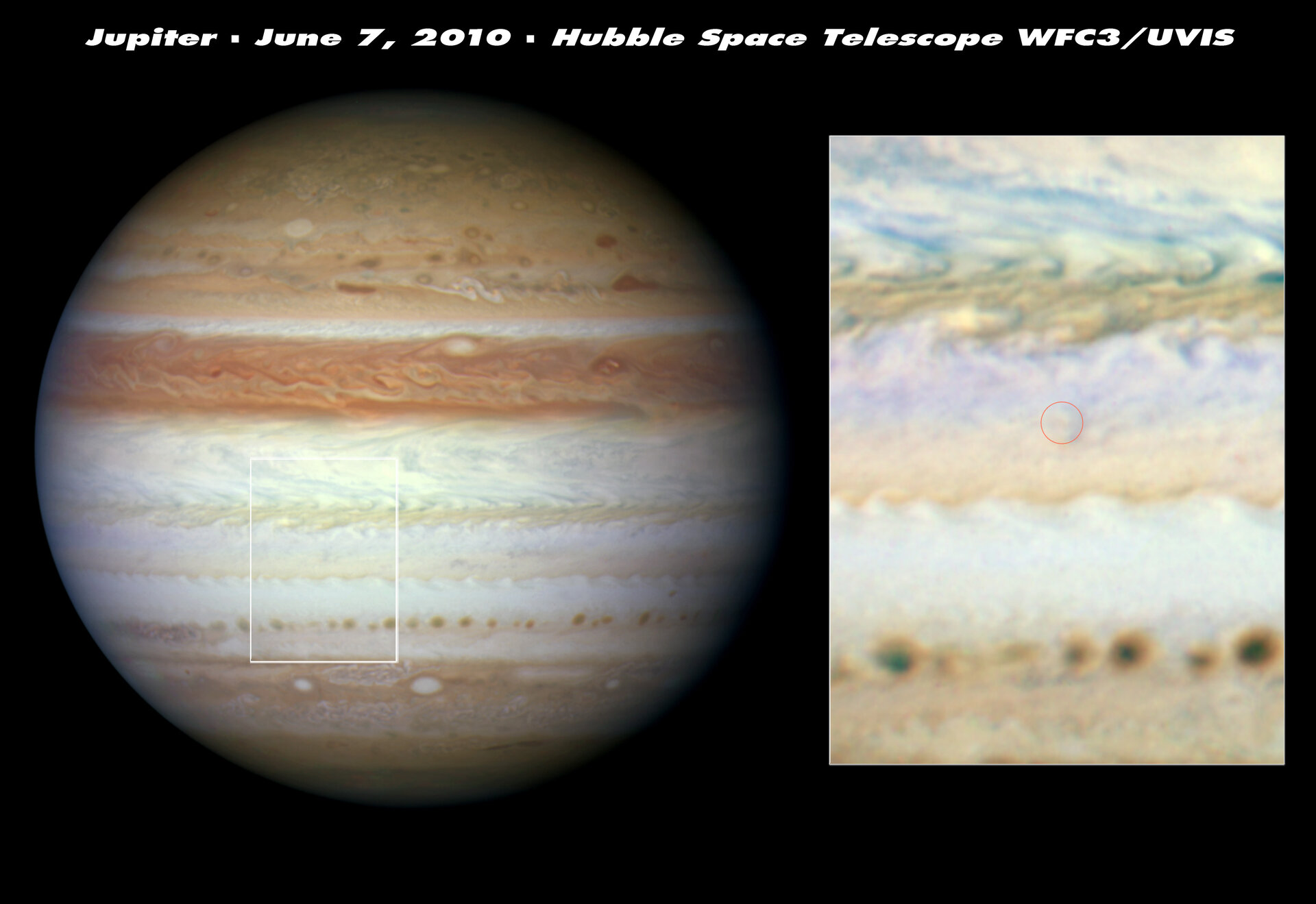
    But not even the space telescope could see anything. Images taken on 7 June, just over three days after the flash was sighted, continue to show no sign of debris above Jupiter’s cloud tops. This means that the object did not descend beneath the clouds and explode as a fireball. If it had, then dark sooty debris would have been ejected to rain down onto the clouds.

    Instead, the flash is thought to have come from a giant meteor burning up high above Jupiter’s cloud tops.

    Dark smudges marred Jupiter’s atmosphere when a series of fragments of Comet Shoemaker-Levy 9 hit the planet in July 1994. A similar phenomenon occurred in July 2009 when a suspected asteroid slammed into Jupiter, again discovered by Wesley.


    Jupiter without its Southern Equatorial Belt

    This year’s intruder is estimated to be only a fraction of the size of these previous ones.

    “Comparing the two collisions, from 2009 and 2010, will hopefully yield insights into the types of impact processes in the outer Solar System, and the physical and chemical response of Jupiter's atmosphere to these amazing events,” says team member Leigh Fletcher of the University of Oxford, UK.

    As a bonus, Hubble’s observations also provided scientists with a close-up of changes in Jupiter’s atmosphere following the disappearance several months ago of the dark cloud feature known as the Southern Equatorial Belt. The last time it faded was in the early 1970s.

    Weather forecast for Jupiter’s Southern Equatorial Belt: cloudy with a chance of ammonia

    In the Hubble view, a slightly higher altitude layer of white ammonia ice crystal clouds appears to obscure the deeper, darker belt clouds. “Weather forecast for Jupiter’s Southern Equatorial Belt: cloudy with a chance of ammonia,” says team member Heidi Hammel of the Space Science Institute in Boulder, Colorado, USA.

    The team predicts that these ammonia clouds should clear in a few months, as they have done in the past. The clearing of the ammonia cloud layer should begin with a number of dark spots like those seen by Hubble along the boundary of the south tropical zone.
    Rate this

    Views

    Share

    • Currently 0 out of 5 Stars.
    • 1
    • 2
    • 3
    • 4
    • 5
    Rating: 0/5 (0 votes cast)

    Thank you for rating!

    You have already rated this page, you can only rate it once!

    Your rating has been changed, thanks for rating!

    14
    facebook
    twitter
    reddit
    google plus
    digg
    tumbler
    digg
    blogger
    myspace
    • More about
    • Hubble overview
      • Hubble factsheet
      • JWST overview
      • Related videos
      • Happy Birthday Hubble!
      • Hubblecast at the Hubble ESA Information Centre
      • Where is Hubble now?
      • Track Hubble
      • Hubble on YouTube
      • Hubble's achievements
      • Importance of Hubble's discoveries
      • Related articles
        • New moon found at Pluto
          • Hubble captures bubbles and baby stars
            • Jupiter’s mysterious flashes and missing cloud belts
              • Hubble catches stars on the move
                • Starry-eyed Hubble celebrates 20 years of awe and discovery
                  • Hubble confirms cosmic acceleration with distorted galaxies
                    • Bully galaxy rules the neighbourhood
                      • Where did today’s spiral galaxies come from?
                        • Born in beauty: proplyds in the Orion Nebula
                          • Opening up a colourful cosmic Jewel Box
                            • Hubble highlights two galaxies that are losing it
                              • Rebirth of an icon: Hubble's first images since Servicing Mission 4
                                • Hubble captures rare Jupiter collision
                                  • Historic Hubble Servicing Mission 4 ends with successful landing
                                    • Servicing Mission 4 — the fifth and final visit to Hubble
                                      • On Hubble's 19th birthday, a fountain of youth
                                      • In depth
                                        • Notes for editors
                                        • Hubble in depth

    Connect with us

    • RSS
    • Youtube
    • Twitter
    • Flickr
    • Google Buzz
    • Subscribe
    • App Store
    • ESA Science Twitter

    Follow ESA science

    • LATEST ARTICLES
    • · CryoSat hits land
    • · Ariane 5 completes seven launches …
    • · Measuring skull pressure without t…
    • · Malargüe station inauguration
    • · The solar wind is swirly
    • FAQ

    • Jobs at ESA

    • Site Map

    • Contacts

    • Terms and conditions