LISA factsheet
Overview of the LISA mission.
Name: Laser Interferometer Space Antenna (LISA)
Planned launch: ~2035
Mission: First gravitational wave detector in space.
Status: On 20 June 2017, LISA was selected as the third large-class mission, L3, under ESA's Cosmic Vision 2015-2025. It was then adopted on 25 January 2024. Construction will begin in 2025 after a prime contractor has been chosen.
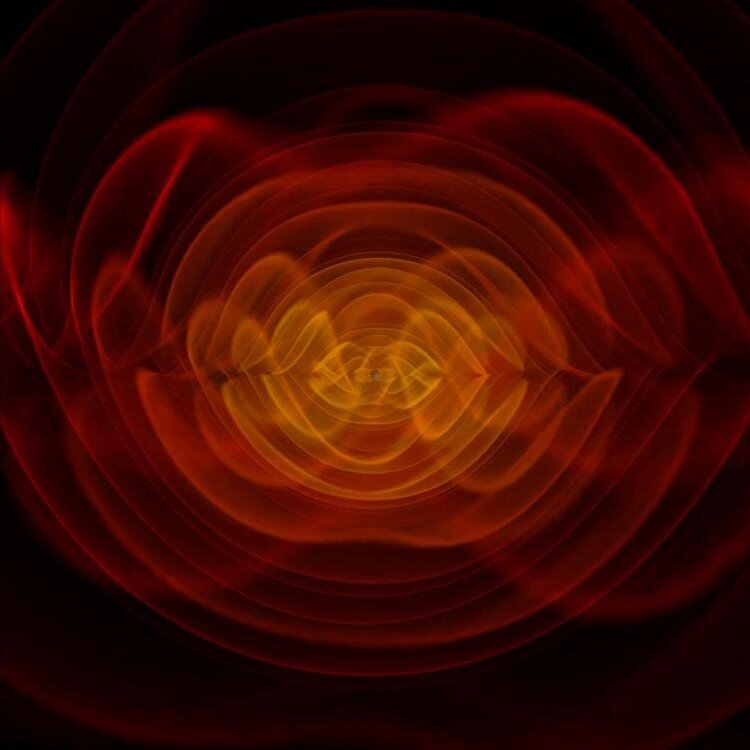
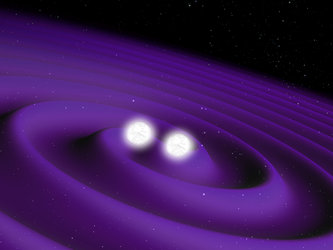
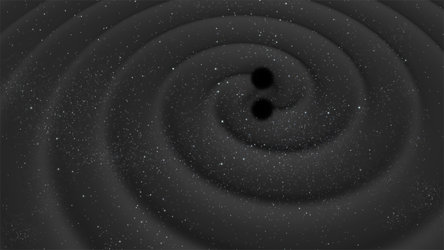
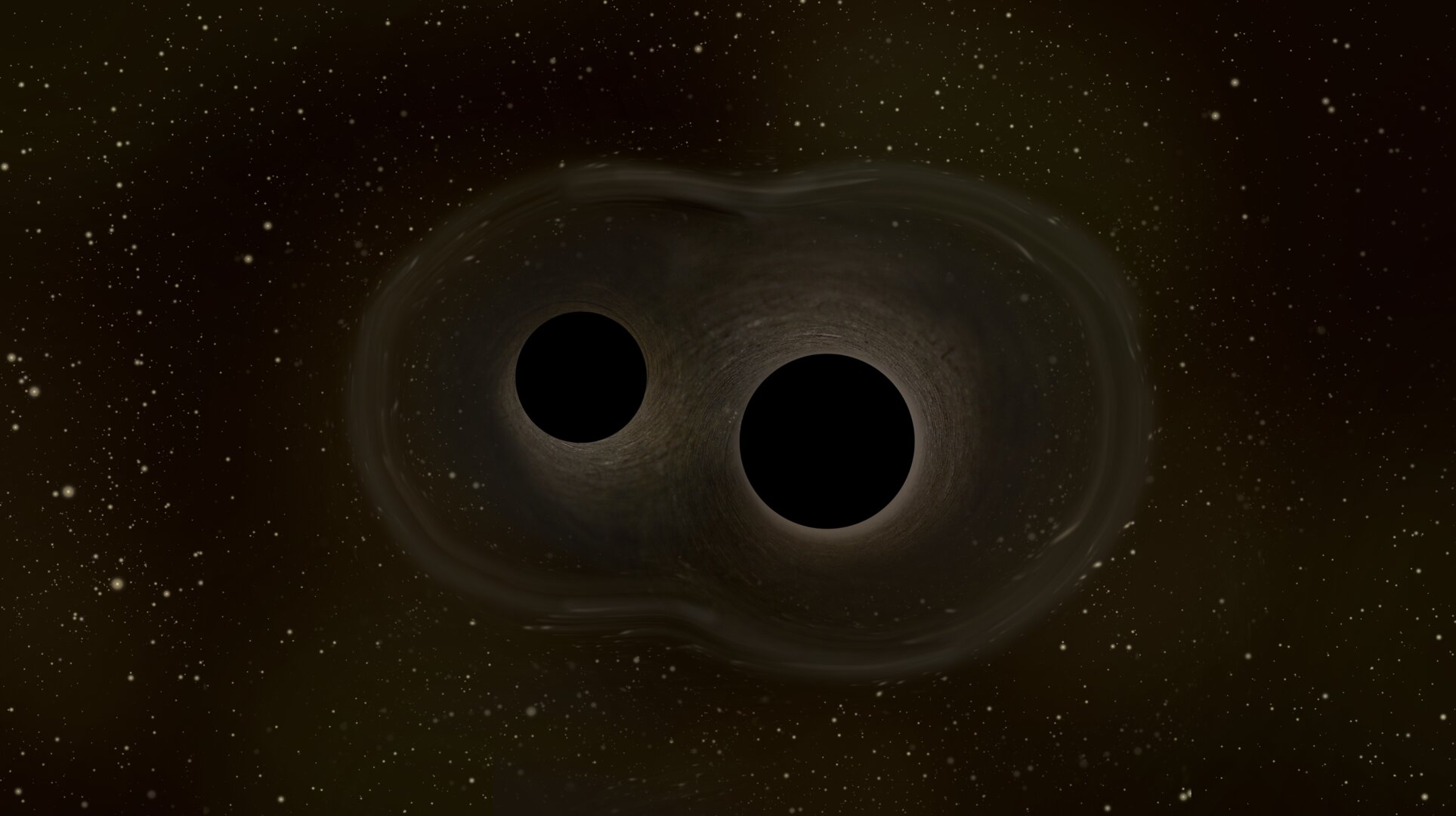
What’s special?: LISA will be the first space-based observatory dedicated to studying gravitational waves: ripples in the fabric of space-time emitted during the most powerful events in the Universe, such as pairs of black holes coming together and merging. LISA will be the first mission to probe the history of the Universe using these waves.
Gravitational waves have been detected by ground-based observatories in recent years – by experiments such as LIGO and the European Virgo observatory – but these facilities are limited in size and sensitivity, meaning that they are only able to detect high-frequency gravitational waves from particular sources (such as merging stellar-mass black holes and neutron stars).
LISA will be able to scour the entire Universe in its hunt for these elusive waves, across a large range of frequencies corresponding to timescales from seconds to several hours. This will enable scientists to study gravitational waves generated by many different type of events, from interacting compact stars to merging supermassive black holes at the cores of galaxies. To detect lower-frequency gravitational waves, an observatory must span millions of kilometres – something that can only be achieved in space
Mission objectives: As part of its core science objectives, LISA will:
- Study the formation and evolution of tens of thousands of compact binary star systems within the Milky Way;
- Trace the origin, growth and mergers of massive black holes across cosmic ages;
- Probe the dynamics of incredibly massive and dense star clusters found near the centres of most galaxies, using decaying orbits known as ‘extreme mass-ratio inspirals’, or EMRIs;
- Understand the astrophysics of stellar-origin black holes;
- Explore the fundamental nature of gravity and black holes;
- Probe the rate of expansion of the Universe;
- Understand the relic gravitational waves from the early evolution of the Universe (‘stochastic’ waves, which arise from many random independent events and combine to form a ‘cosmic gravitational wave background’) and their wider implications;
- Search for gravitational wave bursts and unforeseen sources.
LISA will study the nature of gravity itself by exploring the waves that originate from some of the most massive and extreme phenomena in the Universe.
The observatory will scan the entire sky from space continuously and, as it follows the Earth in its orbit, gradually improve the localisation of the gravitational wave sources it detects. It will observe the dynamic cosmos from the smallest to the largest scales, and expand our cosmic horizon back to the epochs preceding the formation of stars and galaxies
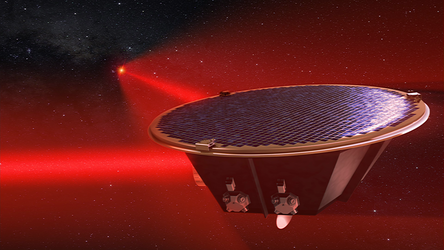
Spacecraft and orbit: The mission will comprise three spacecraft flying in a triangular formation behind the Earth as our planet orbits the Sun. The spacecraft will sit in a heliocentric orbit about 50 million km from Earth, with a distance of around 2.5 million km between each spacecraft. LISA will detect ripples in spacetime through subtle changes in the distances between free-floating cubes nestled within each spacecraft. Changes in the relative distances between these golden cubes will be tracked with extreme accuracy using laser interferometry.
Lifetime: Four years, with a possible six-year extension
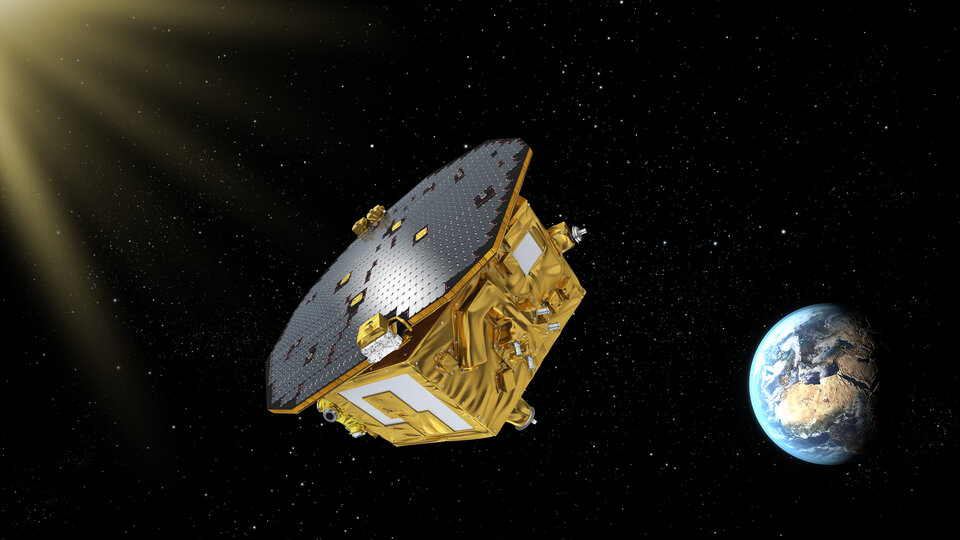
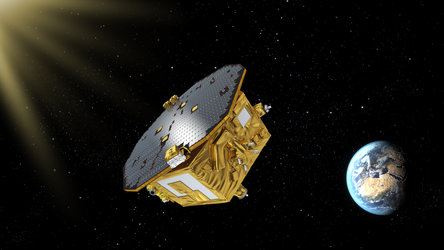
Forebears: LISA builds on the success of LISA Pathfinder and the US-based Laser Interferometer Gravitational-Wave Observatory (LIGO). LISA Pathfinder, launched in late 2015 and operational until mid-2017, successfully paved the way for LISA by demonstrating the key technologies needed for a large gravitational wave observatory to operate in space
Collaboration with NewAthena: There is the exciting and unique opportunity for LISA to collaborate with ESA's NewAthena mission, planned for launch in 2037.
While LISA and NewAthena are individually outstanding, the additional science the two missions will achieve by operating concurrently and gathering coordinated observations (so-called ‘multi-messenger’ astronomy) will provide further breakthroughs and address fundamental questions in modern astrophysics. Together, the duo will reveal much about distant and merging black holes, bright quasars in active galaxies, rapid jets around spinning black holes, the cosmic distance scale, and the speed of gravity. These synergies are addressed in this white paper from the Athena-LISA Synergy Working Group.
Partnership: Led by ESA, the LISA mission is a collaboration between ESA, NASA, and an international consortium of scientists (the LISA consortium)

LISA mission facts
- LISA will map the build-up of structure during the first hundred million years of the Universe
- The observatory will peer back to earlier epochs in cosmic history than ever observed before, to locate the seeds from which the very first black holes formed
- To detect gravitational waves, we must measure relative shifts in position that are truly minuscule – shifts of less than the diameter of a helium atom over a distance of 2.5 million km
- We know of only tens (<50) of star systems comprising two stellar remnants (white dwarfs, neutron stars) whirling around one another fast enough to produce gravitational waves. LISA will detect several more in just its first few weeks, and many thousands across its lifetime
- LISA will be able to map the spacetime in the near vicinity of a supermassive black hole, testing general relativity under the strongest conditions possible
- LISA will use laser interferometry, a technique that observes the pattern that arises when two overlaid beams of light are at different points in their wave cycle at a given time. LISA will look for signs of a gravitational wave compressing or stretching one of these light beams with respect to the other, using interferometer ‘arms’ some 2.5 million km long
- LISA’s three spacecraft will each be individually in orbit round the Sun, and will maintain their triangular formation and precise separation as they travel around our star
- LISA Pathfinder proved that it was possible to monitor free-falling bodies in space precisely enough to determine differences in position of less than a trillionth of a metre (creating the ‘quietest place in space’)