• → European Space Agency

      • Space for Europe
      • Space News
      • Space in Images
      • Space in Videos
    • About Us

      • Welcome to ESA
      • DG's News and Views
      • For Member State Delegations
      • Business with ESA
      • ESA Exhibitions
      • ESA Publications
      • Careers at ESA
    • Our Activities

      • Space News
      • Observing the Earth
      • Human Spaceflight
      • Launchers
      • Navigation
      • Space Science
      • Space Engineering
      • Operations
      • Technology
      • Telecommunications & Integrated Applications
    • For Public

    • For Media

      • Media
      • ESA TV
      • Videos for professionals
      • Photos
    • For Educators

    • For Kids

    • ESA

    • ESA Science

    • Mars Express

    • Europe goes to Mars

      • Europe reclaims a stake in Mars exploration
      • Space age transforms our knowledge about Mars
    • About Mars Express

      • Mars Express mission facts
      • Mars Express instruments
      • The mission
      • The spacecraft
      • The launcher
    • About Mars

      • Geography of Mars
      • Water on early Mars?
      • Signatures of life
      • Facts about Mars
    • Meet the team

      • International collaboration
      • Project Manager
      • Project Scientist
      • Mars Lead Scientist
      • Principal Investigators
      • Operations
      • Industry
    • Multimedia
    • VideoTalk
    • Mars Express images
    • Mars Express videos
    • HRSC videos
    • Animation in 11 languages
    • Download wallpapers
    • Download screensavers
    • 3D Flash 'model'
    • Make a model
    • Services
    • Comments

    ESA > Our Activities > Space Science > Mars Express

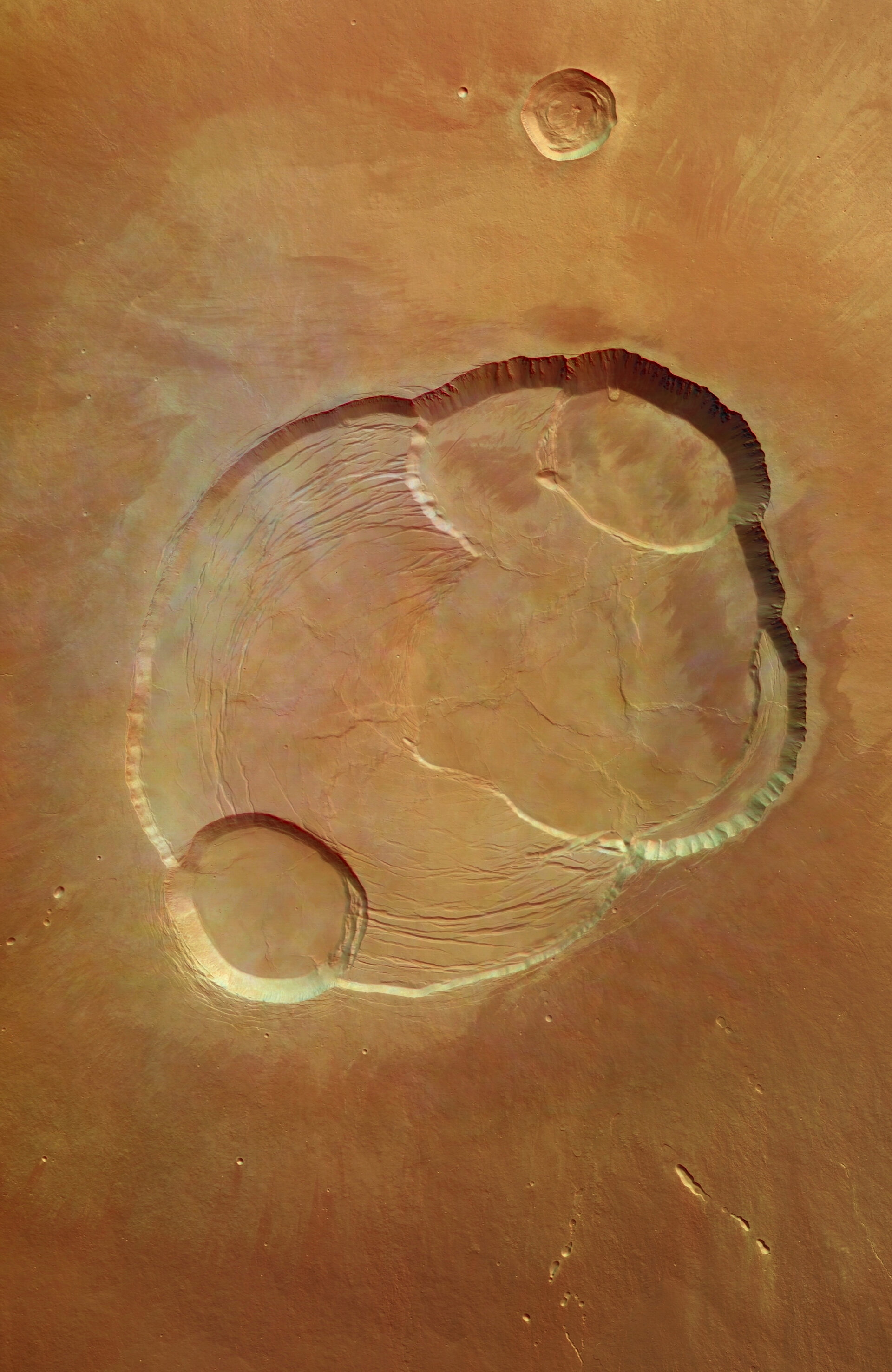
    Complex caldera of Olympus Mons - Mars Express

    Olympus Mons - the caldera in close-up

    11 February 2004

    View from overhead of the complex caldera (summit crater) at the summit of Olympus Mons on Mars, the highest volcano in our Solar System.

    Olympus Mons has an average elevation of 22 km and the caldera has a depth of about 3 km. This is the first high-resolution colour image of the complete caldera of Olympus Mons.

    The image was taken from a height of 273 km during orbit 37 by the High Resolution Stereo Camera (HRSC) on ESA’s Mars Express on 21 January 2004. The view is centred at 18.3°N and 227°E. The image is about 102 km across with a resolution of 12 m per pixel. South is at the top.
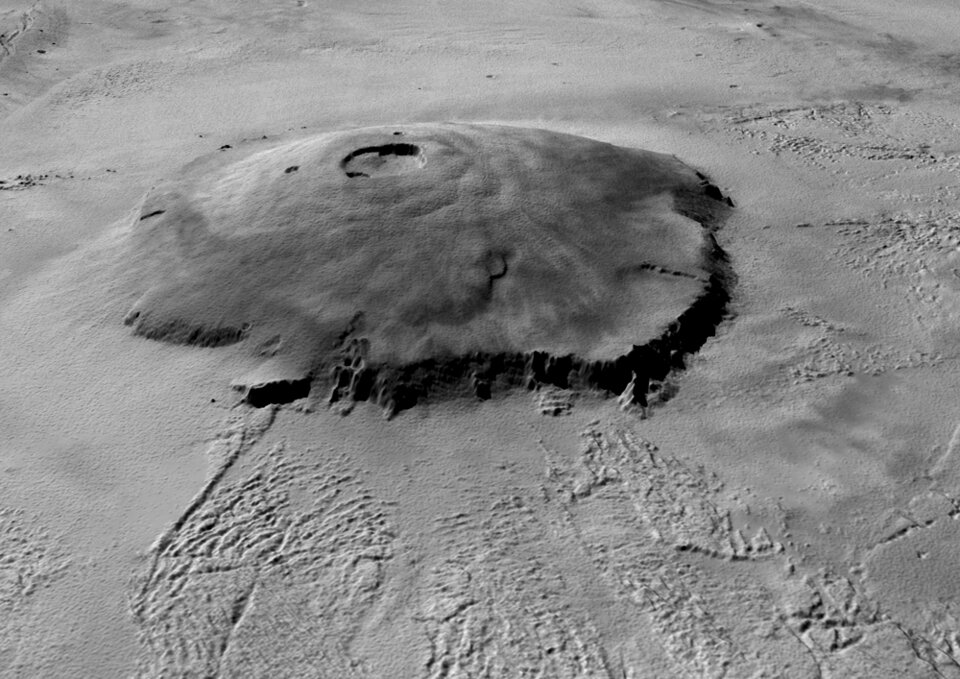
    Olympus Mons

    This complementary 3D view shows the Olympus Mons volcano in its entirety, to put the caldera images in context. It has been derived from the Mars Orbiter Laser Altimeter (MOLA) topographic data superimposed with the Mars Orbiter Camera (MOC) wide-angle image mosaic.
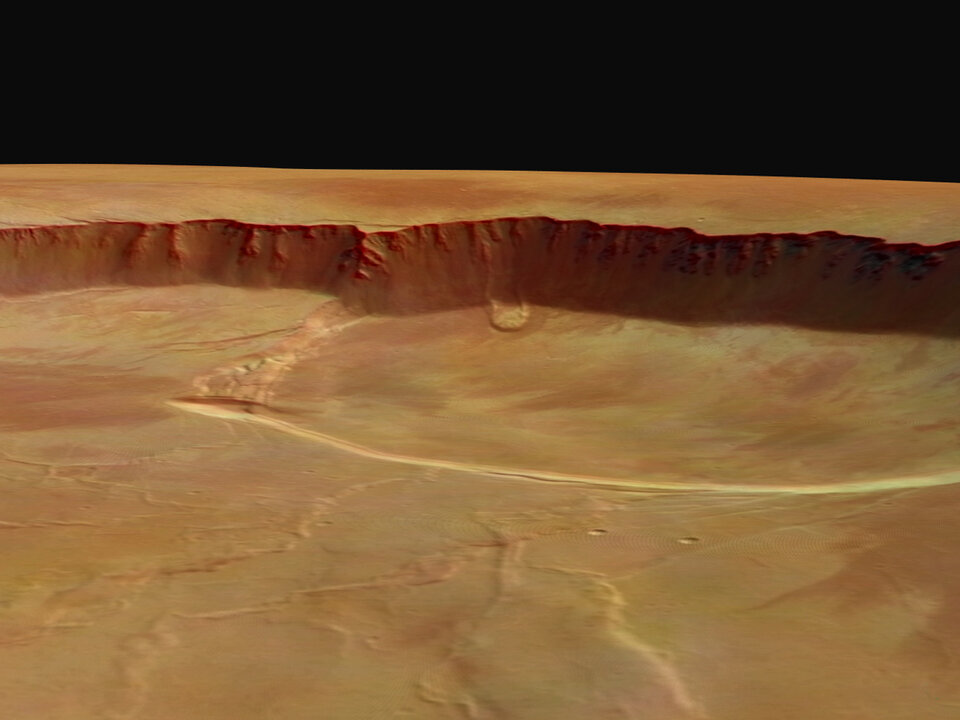

    Detail of the southern part of the caldera in perspective - Mars Express

    This perspective view shows the southern part of the caldera. The image has been calculated from the digital elevation model derived from the stereo channels and combined with the nadir- and colour-channels of the Mars Express HRSC.

    The scene reveals tongue-shaped mass-movement features in 3D on the southern wall. The striations are tectonic faults. After lava production has ceased the caldera collapsed over the emptied magma chamber. Through the collapse the surface suffers from extension and so extensional fractures are formed. The elevation level on which these fractures can be observed represents the event of the oldest caldera collapse. Later lava production has produced new caldera collapses at different locations (the other circular depressions), they partly destroyed the circular fracture pattern of the oldest one.

    The data has been retrieved from a height of 273 km during orbit 37 on 21 January 2004. The view is centred at 18.3°N and 227°E. The image is about 40 km across. The vertical exaggeration is 1.8. South is up to allow the mass-movement features to be seen.
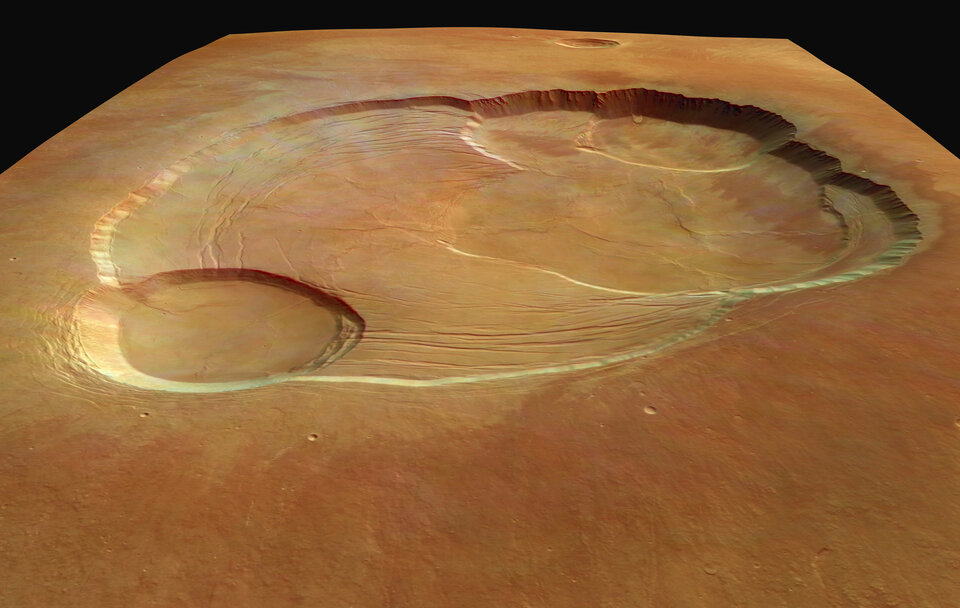
    Wider perspective of the caldera - Mars Express

    This perspective view has been calculated from the digital elevation model derived from the stereo channels and combined with the nadir- and colour- channels of the HRSC.

    The data has been retrieved from a height of 273 km in orbit 37 on 21 January 2004. The view is centred at 18.3°N and 227°E. The image is 102 km across and has a resolution of 12 m per pixel. The vertical exaggeration is 1.8. South is up.
    Rate this

    Views

    Share

    • Currently 3 out of 5 Stars.
    • 1
    • 2
    • 3
    • 4
    • 5
    Rating: 3/5 (8 votes cast)

    Thank you for rating!

    You have already rated this page, you can only rate it once!

    Your rating has been changed, thanks for rating!

    2371
    Tweet
    • Looking at Mars
    • Mars Express image browser
    • Recent images
      • View of deposits in Melas Chasma on Mars
        • Fractured crater near Valles Marineris
          • 'Yardangs' on Mars
            • Northern rim of Hellas basin
              • Melas Chasma, in Valles Marineris
                • Evidence of flooding at Mangala Valles
                  • Arsia Mons volcano in 3D
                    • Deep faults and disrupted crater at Acheron Fossae
                      • Western flank of Olympus Mons
                        • Louros Valles, south of Ius Chasma
                          • Claritas Fossae tectonic region on Mars
                          • High Resolution Stereo Camera
                            • Behind the lens...

    Connect with us

    • RSS
    • Youtube
    • Twitter
    • Flickr
    • G+
    • Facebook
    • Livestream
    • Subscribe
    • App Store
    • LATEST ARTICLES
    • · Rare merger reveals secrets of gal…
    • · Watching for hazards: ESA opens as…
    • · ESA astronaut Timothy Peake set fo…
    • · Space drives e-mobility
    • · Proba-V opens its eyes
    • FAQ

    • Jobs at ESA

    • Site Map

    • Contacts

    • Terms and conditions