• → European Space Agency

      • Space for Europe
      • Space News
      • Space in Images
      • Space in Videos
    • About Us

      • Welcome to ESA
      • DG's News and Views
      • For Member State Delegations
      • Business with ESA
      • ESA Exhibitions
      • ESA Publications
      • Careers at ESA
    • Our Activities

      • Space News
      • Observing the Earth
      • Human Spaceflight
      • Launchers
      • Navigation
      • Space Science
      • Space Engineering
      • Operations
      • Technology
      • Telecommunications & Integrated Applications
    • For Public

    • For Media

    • For Educators

    • For Kids

    • ESA

    • Launch Special

    • Planck

    • Herschel

    • ESA Science

    • About Planck

      • Planck at a glance
      • Science objectives
      • Planck highlights
      • History of microwave astronomy
    • The Microwave Universe

      • Why the microwave
      • Key questions
    • The spacecraft

      • Vital stats
      • Telescope
      • Instruments
      • Sophisticated spacecraft
    • The mission

      • Journey
      • Launch and early operations
      • Operating Planck
    • Meet the team

      • Planck Project Scientist: An interview with Jan Tauber
      • Herschel and Planck Programme Manager: An interview with Thomas Passvogel
    • Multimedia
    • Planck images
    • Planck videos
    • Science@ESA vodcast

    ESA > Our Activities > Space Science > Planck

    Instruments

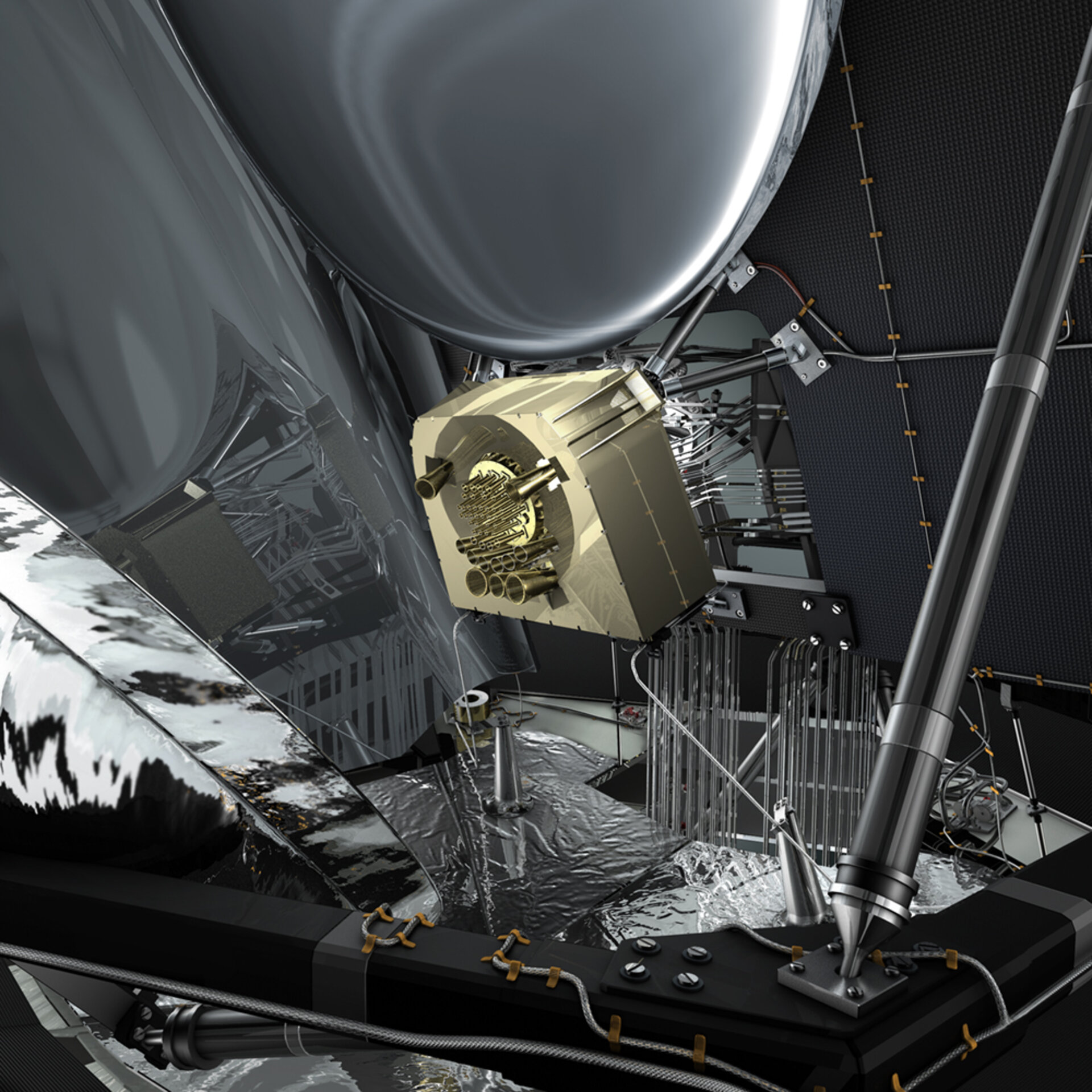
    Planck telescope focal plane unit

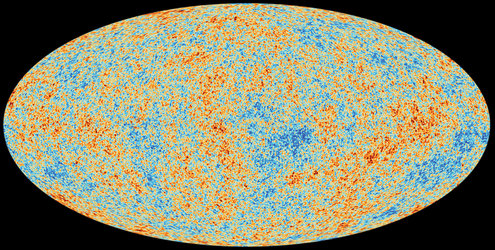
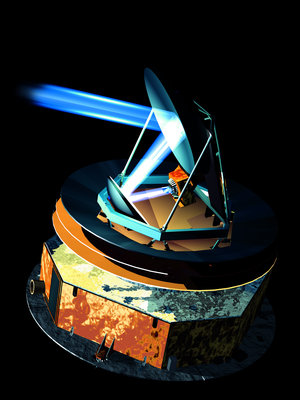
    Planck carries two scientific instruments: the High Frequency Instrument, or HFI, and the Low Frequency Instrument, or LFI. Their detectors convert the microwave and radio light gathered by the telescope into very accurate maps of the microwave sky. This data will then be used to extract the most accurate estimates of the spatial variations of the temperature of the Cosmic Microwave Background (CMB) radiation, a key to understanding the origin of the Universe and the evolution of galaxies.

    The Planck instrument detectors feature the highest sensitivity and angular resolution ever for a space observatory at these wavelengths. The angular resolution indicates the smallest separation between regions in the sky that the detectors are able to distinguish; the smaller the separation, the sharper (better) will be the information gathered on the temperature of the cosmic background. The angular resolution can be compared to the ability to distinguish fine details, the 'sharpness' of vision.

    The detectors are so sensitive that they can measure temperature variations in the sky of millionths of a degree - a task similar to measuring from Earth the heat produced by a rabbit sitting on the Moon. In order to achieve this, some of Planck's detectors must be cooled to about one-tenth of a degree above absolute zero (-273.15 °C), so that their own heat does not swamp the signal from the sky.

    The Low Frequency Instrument (LFI)
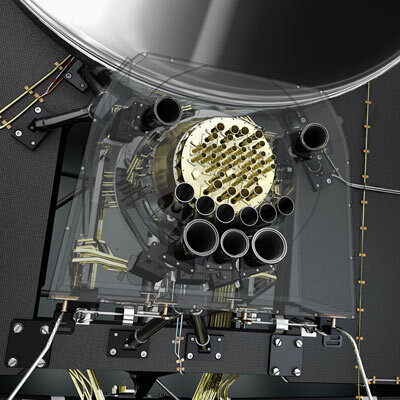
    Combined focal planes of Planck's two instruments
    Combined focal plane of Planck's two instruments

    LFI is designed to produce high-sensitivity, multi-frequency measurements of the microwave sky in the frequency range of 27 to 77 GHz (wavelength range 11.1 to 3.9 mm). The instrument consists of an array of 22 tuned radio receivers located in the focal plane of the telescope. These radio receivers gather microwaves from the sky and convert them to a measure of the intensity of radiation at each frequency.

    Principal Investigator: Nazzareno Mandolesi, Istituto di Astrofisica Spaziale e Fisica Cosmica, Bologna Italy.


    The High Frequency Instrument (HFI)

    HFI is designed to produce high-sensitivity, multi-frequency measurements of the diffuse radiation permeating the sky in all directions in the frequency range of 84 GHz to 1 THz (wavelength range 3.6 to 0.3 mm). The instrument consists of an array of 52 bolometric detectors placed in the focal plane of the telescope. Bolometric detectors are devices capable of detecting and measuring small amounts of thermal radiation.

    The instruments are complementary and they work together to produce the overall mission results.

    Principal Investigators (PI): Jean-Loup Puget (PI), Institut d’Astrophysique Spatiale in Orsay, France,
    François Bouchet (co-PI), Institut d’Astrophysique de Paris, France.
     

    Rate this

    Views

    Share

    • Currently 5 out of 5 Stars.
    • 1
    • 2
    • 3
    • 4
    • 5
    Rating: 5/5 (1 votes cast)

    Thank you for rating!

    You have already rated this page, you can only rate it once!

    Your rating has been changed, thanks for rating!

    58
    facebook
    twitter
    reddit
    google plus
    digg
    tumbler
    digg
    blogger
    myspace
    • Planck: looking back at the dawn of time
    • Read more
      • Cosmic Microwave Background (CMB) radiation
        • Travelling back in time
          • Observations: Seeing in microwave wavelengths
            • So, how did everything start?
            • In depth
            • Planck instruments in depth
            • Planck spacecraft in depth
            • Planck in depth
            • HFI consortium
            • LFI consortium

    Connect with us

    • RSS
    • Youtube
    • Twitter
    • Flickr
    • Google Buzz
    • Subscribe
    • App Store
    • LATEST ARTICLES
    • · CryoSat hits land
    • · Ariane 5 completes seven launches …
    • · Measuring skull pressure without t…
    • · Malargüe station inauguration
    • · The solar wind is swirly
    • FAQ

    • Jobs at ESA

    • Site Map

    • Contacts

    • Terms and conditions