• → European Space Agency

      • Space for Europe
      • Space News
      • Space in Images
      • Space in Videos
    • About Us

      • Welcome to ESA
      • DG's News and Views
      • For Member State Delegations
      • Business with ESA
      • ESA Exhibitions
      • ESA Publications
      • Careers at ESA
    • Our Activities

      • Space News
      • Observing the Earth
      • Human Spaceflight
      • Launchers
      • Navigation
      • Space Science
      • Space Engineering
      • Operations
      • Technology
      • Telecommunications & Integrated Applications
    • For Public

    • For Media

    • For Educators

    • For Kids

    • ESA

    • Launch Special

    • Planck

    • Herschel

    • ESA Science

    • About Planck

      • Planck at a glance
      • Science objectives
      • Planck highlights
      • History of microwave astronomy
    • The Microwave Universe

      • Why the microwave
      • Key questions
    • The spacecraft

      • Vital stats
      • Telescope
      • Instruments
      • Sophisticated spacecraft
    • The mission

      • Journey
      • Launch and early operations
      • Operating Planck
    • Meet the team

      • Planck Project Scientist: An interview with Jan Tauber
      • Herschel and Planck Programme Manager: An interview with Thomas Passvogel
    • Multimedia
    • Planck images
    • Planck videos
    • Science@ESA vodcast

    ESA > Our Activities > Space Science > Planck

    Telescope

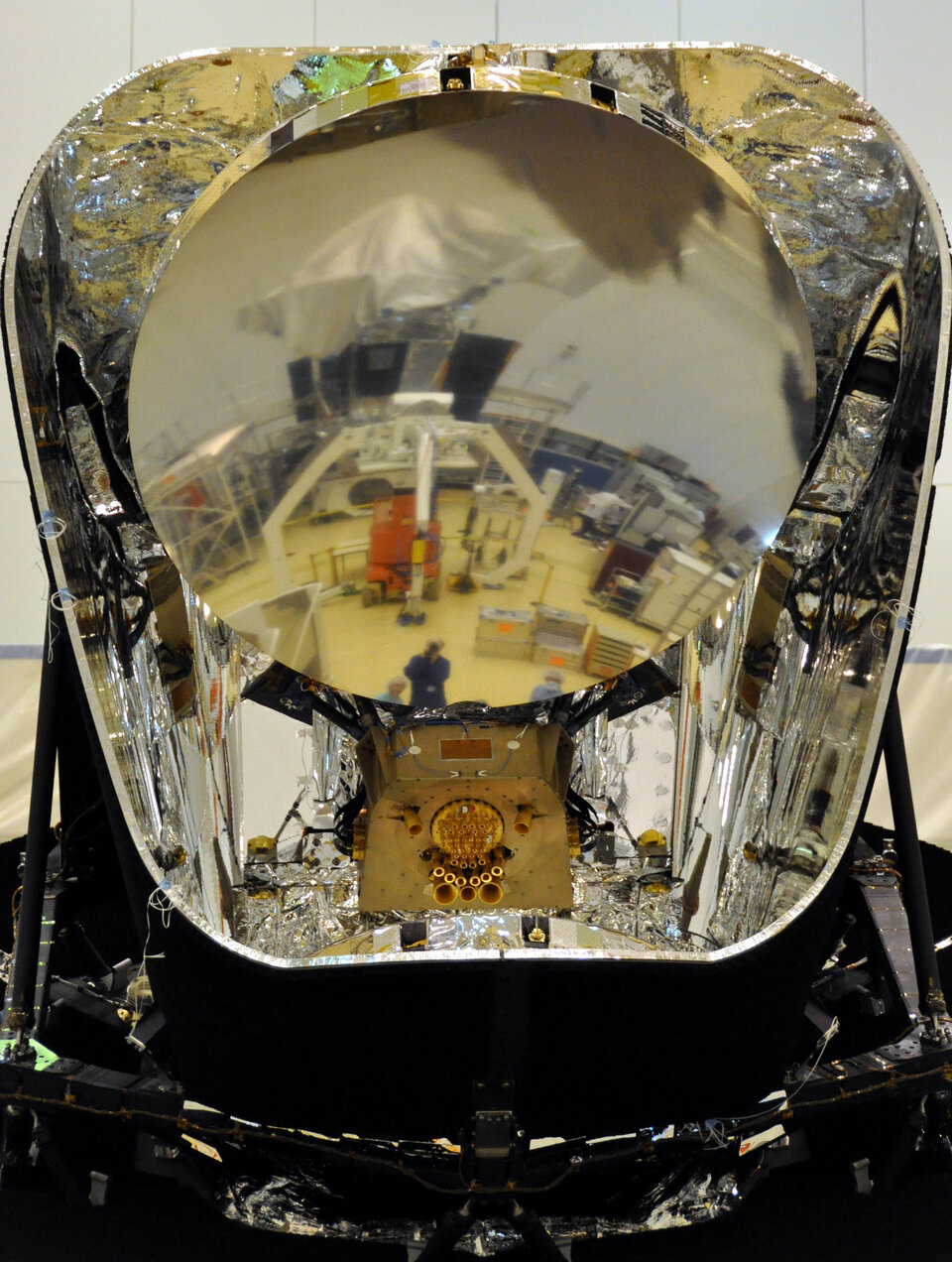
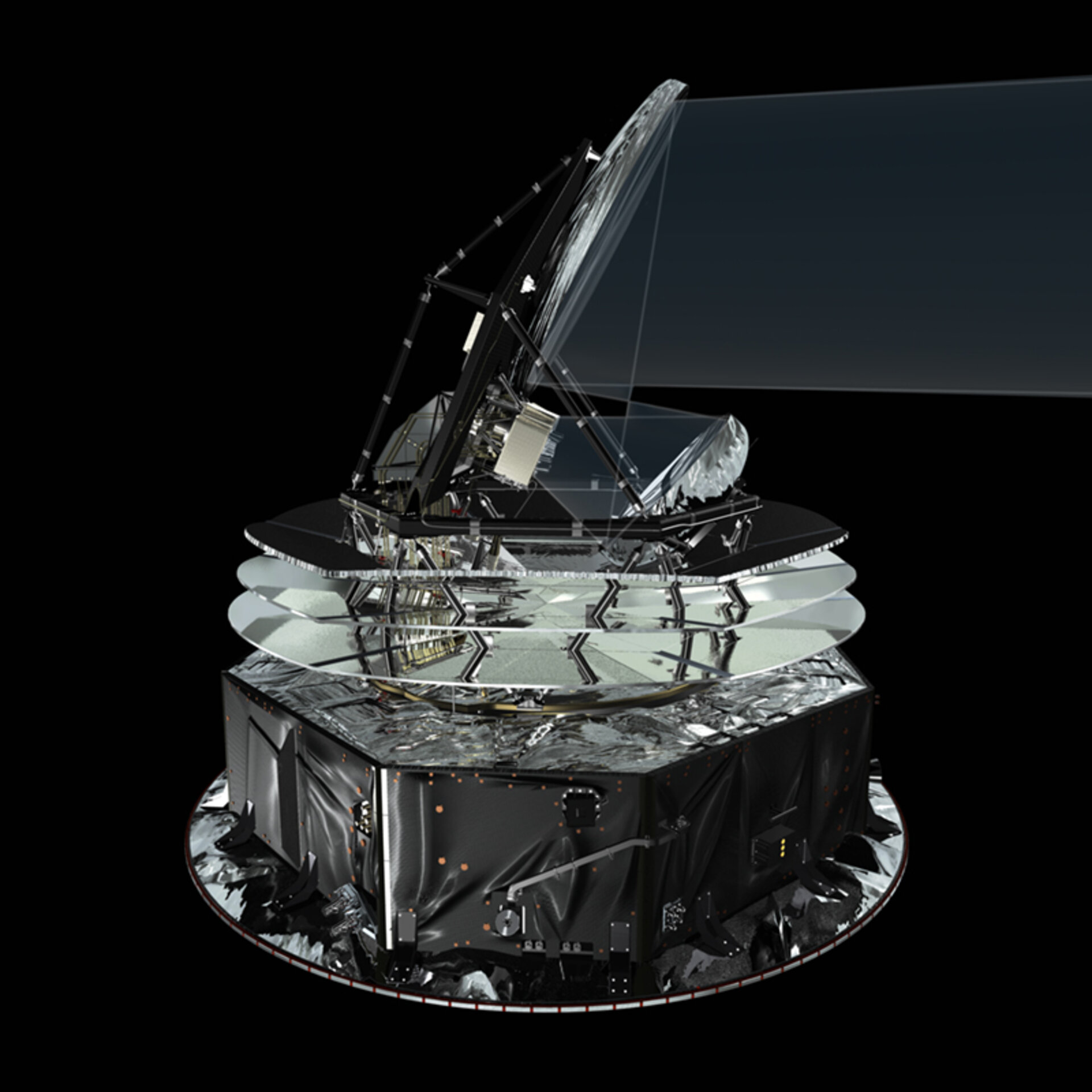
    Planck satellite and telescope

    Planck's large telescope collects the light from the Cosmic Microwave Background and focuses it onto the focal plane of the scientific instruments on board.

    The primary mirror, 1.9 x 1.5 m in diameter, weighs only about 28 kg; the effective telescope aperture is 1.5 m. It has been designed to be robust enough to withstand the 'shake-and-bake' stresses of launch, and the temperature difference between launch, when it is at an ambient temperature of about 300 K, and operation, at about 40 K.

    It is made of carbon-fiber-reinforced plastic and is coated with a thin reflective layer (reflectivity >99.5%) of aluminium - so smooth that any bumps in the coating are less than 5 microns in size. The telescope is surrounded by a large baffle that minimises stray light interference from the Earth, Sun and Moon, and cools it by radiating heat into space.

    The Planck telescope up close

    Seen in the microwave range, the CMB is only 1% as luminous as Earth, so straylight is a particular concern for any space-based telescopes observing the CMB in the microwave. This is why Planck will be strategically positioned at L2. From this vantage point in space, Earth will appear to be the same size as the full Moon seen from Earth.

    Planck will also be better sheltered from the heat emitted by Earth, the Moon and the Sun. In addition, the telescope is surrounded by a large baffle to minimise straylight interference from the Earth, Sun and Moon.
    Rate this

    Views

    Share

    • Currently 0 out of 5 Stars.
    • 1
    • 2
    • 3
    • 4
    • 5
    Rating: 0/5 (0 votes cast)

    Thank you for rating!

    You have already rated this page, you can only rate it once!

    Your rating has been changed, thanks for rating!

    84
    facebook
    twitter
    reddit
    google plus
    digg
    tumbler
    digg
    blogger
    myspace
    • Planck: looking back at the dawn of time
    • Read more
      • Cosmic Microwave Background (CMB) radiation
        • Travelling back in time
          • Observations: Seeing in microwave wavelengths
            • So, how did everything start?
            • In depth
            • Planck in depth
            • Planck spacecraft in depth

    Connect with us

    • RSS
    • Youtube
    • Twitter
    • Flickr
    • Google Buzz
    • Subscribe
    • App Store
    • LATEST ARTICLES
    • · CryoSat hits land
    • · Ariane 5 completes seven launches …
    • · Measuring skull pressure without t…
    • · Malargüe station inauguration
    • · The solar wind is swirly
    • FAQ

    • Jobs at ESA

    • Site Map

    • Contacts

    • Terms and conditions