• → European Space Agency

      • Space for Europe
      • Space News
      • Space in Images
      • Space in Videos
    • About Us

      • Welcome to ESA
      • DG's News and Views
      • For Member State Delegations
      • Business with ESA
      • ESA Exhibitions
      • ESA Publications
      • Careers at ESA
    • Our Activities

      • Space News
      • Observing the Earth
      • Human Spaceflight
      • Launchers
      • Navigation
      • Space Science
      • Space Engineering
      • Operations
      • Technology
      • Telecommunications & Integrated Applications
    • For Public

    • For Media

    • For Educators

    • For Kids

    • ESA

    • Rosetta

    • ESA Science

    • About Rosetta

      • Rosetta at a glance
      • Europe's comet chaser
      • Why 'Rosetta'?
    • About the spacecraft

      • The Rosetta orbiter
      • Orbiter: Instruments
      • The Rosetta lander
      • Lander: Instruments
    • About the journey

      • The long trek
      • Debris of the Solar System: Asteroids
      • Asteroid (2867) Steins: a portrait
      • Life and survival in deep space
      • Long-distance communication
      • The Rosetta ground segment
    • About the arrival

      • Comets - an introduction
      • Comet 67P/Churyumov- Gerasimenko
      • Comet rendezvous
      • Giotto - ESA's first comet mission
    • Meet the team
    • Mission Manager
    • Project Scientist
    • Multimedia
    • VideoTalk
    • 3D Flash 'model'
    • Rosetta images
    • Rosetta videos
    • Rosetta Animations
    • Rosetta wallpaper
    • Life of a comet
    • Services
    • Frequently asked questions
    • Comments

    ESA > Our Activities > Space Science > Rosetta

    How many comets are there?

    Comet 67P/Churyumov-Gerasimenko

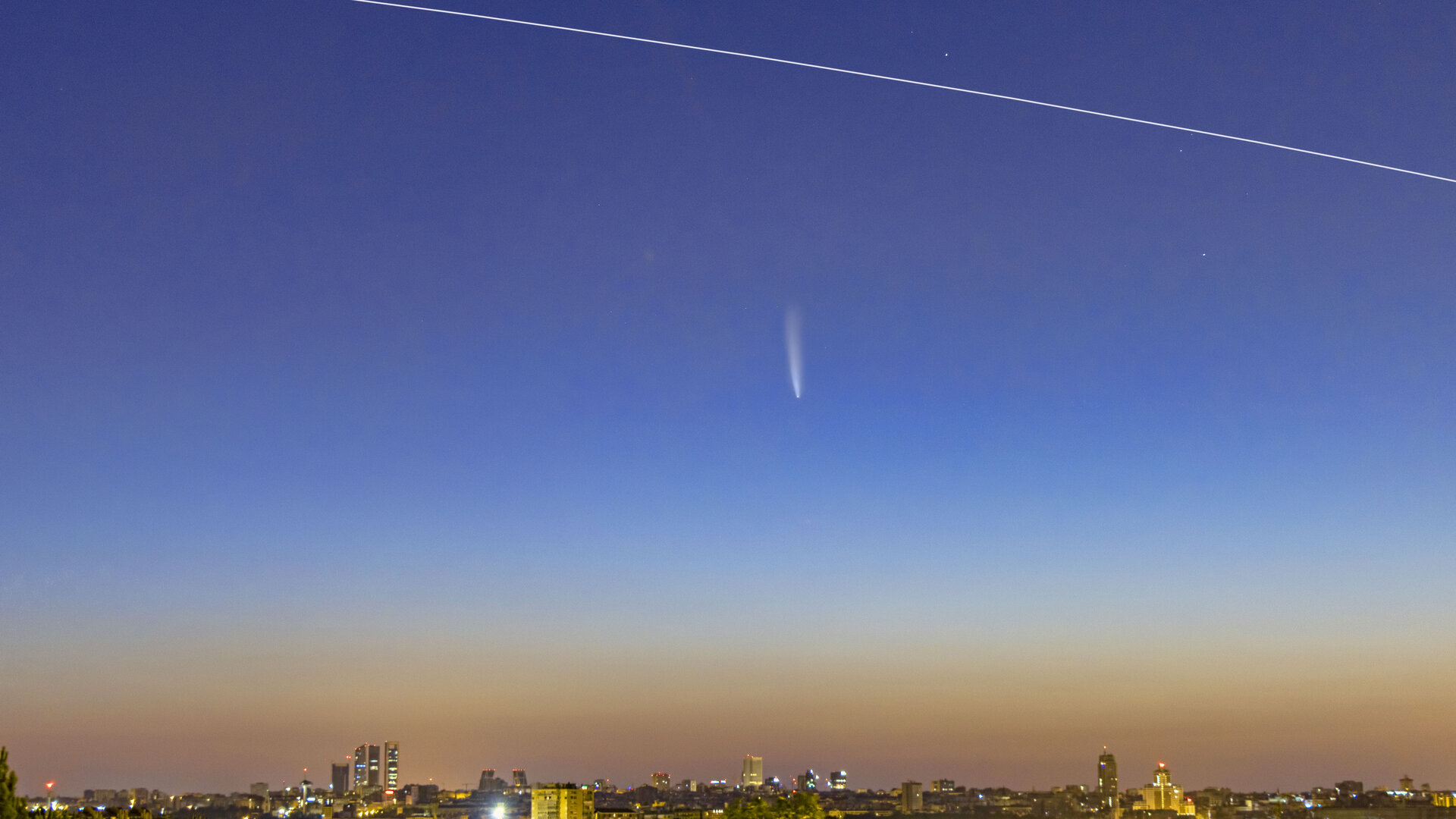
    Occasionally a comet makes the headlines, perhaps because it is visible from Earth with the unaided eye. This gives the impression that comets are rare. However, nothing could be further from the truth. There are thought to be so many comets that even astronomers can’t count them all…

    Comets were born in the outer reaches of the Solar System, 4600 million years ago, when the planets were forming. Far from the Sun, they formed out of icy material as well as some rocky matter and this turned them into the 'icebergs' of space.

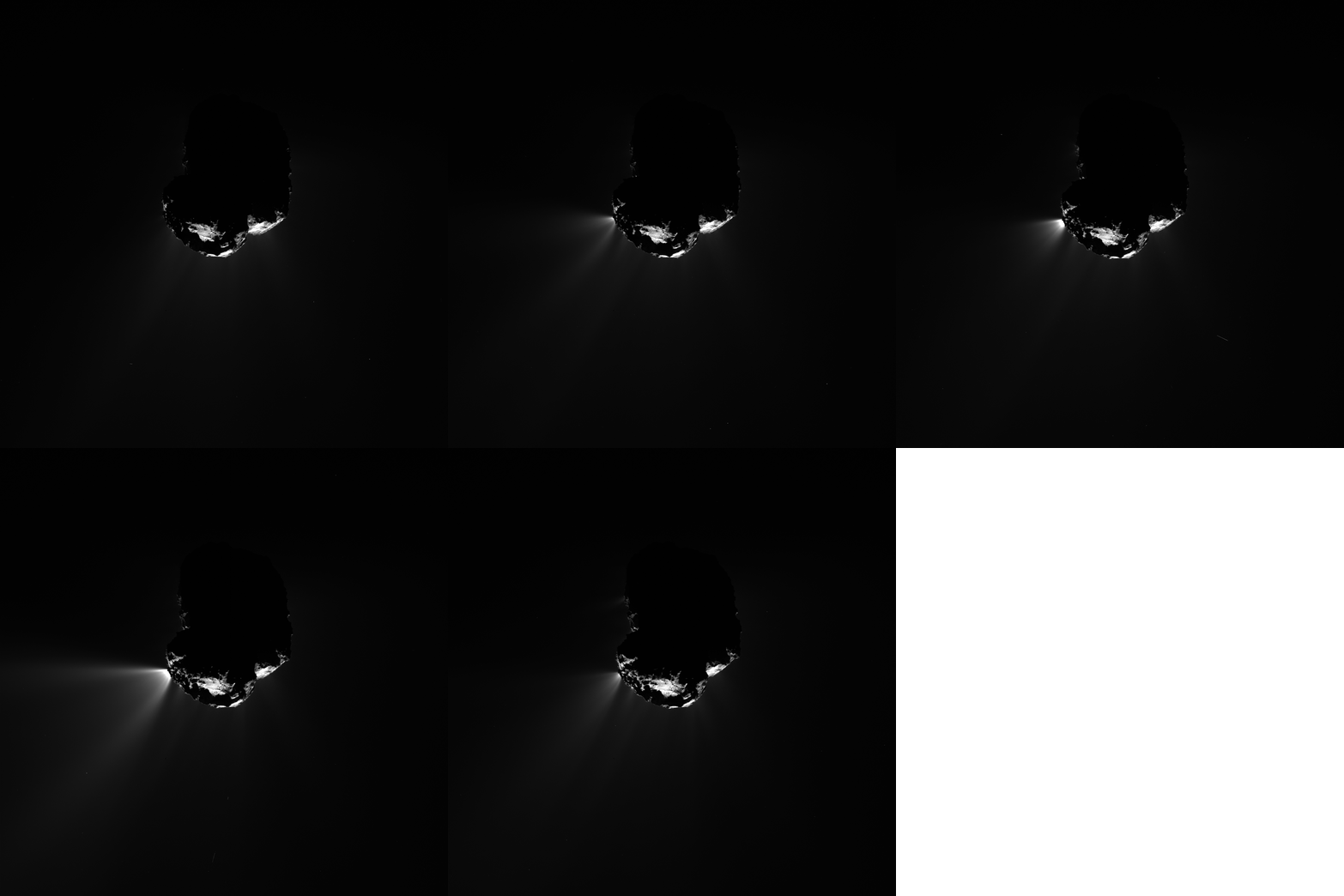
    Only when a comet swings in towards the Sun does it begin to evaporate and generate the tails for which comets are so famous. Observations of Comet Halley during its last appearance in 1986 show that the top one-metre layer of the comet’s surface was lost to form the tail.


    A comet probably has enough surplus ice for a few hundred passes of the Sun. After that, it may become so weakened by the loss of material that it shatters, or its surface may become so choked with tar-like substances, left behind when the ice evaporates, that it forms a layer, insulating the remaining ice from further exposure to the Sun.

    Asteroid 951 Gaspra
    Asteroid 951 Gaspra

    If this happens it transforms into a ‘stealth’ comet! It stops producing a tail and joins the army of other near-Earth asteroids (NEAs).

    Only better observations or even visits by spacecraft will tell us how many of the NEAs are really extinct comet cores.

    The fact that comets die in what, astronomically speaking, is a short period of time (around 10 000 years), suggests that there must be a great reservoir of extra comets to restock them.
    The nucleus of Comet Halley
    The nucleus of Comet Halley

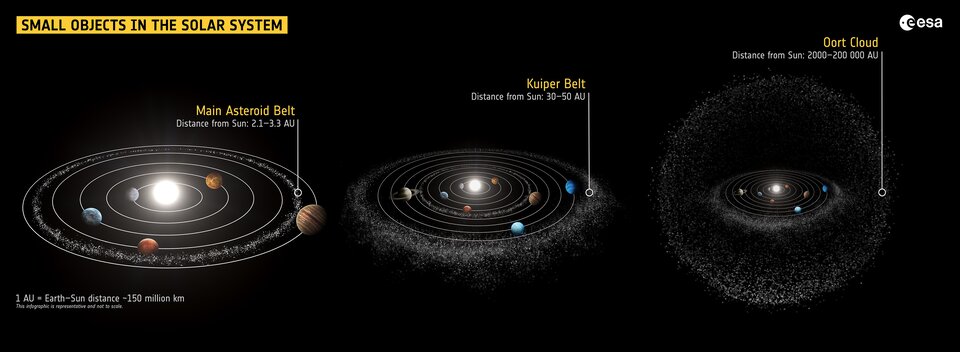
    By studying the orbits of comets, astronomers have come to the conclusion that two such reservoirs exist. The Kuiper belt, out beyond Pluto, is a flared disc of comets that supplies most of the short-period comets (those that orbit the Sun in less than a century).

    The Oort cloud (named after Jan H. Oort) is much larger and supplies the long-period comets. It encloses the Solar System, with an outer edge that reaches almost a quarter of the way to the nearest star.

    By taking the size of the Oort cloud into account, and the number of long-period comets that have been seen, astronomers estimate that a staggering one 'trillion' (12 zeros) comets may be waiting out there!

    Last update: 9 November 2007

    Rate this

    Views

    Share

    • Currently 0 out of 5 Stars.
    • 1
    • 2
    • 3
    • 4
    • 5
    Rating: 0/5 (0 votes cast)

    Thank you for rating!

    You have already rated this page, you can only rate it once!

    Your rating has been changed, thanks for rating!

    90
    facebook
    twitter
    reddit
    google plus
    digg
    tumbler
    digg
    blogger
    myspace
    • More about...
      • Rosetta at a glance
      • Rosetta press kit
        • Rosetta's journey
        • Related articles
          • History of cometary missions
            • Why 'Rosetta'?
              • Comets - an introduction
                • Life of a comet
                  • How many comets are there?
                    • Where life began
                    • Related links
                    • ESA Science - Rosetta
                    • Arianespace
                    • Astrium
                    • DLR

    Connect with us

    • RSS
    • Youtube
    • Twitter
    • Flickr
    • Google Buzz
    • Subscribe
    • App Store
    • LATEST ARTICLES
    • · CryoSat hits land
    • · Ariane 5 completes seven launches …
    • · Measuring skull pressure without t…
    • · Malargüe station inauguration
    • · The solar wind is swirly
    • FAQ

    • Jobs at ESA

    • Site Map

    • Contacts

    • Terms and conditions