• → European Space Agency

      • Space for Europe
      • Space News
      • Space in Images
      • Space in Videos
    • About Us

      • Welcome to ESA
      • DG's News and Views
      • For Member State Delegations
      • Business with ESA
      • ESA Exhibitions
      • ESA Publications
      • Careers at ESA
    • Our Activities

      • Space News
      • Observing the Earth
      • Human Spaceflight
      • Launchers
      • Navigation
      • Space Science
      • Space Engineering
      • Operations
      • Technology
      • Telecommunications & Integrated Applications
    • For Public

    • For Media

    • For Educators

    • For Kids

    • ESA

    • Rosetta

    • ESA Science

    • About Rosetta

      • Rosetta at a glance
      • Europe's comet chaser
      • Why 'Rosetta'?
    • About the spacecraft

      • The Rosetta orbiter
      • Orbiter: Instruments
      • The Rosetta lander
      • Lander: Instruments
    • About the journey

      • The long trek
      • Debris of the Solar System: Asteroids
      • Asteroid (2867) Steins: a portrait
      • Life and survival in deep space
      • Long-distance communication
      • The Rosetta ground segment
    • About the arrival

      • Comets - an introduction
      • Comet 67P/Churyumov- Gerasimenko
      • Comet rendezvous
      • Giotto - ESA's first comet mission
    • Meet the team
    • Mission Manager
    • Project Scientist
    • Multimedia
    • VideoTalk
    • 3D Flash 'model'
    • Rosetta images
    • Rosetta videos
    • Rosetta Animations
    • Rosetta wallpaper
    • Life of a comet
    • Services
    • Frequently asked questions
    • Comments

    ESA > Our Activities > Space Science > Rosetta

    The Rosetta ground segment

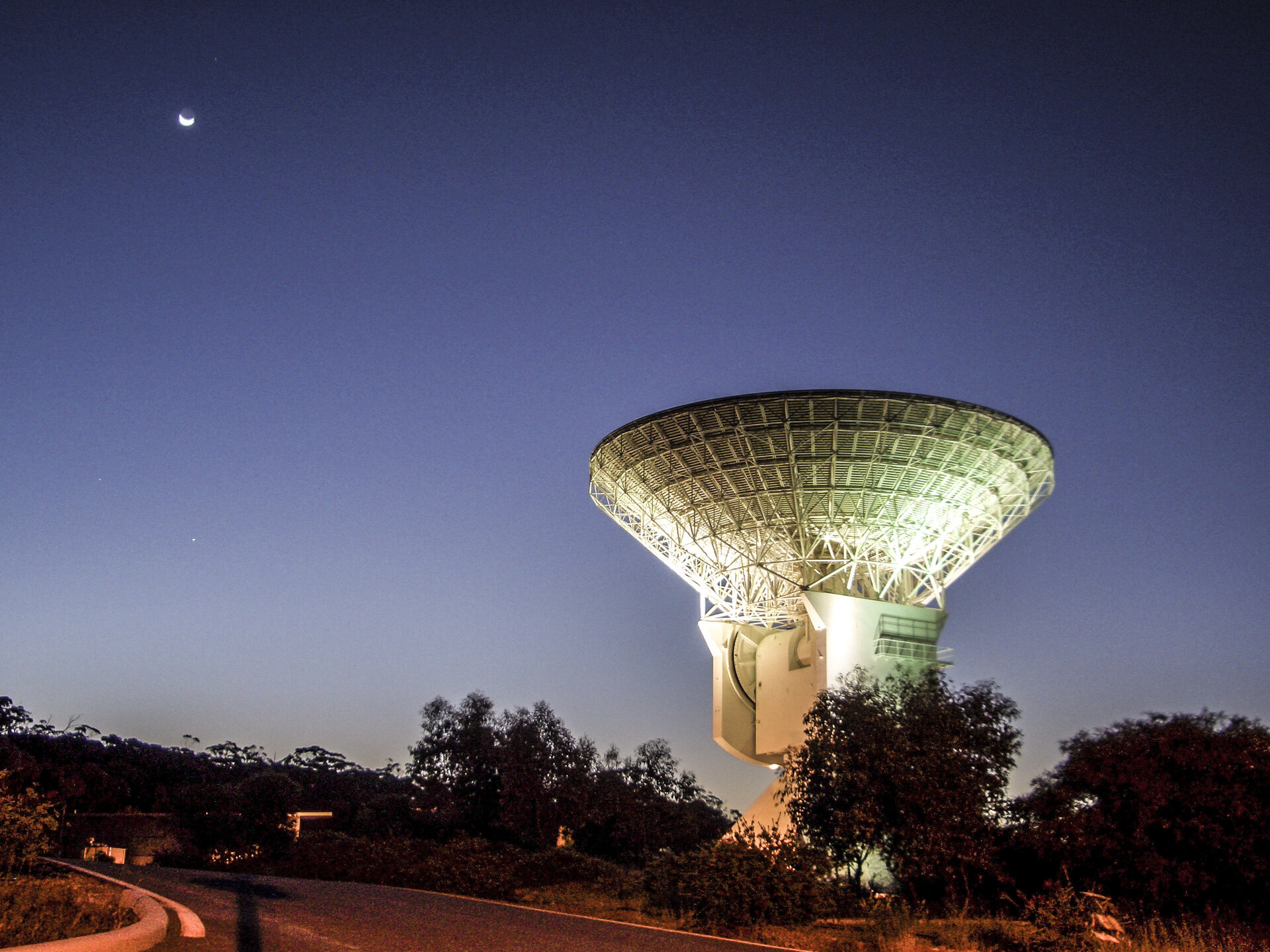
    The framework of ESA's new antenna at New Norcia, Australia
    17 February 2004

    A ‘ground segment’ is the system set up on Earth to manage and control a space mission, and to receive and process the data produced by a spacecraft’s instruments, and if necessary to send out and archive any generated products.

    The Rosetta ground segment is designed to meet both the scientific objectives and the challenges imposed by a deep-space mission. These challenges include long turnaround times for signals (up to 100 minutes), low bit rates for data (8 bps), low power (hibernation for two years), and the requirement for particular positions of planets (Rosetta makes use of gravity-assist manoeuvres with Mars and Earth). In addition ESOC will cope with the long mission duration and the related problem in keeping expertise and experience, while minimising the overall cost.
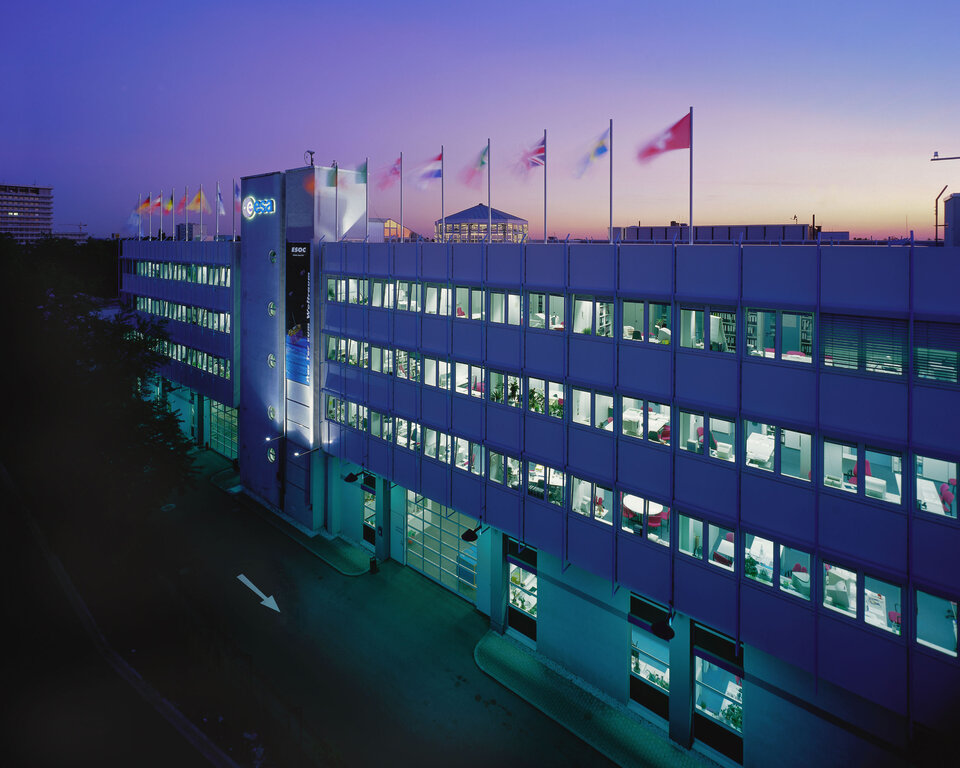
    View of ESOC main building

    The Rosetta spacecraft will be launched on an Ariane 5 launch vehicle from Kourou, French Guiana. After launch, the Rosetta mission will be controlled from a single control centre, the Rosetta Mission Operations Centre (RMOC) at ESOC, in Darmstadt, Germany, in conjunction with the ESA deep space ground station at New Norcia.


    New Norcia is ESA’s first deep space ground station, located near Perth, Western Australia. The 35-metre antenna will be used to maintain communications with the spacecraft at distances of up to 900 million kilometres away from Earth.

    Throughout all mission phases, the RMOC is the primary interface with the spacecraft through the ground stations. It will be responsible for monitoring and control of the complete mission. During critical mission phases (launch, planet fly-bys, and so on) it will be supported for tracking, telemetry and command by the ESA ground station located at Kourou and the NASA Deep Space Network (DSN) stations at Madrid, Spain, and Goldstone, USA.

    ESOC control room
    The ESOC control room

    A mission duration is defined as the period from launch to the ‘end of mission’, when ground contact to the spacecraft and its payload is ended. For Rosetta’s mission duration, ESOC will provide facilities and services to the scientific community for planning and execution of gathering scientific data. This will include generating and providing of complete raw-data sets and other data to the Principal Investigators and the Rosetta Lander Ground Segment.

    The Rosetta Science Operations Centre (RSOC) will support scientific mission planning and the planning of commands for experiments for submitting to RMOC. RSOC will make pre-processed scientific data and the scientific data archive available to the scientific community.

    A Rosetta Lander Ground Segment (RLGS) will support operations of the lander, in particular before and after completion of the landing and relay phase. These will be co-ordinated through the German Aerospace Research Centre (DLR) in Cologne, Germany, and the scientific control centre of CNES, the French space agency, in Toulouse, France.
    Rate this

    Views

    Share

    • Currently 0 out of 5 Stars.
    • 1
    • 2
    • 3
    • 4
    • 5
    Rating: 0/5 (0 votes cast)

    Thank you for rating!

    You have already rated this page, you can only rate it once!

    Your rating has been changed, thanks for rating!

    33
    facebook
    twitter
    reddit
    google plus
    digg
    tumbler
    digg
    blogger
    myspace
    • More about...
      • Rosetta at a glance
      • Rosetta press kit
        • Rosetta's journey
        • Related articles
          • History of cometary missions
            • Why 'Rosetta'?
              • Comets - an introduction
                • Life of a comet
                  • How many comets are there?
                    • Where life began
                    • Related links
                    • ESA Science - Rosetta
                    • Arianespace
                    • Astrium
                    • DLR

    Connect with us

    • RSS
    • Youtube
    • Twitter
    • Flickr
    • Google Buzz
    • Subscribe
    • App Store
    • LATEST ARTICLES
    • · CryoSat hits land
    • · Ariane 5 completes seven launches …
    • · Measuring skull pressure without t…
    • · Malargüe station inauguration
    • · The solar wind is swirly
    • FAQ

    • Jobs at ESA

    • Site Map

    • Contacts

    • Terms and conditions