• → European Space Agency

      • Space for Europe
      • Space News
      • Space in Images
      • Space in Videos
    • About Us

      • Welcome to ESA
      • DG's News and Views
      • For Member State Delegations
      • Business with ESA
      • ESA Exhibitions
      • ESA Publications
      • Careers at ESA
    • Our Activities

      • Space News
      • Observing the Earth
      • Human Spaceflight
      • Launchers
      • Navigation
      • Space Science
      • Space Engineering
      • Operations
      • Technology
      • Telecommunications & Integrated Applications
    • For Public

    • For Media

    • For Educators

    • For Kids

    • ESA

    • Rosetta

    • ESA Science

    • About Rosetta

      • Rosetta at a glance
      • Europe's comet chaser
      • Why 'Rosetta'?
    • About the spacecraft

      • The Rosetta orbiter
      • Orbiter: Instruments
      • The Rosetta lander
      • Lander: Instruments
    • About the journey

      • The long trek
      • Debris of the Solar System: Asteroids
      • Asteroid (2867) Steins: a portrait
      • Life and survival in deep space
      • Long-distance communication
      • The Rosetta ground segment
    • About the arrival

      • Comets - an introduction
      • Comet 67P/Churyumov- Gerasimenko
      • Comet rendezvous
      • Giotto - ESA's first comet mission
    • Meet the team
    • Mission Manager
    • Project Scientist
    • Multimedia
    • VideoTalk
    • 3D Flash 'model'
    • Rosetta images
    • Rosetta videos
    • Rosetta Animations
    • Rosetta wallpaper
    • Life of a comet
    • Services
    • Frequently asked questions
    • Comments

    ESA > Our Activities > Space Science > Rosetta

    The Rosetta lander

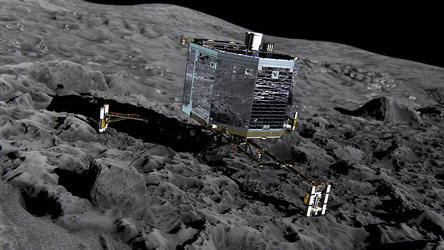
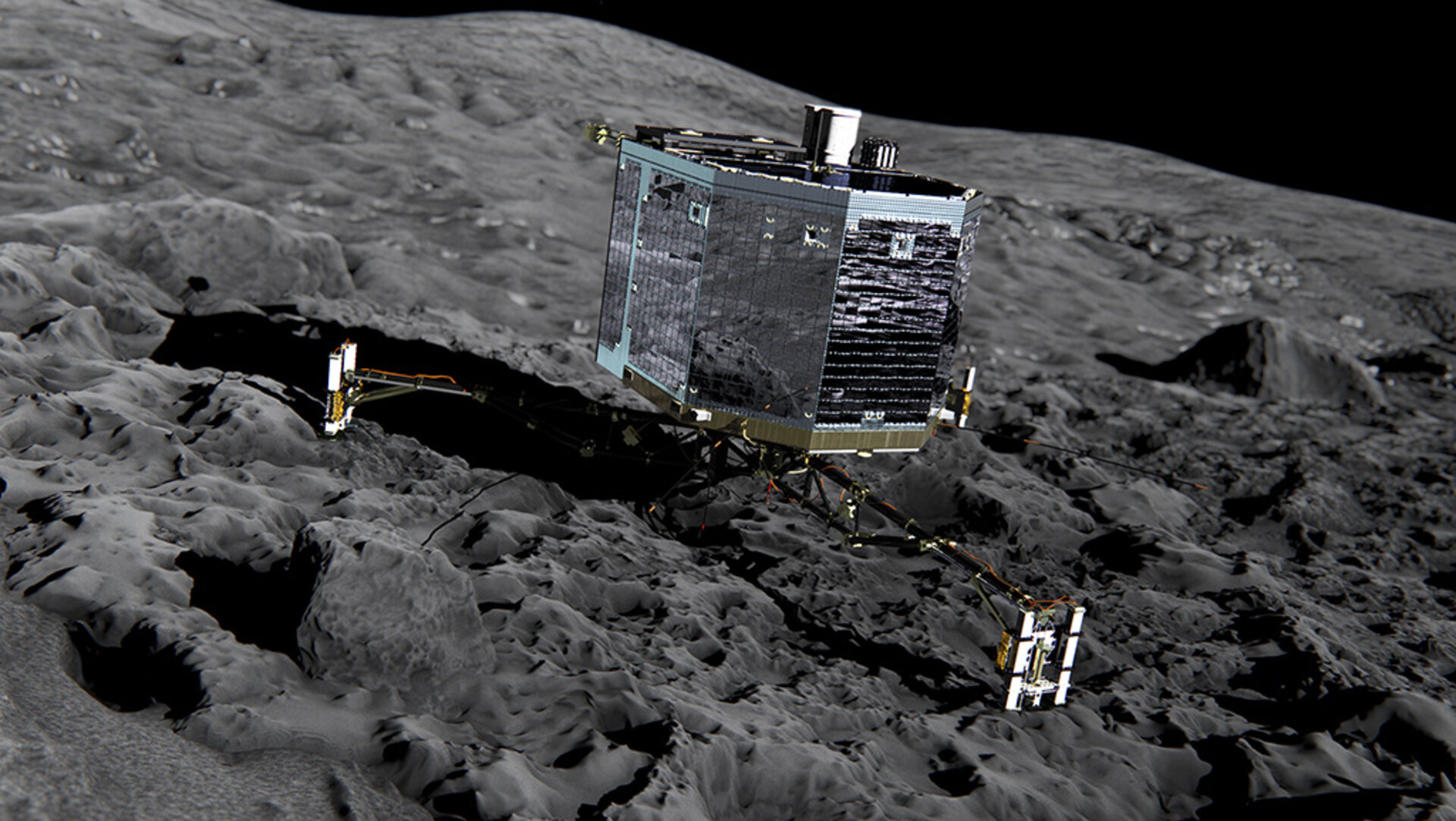
    Rosetta’s Philae lander on comet nucleus

    The 100-kilogram Rosetta lander is provided by a European consortium under the leadership of the German Aerospace Research Institute (DLR). Other members of the consortium are ESA and institutes from Austria, Finland, France, Hungary, Ireland, Italy and the UK.

    The box-shaped lander is carried on the side of the orbiter until it arrives at Comet 67P/Churyumov-Gerasimenko. Once the orbiter is aligned correctly, the lander is commanded to self-eject from the main spacecraft and unfold its three legs, ready for a gentle touchdown at the end of the ballistic descent.

    On landing, the legs damp out most of the kinetic energy to reduce the chance of bouncing, and they can rotate, lift or tilt to return the lander to an upright position.

    Immediately after touchdown, a harpoon is fired to anchor the lander to the ground and prevent it escaping from the comet’s extremely weak gravity. The minimum mission target is one week, but surface operations may continue for many months.


    Lander design

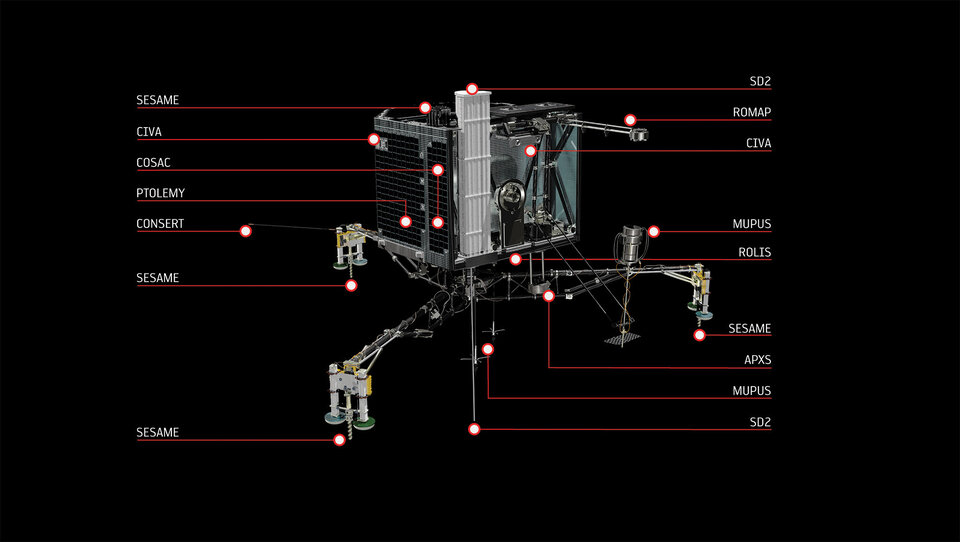
    The lander structure consists of a baseplate, an instrument platform, and a polygonal sandwich construction, all made of carbon fibre. Some of the instruments and subsystems are beneath a hood that is covered with solar cells.

    An antenna transmits data from the surface to Earth via the orbiter. The lander carries nine experiments, with a total mass of about 21 kilograms. It also carries a drilling system to take samples of subsurface material.

    Last update: 1 November 2004

    Rate this

    Views

    Share

    • Currently 5 out of 5 Stars.
    • 1
    • 2
    • 3
    • 4
    • 5
    Rating: 5/5 (1 votes cast)

    Thank you for rating!

    You have already rated this page, you can only rate it once!

    Your rating has been changed, thanks for rating!

    88
    facebook
    twitter
    reddit
    google plus
    digg
    tumbler
    digg
    blogger
    myspace
      • Rosetta at a glance
        • The Rosetta orbiter
          • The Rosetta lander
          • Instruments on the orbiter
            • ALICE
              • CONSERT
                • COSIMA
                  • GIADA
                    • MIDAS
                      • MIRO
                        • OSIRIS
                          • ROSINA
                            • RPC
                              • RSI
                                • VIRTIS
                                • Instruments on the lander
                                  • APXS
                                    • ÇIVA
                                      • CONSERT
                                        • COSAC
                                          • MODULUS PTOLEMY
                                            • MUPUS
                                              • ROLIS
                                                • ROMAP
                                                  • SD2
                                                    • SESAME

    Connect with us

    • RSS
    • Youtube
    • Twitter
    • Flickr
    • Google Buzz
    • Subscribe
    • App Store
    • LATEST ARTICLES
    • · CryoSat hits land
    • · Ariane 5 completes seven launches …
    • · Measuring skull pressure without t…
    • · Malargüe station inauguration
    • · The solar wind is swirly
    • FAQ

    • Jobs at ESA

    • Site Map

    • Contacts

    • Terms and conditions