• → European Space Agency

      • Space for Europe
      • Space News
      • Space in Images
      • Space in Videos
    • About Us

      • Welcome to ESA
      • DG's News and Views
      • For Member State Delegations
      • Business with ESA
      • ESA Exhibitions
      • ESA Publications
      • Careers at ESA
    • Our Activities

      • Space News
      • Observing the Earth
      • Human Spaceflight
      • Launchers
      • Navigation
      • Space Science
      • Space Engineering
      • Operations
      • Technology
      • Telecommunications & Integrated Applications
    • For Public

    • For Media

    • For Educators

    • For Kids

    • ESA

    • Space Science

    • Our Universe
    • About Space Science
    • ESA's 'Cosmic Vision'
    • Science missions
    • Mission navigator
    • Target groups
    • For Media
    • For Scientists
    • For Kids
    • Multimedia
    • Science images
    • Science videos
    • Animations
    • Downloads
    • Sounds from space
    • Resources
    • Reference section
    • Services
    • FAQs
    • Glossary
    • Help
    • Portal terms of use
    • Comments
    • ESA Press Releases
    • Follow us
    • RSS feeds
    • ESA Sci on Twitter
    • ESA Space Science Images on Flickr
    • ESA 3D on Flickr

    ESA > Our Activities > Space Science

    Ring clumps and strands

    Scrambling Saturn’s B-ring

    10 September 2012

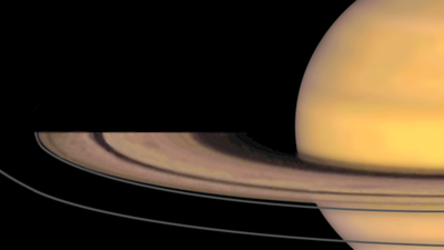
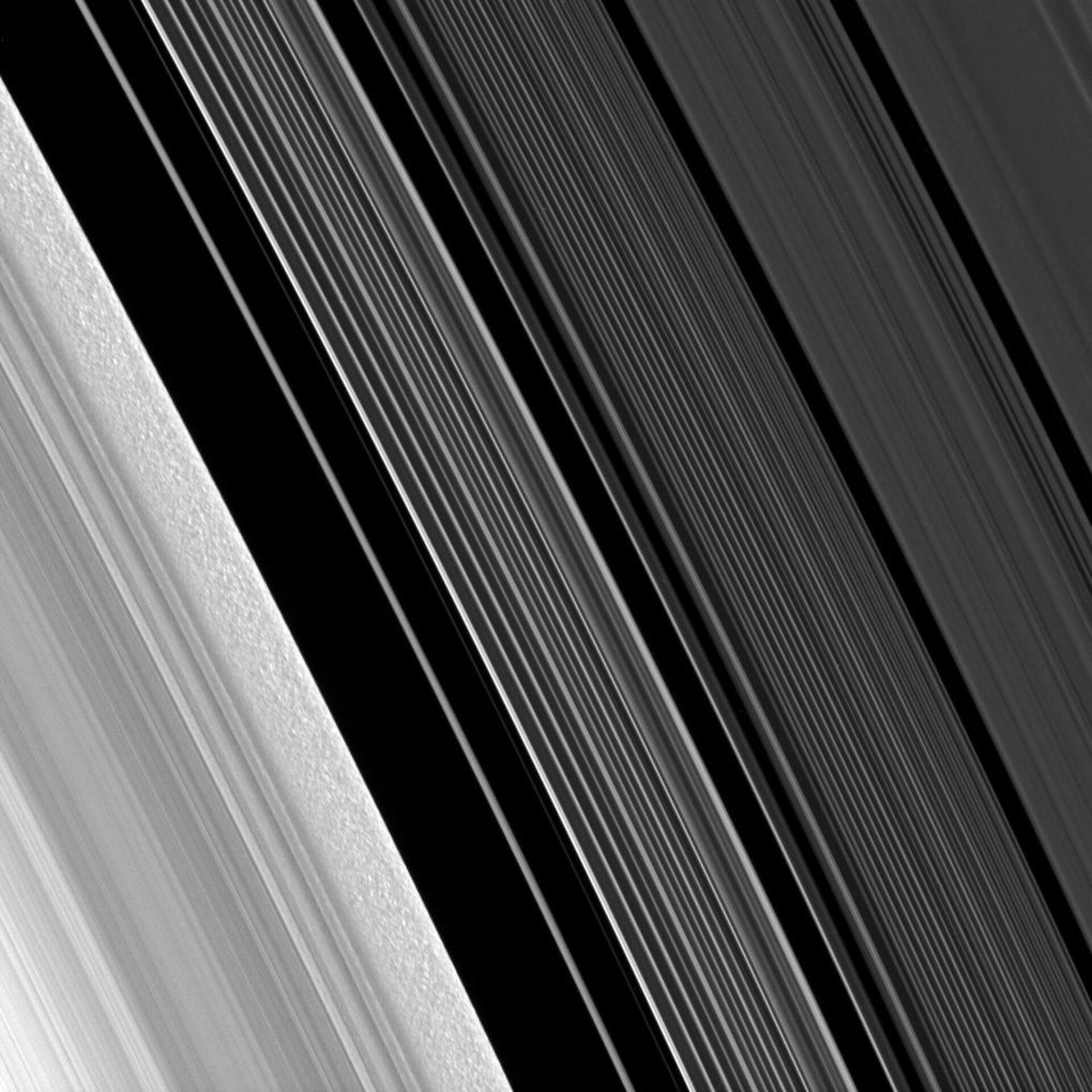
    Clumpy particles in Saturn’s B-ring provide stark contrast to the delicately ordered ringlets seen in the rest of this view presented by the Cassini spacecraft.

    Saturn’s B-ring is the largest and brightest of the gas giant’s rings, the outer portion of which is seen in the left side of this image.

    The ring’s outside edge is influenced by meddling moon Mimas, which orbits the planet once for every two circuits the icy ring particles complete.

    These periodic gravity perturbations are thought to compress the ring particles into clumps, while maintaining the ring’s well-defined outer edge.

    Beyond the B-ring lies the Huygens gap, the widest dark void visible in this image, punctuated only by the bright Huygens ringlet. The 4800 km-wide Cassini Division separates the B-ring from the outermost A-ring, but itself is marked out with faint, concentric strands of ring material.

    From Earth, the Cassini Division appears as a thin black gap in Saturn’s rings, but close-up views from spacecraft expose the delicate structures in fine detail.

    This image was taken in visible light with the Cassini spacecraft narrow-angle camera on 10 July 2009 from a distance of 320 000 km from Saturn.

    Cassini is a joint mission between ESA, NASA and ASI and has been in orbit around Saturn since 2004. It is now in its second extended mission phase, the Cassini Solstice Mission, which will continue until 2017.

    Rate this

    Views

    Share

    • Currently 0 out of 5 Stars.
    • 1
    • 2
    • 3
    • 4
    • 5
    Rating: 0/5 (0 votes cast)

    Thank you for rating!

    You have already rated this page, you can only rate it once!

    Your rating has been changed, thanks for rating!

    33
    facebook
    twitter
    reddit
    google plus
    digg
    tumbler
    digg
    blogger
    myspace
    • Archive
      • Image of the week archive
      • Space Live
        Space Live
        Space science image gallery
      • At Saturn and Titan
      • Related articles
        • In the shadows of Saturn’s rings
          • Rings, Titan and Enceladus
            • Cassini movie shows blazing trails in Saturn’s F-ring
              • Saturn and Titan
                • Saturn's Rings and Enceladus
                • In depth
                • Cassini in depth
                • Follow us
                • ESA Space Science Image of the Week on Flickr
                • ESA 3D on Flickr
                • ESA Sci on Twitter

    Connect with us

    • RSS
    • Youtube
    • Twitter
    • Flickr
    • Google Buzz
    • Subscribe
    • App Store
    • ESA Science Twitter

    Follow ESA science

    • LATEST ARTICLES
    • · CryoSat hits land
    • · Ariane 5 completes seven launches …
    • · Measuring skull pressure without t…
    • · Malargüe station inauguration
    • · The solar wind is swirly
    • FAQ

    • Jobs at ESA

    • Site Map

    • Contacts

    • Terms and conditions