• → European Space Agency

      • Space for Europe
      • Space News
      • Space in Images
      • Space in Videos
    • About Us

      • Welcome to ESA
      • DG's News and Views
      • For Member State Delegations
      • Business with ESA
      • ESA Exhibitions
      • ESA Publications
      • Careers at ESA
    • Our Activities

      • Space News
      • Observing the Earth
      • Human Spaceflight
      • Launchers
      • Navigation
      • Space Science
      • Space Engineering
      • Operations
      • Technology
      • Telecommunications & Integrated Applications
    • For Public

    • For Media

    • For Educators

    • For Kids

    • ESA

    • Space Science

    • Our Universe
    • About Space Science
    • ESA's 'Cosmic Vision'
    • Science missions
    • Mission navigator
    • Target groups
    • For Media
    • For Scientists
    • For Kids
    • Multimedia
    • Science images
    • Science videos
    • Animations
    • Downloads
    • Sounds from space
    • Resources
    • Reference section
    • Services
    • FAQs
    • Glossary
    • Help
    • Portal terms of use
    • Comments
    • ESA Press Releases
    • Follow us
    • RSS feeds
    • ESA Sci on Twitter
    • ESA Space Science Images on Flickr
    • ESA 3D on Flickr

    ESA > Our Activities > Space Science

    Valles Marineris

    The Solar System’s grandest canyon

    22 October 2012

    Earth’s Grand Canyon inspires awe for anyone who casts eyes upon the vast river-cut valley, but it would seem nothing more than a scratch next to the cavernous scar of Valles Marineris that marks the face of Mars.

    Stretching over 4000 km long and 200 km wide, and with a dizzying depth of 10 km, it is some ten times longer and five times deeper than Earth’s Grand Canyon, a size that earns it the status of the largest canyon in the Solar System.

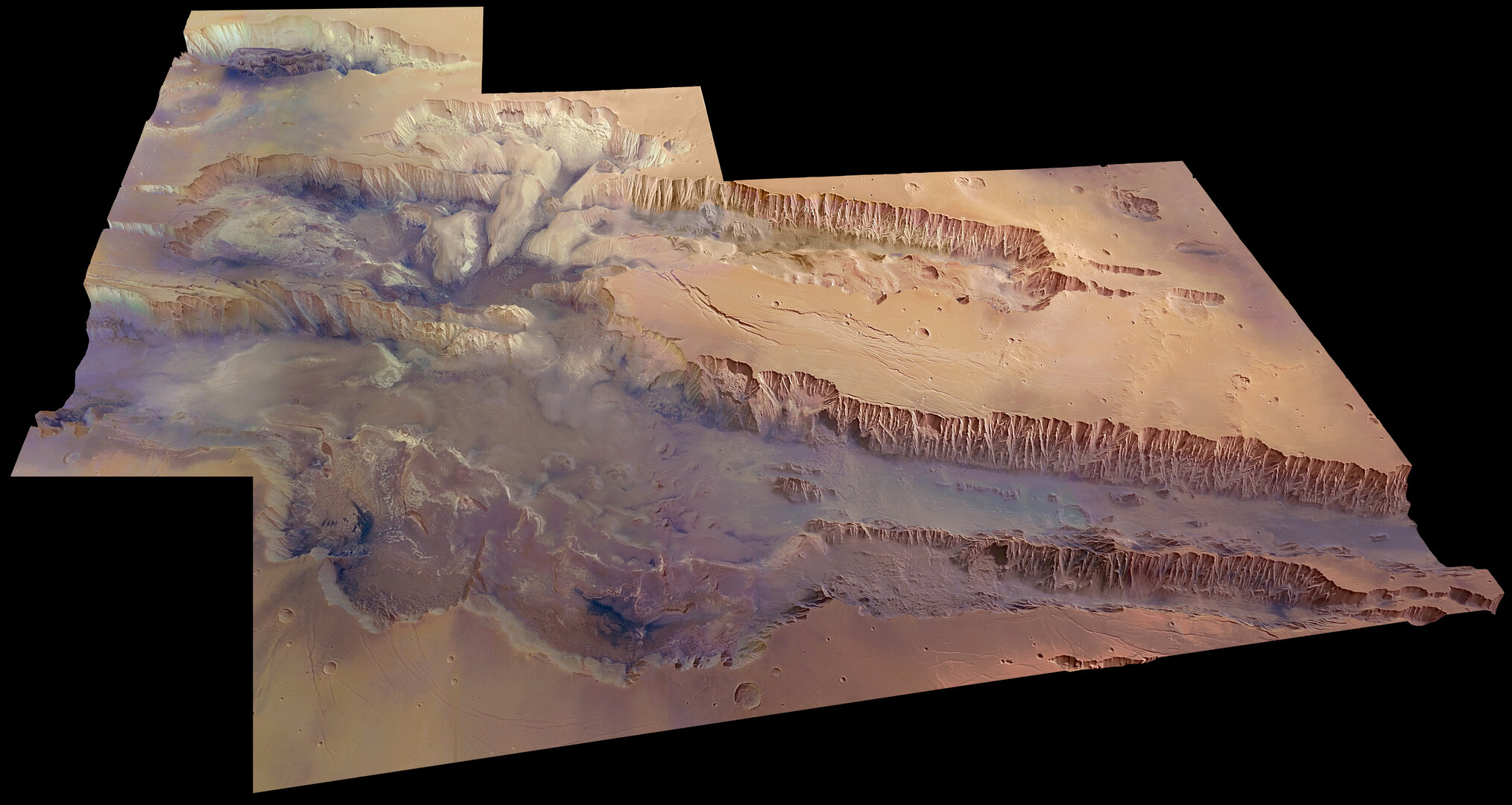
    Seen here in new light and online for the first time, this bird’s-eye view of Valles Marineris was created from data captured during 20 individual orbits of ESA’s Mars Express. It is presented in near-true colour and with four times vertical exaggeration.

    A wide variety of geological features can be seen, reflecting the complex geological history of the region.

    The canyon’s formation is likely intimately linked with the formation of the neighbouring Tharsis bulge, which is out of shot and to the left of this image and home to the largest volcano in the Solar System, Olympus Mons.

    The volcanic activity is revealed by the nature of the rocks in the walls of the canyon and the surrounding plains, which were built by successive lava flows.

    As the Tharsis bulge swelled with magma during the planet’s first billion years, the surrounding crust was stretched, ripping apart and eventually collapsing into the gigantic troughs of Valles Marineris.

    Intricate fault patterns have also developed due to the imposing extensional forces; the most recent are particularly evident in the middle portion of the image and along the lower boundary of the frame.

    Landslides have also played a role in shaping the scene, especially in the northern-most troughs, where material has recently slumped down the steep walls. Mass wasting has also created delicate erosion of the highest part of the walls.

    Strong water flows may have reshaped Valles Marineris after it was formed, deepening the canyon. Mineralogical information collected by orbiting spacecraft, including Mars Express, shows that the terrain here was altered by water hundreds of millions of years ago.

    Rate this

    Views

    Share

    • Currently 5 out of 5 Stars.
    • 1
    • 2
    • 3
    • 4
    • 5
    Rating: 5/5 (8 votes cast)

    Thank you for rating!

    You have already rated this page, you can only rate it once!

    Your rating has been changed, thanks for rating!

    607
    facebook
    twitter
    reddit
    google plus
    digg
    tumbler
    digg
    blogger
    myspace
    • Archive
      • Image of the week archive
      • Space Live
        Space Live
        Space science image gallery
      • Mars Express
      • Related articles
        • Ice-coated beauty in Mars’ Silver Island
          • Hadley Crater provides deep insight into martian geology
            • The fractured features of Ladon basin
              • Melas Dorsa reveals a complex geological history on Mars
                • Mars crater shows evidence for climate evolution
                  • Signs of ancient flowing water on Mars
                  • Related links
                  • High Resolution Stereo Camera
                    • Behind the lens...
                      • Frequently asked questions
                      • Related ESA publications
                        • ESA SP-1291 Mars Express: The Scientific Investigations
                        • In depth
                        • Mars Express in depth
                        • Follow us
                        • ESA Space Science Image of the Week on Flickr
                        • ESA 3D on Flickr
                        • ESA Sci on Twitter

    Connect with us

    • RSS
    • Youtube
    • Twitter
    • Flickr
    • Google Buzz
    • Subscribe
    • App Store
    • ESA Science Twitter

    Follow ESA science

    • LATEST ARTICLES
    • · CryoSat hits land
    • · Ariane 5 completes seven launches …
    • · Measuring skull pressure without t…
    • · Malargüe station inauguration
    • · The solar wind is swirly
    • FAQ

    • Jobs at ESA

    • Site Map

    • Contacts

    • Terms and conditions