• → European Space Agency

      • Space for Europe
      • Space News
      • Space in Images
      • Space in Videos
    • About Us

      • Welcome to ESA
      • DG's News and Views
      • For Member State Delegations
      • Business with ESA
      • ESA Exhibitions
      • ESA Publications
      • Careers at ESA
    • Our Activities

      • Space News
      • Observing the Earth
      • Human Spaceflight
      • Launchers
      • Navigation
      • Space Science
      • Space Engineering
      • Operations
      • Technology
      • Telecommunications & Integrated Applications
    • For Public

    • For Media

    • For Educators

    • For Kids

    • ESA

    • Space Science

    • Our Universe
    • About Space Science
    • ESA's 'Cosmic Vision'
    • Science missions
    • Mission navigator
    • Target groups
    • For Media
    • For Scientists
    • For Kids
    • Multimedia
    • Science images
    • Science videos
    • Animations
    • Downloads
    • Sounds from space
    • Resources
    • Reference section
    • Services
    • FAQs
    • Glossary
    • Help
    • Portal terms of use
    • Comments
    • ESA Press Releases
    • Follow us
    • RSS feeds
    • ESA Sci on Twitter
    • ESA Space Science Images on Flickr
    • ESA 3D on Flickr

    ESA > Our Activities > Space Science

    The Sun’s great idea

    The Sun has a great idea

    23 July 2012

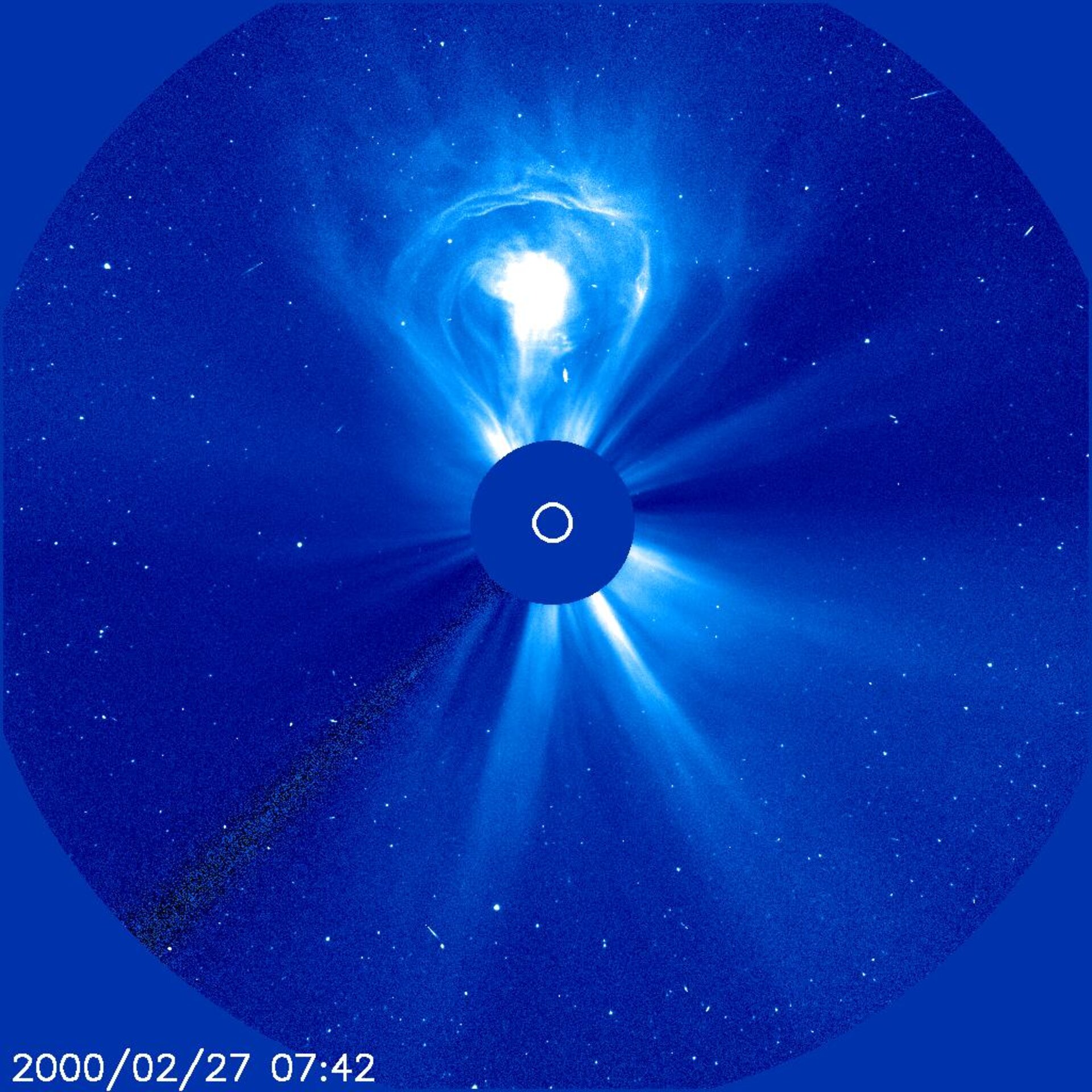
    A light bulb-shaped eruption leaps from the Sun and blasts into space in this archival image from the ESA/NASA Solar and Heliospheric Observatory, SOHO.

    SOHO captured the scene on 27 February 2000, watching as a large filament rose from the Sun’s broiling atmosphere and evolved into the coronal mass ejection loop seen here.

    A coronal mass ejection – or CME – is a huge cloud of magnetised plasma ejected from the Sun’s atmosphere – the corona – and launched into interplanetary space. They comprise millions of tonnes of gas and race away from the Sun at hundreds of kilometres per second.

    If a powerful CME is aimed in Earth’s direction then the resulting geomagnetic storm may trigger regional power outages and communications blackouts.

    But CMEs also have an appealing side: interactions with Earth’s magnetic field ignite auroras over the northern or southern poles, producing spectacular natural light displays that dance across the night sky in shades of red and green.

    This particular CME shows three distinctive features as it leaps from the Sun. A bright loop of plasma leads the way with a dark, low-density cavity behind it. The light bulb ‘filament’ – a bright orb of solar plasma – follows behind and dominates the centre of feature.

    Rate this

    Views

    Share

    • Currently 0 out of 5 Stars.
    • 1
    • 2
    • 3
    • 4
    • 5
    Rating: 0/5 (0 votes cast)

    Thank you for rating!

    You have already rated this page, you can only rate it once!

    Your rating has been changed, thanks for rating!

    36
    facebook
    twitter
    reddit
    google plus
    digg
    tumbler
    digg
    blogger
    myspace
    • Archive
      • Image of the week archive
      • Polar plumes as seen by SOHO
        Polar plumes as seen by SOHO
        SOHO 10-year special
      • More about
        • SOHO overview
          • SOHO factsheet
          • Related articles
            • Space weather
              • What are solar flares?
                • Safety tips for observing the Sun
                • In depth
                • SOHO in depth
                • Related links
                • ESA's SOHO home page
                • The Sun now
                • Follow us
                • ESA Space Science Image of the Week on Flickr
                • ESA 3D on Flickr
                • ESA Sci on Twitter

    Connect with us

    • RSS
    • Youtube
    • Twitter
    • Flickr
    • Google Buzz
    • Subscribe
    • App Store
    • ESA Science Twitter

    Follow ESA science

    • LATEST ARTICLES
    • · CryoSat hits land
    • · Ariane 5 completes seven launches …
    • · Measuring skull pressure without t…
    • · Malargüe station inauguration
    • · The solar wind is swirly
    • FAQ

    • Jobs at ESA

    • Site Map

    • Contacts

    • Terms and conditions