Ulysses spacecraft data indicate Solar System shield lowering
Data from the joint ESA/NASA Ulysses mission show that the Sun has reduced its output of solar wind to the lowest levels since accurate readings have become available. This current state of the Sun could reduce the natural shielding that envelops our Solar System.
"The Sun’s 1.5 million km-per-hour solar wind inflates a protective bubble around the Solar System and can influence how things work here on Earth and even out at the boundary of our Solar System, where it meets the galaxy," said Dave McComas, Principal Investigator for the Ulysses solar wind instrument and senior Executive Director at the Southwest Research Institute in San Antonio, Texas. "Ulysses data indicate the solar wind’s global pressure is the lowest we have seen since the beginning of the space age."
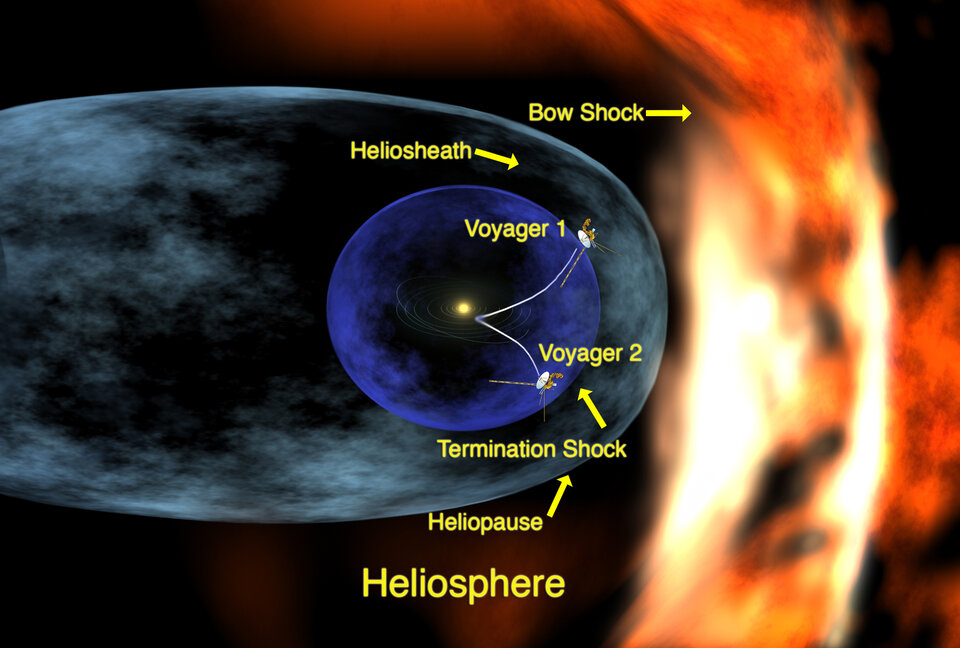
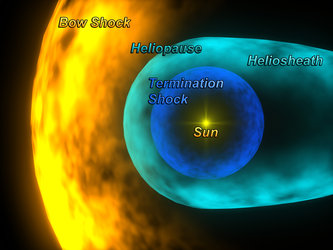
The Sun's solar wind plasma is a stream of charged particles that are ejected from the upper atmosphere of the Sun. The solar wind interacts with every planetary body in our Solar System. It even defines the border between our Solar System and interstellar space.
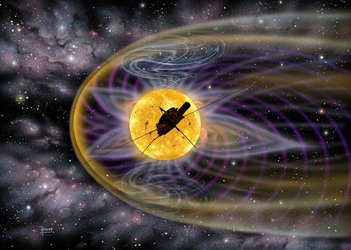
This border, called the heliopause, is a bubble-shaped boundary surrounding our Solar System where the solar wind's strength is no longer great enough to push back the wind originating from other stars. The region around the heliopause also acts as a shield for our Solar System, warding off a significant portion of the cosmic rays outside the galaxy.
These exciting results could only have been obtained by a spacecraft orbiting the poles of the Sun... Even though the end is now in sight, every day's worth of new data is adding to our knowledge of the Sun and its environment.
"Galactic cosmic rays carry with them radiation from other parts of our galaxy," said Ed Smith, NASA's Ulysses Project Scientist from the Jet Propulsion Laboratory in California, USA. "With the solar wind at an all-time low, there is an excellent chance that the heliosphere will diminish in size and strength. If that occurs, more galactic cosmic rays will make it into the inner part of our Solar System."
Galactic cosmic rays are of great interest; cosmic rays are linked to engineering decisions for unmanned interplanetary spacecraft and exposure limits for astronauts traveling beyond low-Earth orbit.
In 2007, Ulysses executed its third scan of the solar wind and magnetic field from the Sun’s south to the north pole. When the results were compared with Ulysses observations from the previous cycle, the strength of the solar wind pressure and the radial component of the magnetic field embedded in the solar wind were found to have decreased by 20%. The field strength near the spacecraft has decreased by 36%.
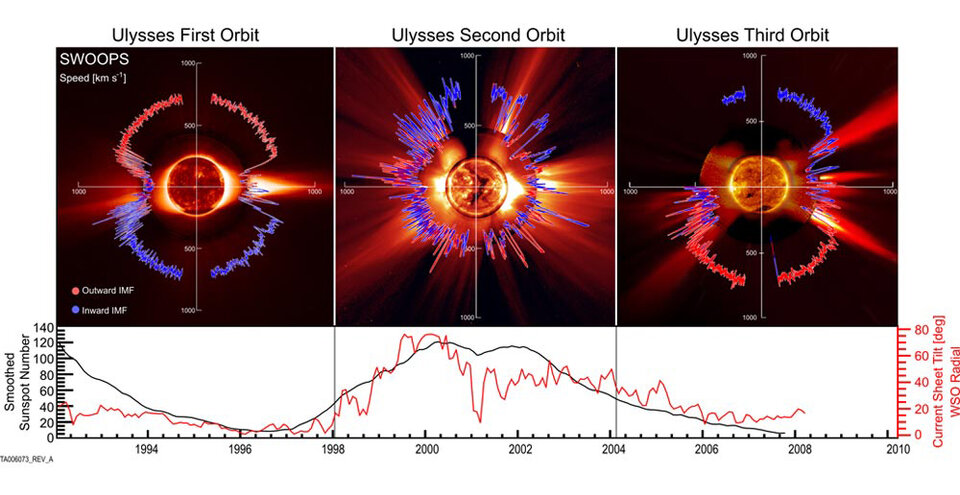
"The sun cycles between periods of great activity and lesser activity," Smith said. "Right now, we are in a period of minimal activity that has stretched on longer than anyone anticipated."
"These exciting results could only have been obtained by a spacecraft orbiting the poles of the Sun and are a perfect example of what makes Ulysses a unique mission," said Richard Marsden, ESA's Ulysses Project Scientist and Mission Manager.
The venerable spacecraft has lasted almost 18 years, or almost four times its expected mission lifetime. It was expected to end its operations in July this year, but is still working and collecting data. "Even though the end is now in sight, every day's worth of new data is adding to our knowledge of the Sun and its environment," added Marsden.
Notes for editors:
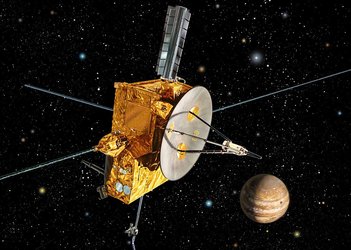
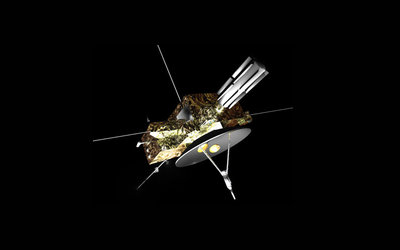
The Ulysses spacecraft was carried into Earth orbit in the cargo bay of the Space Shuttle Discovery on 6 October 1990. From Earth orbit, it was propelled toward Jupiter by a combination of solid-fuel motors. Ulysses passed Jupiter on 8 February 1992; the giant planet's gravity bent the spacecraft's flight path downward and away from the plane of the planets. This put it into a final orbit around the Sun that would take it over the Sun's north and south poles. The Ulysses solar wind findings were published in a recent edition of Geophysical Research Letters.
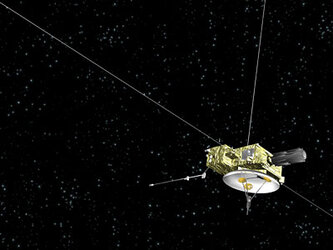
Ulysses is a joint ESA/NASA mission. ESA provided the spacecraft, built by Astrium GmbH, Friedrichshafen, Germany (formerly Dornier Systems). NASA provided the launch via the Space Shuttle and the upper stage boosters. The US Department of Energy supplied a radioisotope thermoelectric generator which powers the spacecraft; science instruments were provided by both US and European investigators. The spacecraft is operated from JPL by a joint ESA and NASA team.