• → European Space Agency

      • Space for Europe
      • Space News
      • Space in Images
      • Space in Videos
    • About Us

      • Welcome to ESA
      • DG's News and Views
      • For Member State Delegations
      • Business with ESA
      • ESA Exhibitions
      • ESA Publications
      • Careers at ESA
    • Our Activities

      • Space News
      • Observing the Earth
      • Human Spaceflight
      • Launchers
      • Navigation
      • Space Science
      • Space Engineering
      • Operations
      • Technology
      • Telecommunications & Integrated Applications
    • For Public

    • For Media

    • For Educators

    • For Kids

    • ESA

    • Venus Express

    • ESA Science

    • Europe goes to Venus

      • Tribute to the cryptic planet
      • Penetrating an impenetrable world
      • Past missions to Venus
    • About Venus Express

      • Venus Express mission facts
      • Venus Express objectives
      • The spacecraft
      • Orbiter instruments
      • The launcher
      • Operating Venus Express
    • About Venus

      • Venusian geography
      • The surface
      • Acid clouds and lightning
      • Greenhouse effect, clouds and winds
      • Venus compared to Earth
    • Meet the team

      • International collaboration
      • Project Manager: An interview with Don McCoy
      • Project Scientist: An interview with Håkan Svedhem
      • Launch Campaign Manager: An interview with Michael Witting
      • Spacecraft Operations Manager: An interview with Andrea Accomazzo
      • Venus Express Flight Control Team
      • Principal Investigators
    • Multimedia
    • Venus Express images
    • Venus Express videos
    • VideoTalk
    • 3D Flash 'model'
    • Build a model (pdf)
    • Wallpapers
    • Screensavers
    • Services
    • Comments

    ESA > Our Activities > Space Science > Venus Express

    Acid clouds and lightning

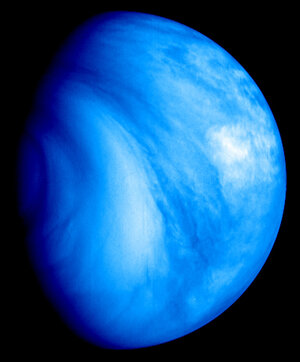
    Mariner 10 image of Venus cloud tops

    At around 60 kilometres altitude is a very thick cloud layer – a 20 kilometre-deep blanket surrounding the planet. It marks the limit between Venus’s lower and middle atmospheric layers. It is this yellowish layer that prevented for a long time Earth-based observatories and previous orbiter missions to see through.

    It is known today that the upper part of this layer is mostly composed of tiny droplets of sulphuric acid, but what is happening chemically in the lower clouds is still unknown. For instance, what is the origin of the large solid particles floating in the lower clouds observed by Pioneer-Venus?

    The Venus Express remote-sensing instruments will be able to see how the clouds are shaped and structured, how they form and evolve in time, how their opacity varies and what molecules they are made of. Local and global weather will be no secret for Venus Express.

    During previous ground and satellite observations, visible flashes in the atmosphere have been observed, and localised emissions of radio waves have also been reported. Are they due to lightning?

    The sulphuric acid droplets can be highly electrically charged, and so they offer the potential for lightning. This is very important, not only to learn whether it is possible that lightning has an influence on Venus atmospheric chemistry, but also to globally understand how the atmosphere of all terrestrial planets become electrified and then discharge.

    Where the sulphuric acid forms

    The higher layers of the atmosphere, between 60 and 200 kilometres altitude, are also still relatively unknown. We know that in the middle atmosphere (60-110 kilometres), above the cloud tops, carbon monoxide is in great abundance among the minor species. This is formed by dissociation of carbon dioxide by ultraviolet radiation coming from the Sun.

    Photo-dissociation of sulphur dioxide leads to the formation of sulphuric acid molecules that eventually form the cloud aerosols. Also limited amounts of oxygen and water vapour are present in the middle atmosphere. Studying the chemical cycles of these elements is important to understand the formation of the clouds below.

    Higher in the atmosphere, above 110 kilometres, the mysteries continue. In the higher atmosphere of a planet as close to the Sun as Venus, why do we measure temperatures as low as 30 °C on the day side, and even –160 °C on the night side?

    And why do such differences between day and night sides not cause the strong winds we would expect? This behaviour is unique in the Solar System.
    Rate this

    Views

    Share

    • Currently 0 out of 5 Stars.
    • 1
    • 2
    • 3
    • 4
    • 5
    Rating: 0/5 (0 votes cast)

    Thank you for rating!

    You have already rated this page, you can only rate it once!

    Your rating has been changed, thanks for rating!

    109
    facebook
    twitter
    reddit
    google plus
    digg
    tumbler
    digg
    blogger
    myspace
    • Looking at Venus
    • Launch replay
    • Venus Express launch
    • Related articles
      • Venus Express performs flawlessly, LEOP complete
        • Venus Express mission operations update
          • "Venus Express, give me a GO/NO GO for launch..."
            • Venus Express: ready for lift-off
              • Green light for Venus Express launcher fuelling
                • Venus Express countdown activities started
                  • Venus Express moved back to launch pad
                    • Venus Express set for transport to launcher assembly building
                      • Venus Express mated with upper-stage
                      • More about...
                      • Status reports
                      • Launch in detail
                        • Venus Express factsheet
                        • Related links
                        • Starsem - the Soyuz
                        • Venus Express operations
                        • Cebreros station webcam

    Connect with us

    • RSS
    • Youtube
    • Twitter
    • Flickr
    • Google Buzz
    • Subscribe
    • App Store
    • LATEST ARTICLES
    • · CryoSat hits land
    • · Ariane 5 completes seven launches …
    • · Measuring skull pressure without t…
    • · Malargüe station inauguration
    • · The solar wind is swirly
    • FAQ

    • Jobs at ESA

    • Site Map

    • Contacts

    • Terms and conditions