• → European Space Agency

      • Space for Europe
      • Space News
      • Space in Images
      • Space in Videos
    • About Us

      • Welcome to ESA
      • DG's News and Views
      • For Member State Delegations
      • Business with ESA
      • ESA Exhibitions
      • ESA Publications
      • Careers at ESA
    • Our Activities

      • Space News
      • Observing the Earth
      • Human Spaceflight
      • Launchers
      • Navigation
      • Space Science
      • Space Engineering
      • Operations
      • Technology
      • Telecommunications & Integrated Applications
    • For Public

    • For Media

    • For Educators

    • For Kids

    • ESA

    • Venus Express

    • ESA Science

    • Europe goes to Venus

      • Tribute to the cryptic planet
      • Penetrating an impenetrable world
      • Past missions to Venus
    • About Venus Express

      • Venus Express mission facts
      • Venus Express objectives
      • The spacecraft
      • Orbiter instruments
      • The launcher
      • Operating Venus Express
    • About Venus

      • Venusian geography
      • The surface
      • Acid clouds and lightning
      • Greenhouse effect, clouds and winds
      • Venus compared to Earth
    • Meet the team

      • International collaboration
      • Project Manager: An interview with Don McCoy
      • Project Scientist: An interview with Håkan Svedhem
      • Launch Campaign Manager: An interview with Michael Witting
      • Spacecraft Operations Manager: An interview with Andrea Accomazzo
      • Venus Express Flight Control Team
      • Principal Investigators
    • Multimedia
    • Venus Express images
    • Venus Express videos
    • VideoTalk
    • 3D Flash 'model'
    • Build a model (pdf)
    • Wallpapers
    • Screensavers
    • Services
    • Comments

    ESA > Our Activities > Space Science > Venus Express

    Greenhouse effect, clouds and winds

    Greenhouse effect on Venus
    Greenhouse effect on Venus

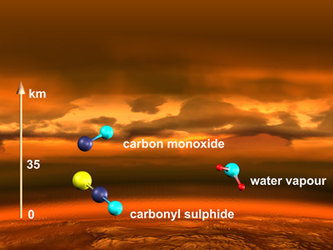
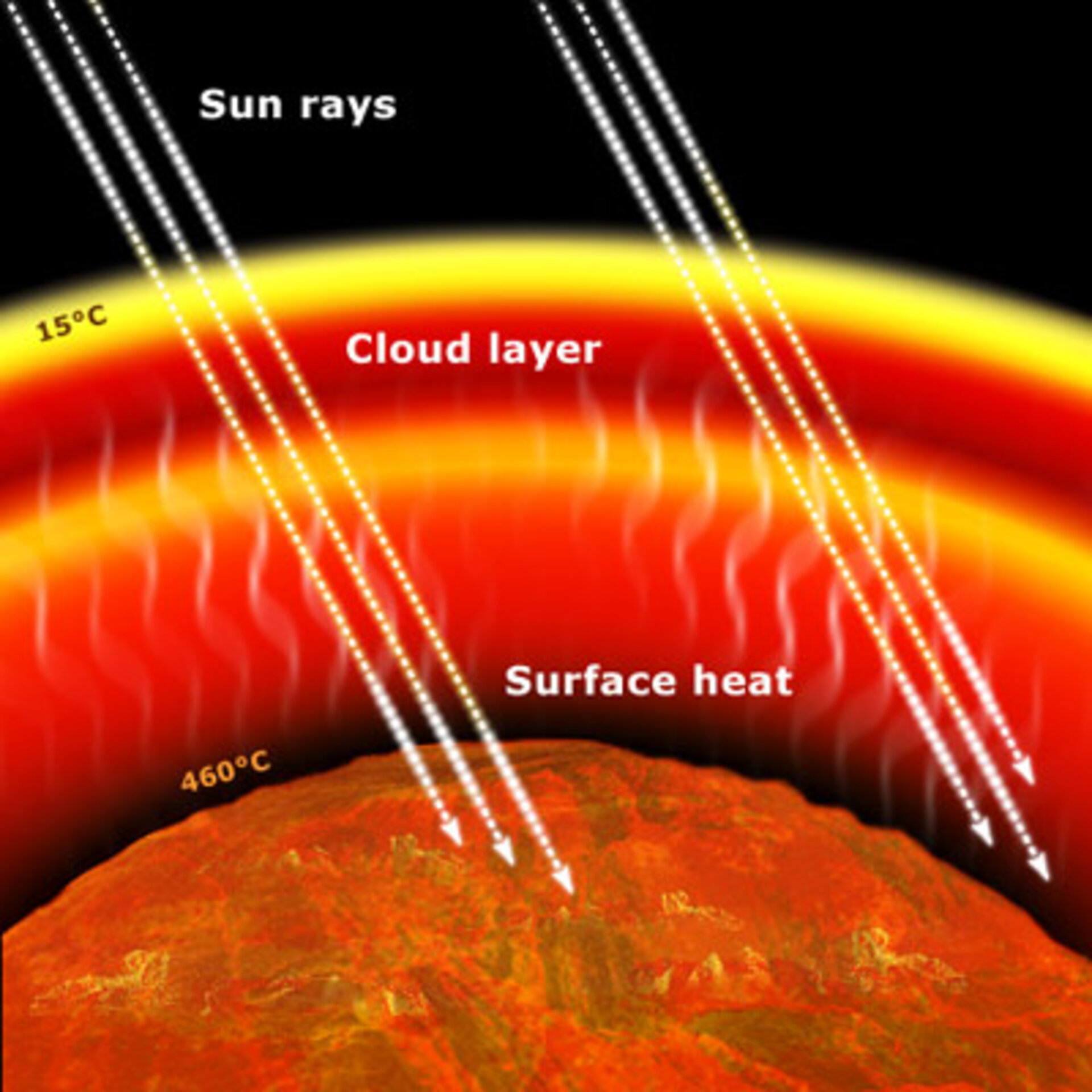
    On the global scale, Venus’s climate is strongly driven by the most powerful greenhouse effect found in the Solar System. The greenhouse agents sustaining it are water vapour, carbon dioxide and sulphuric acid aerosols.

    About 80% of the incoming solar radiation is reflected back to space by the cloud layer, about 10% is absorbed by the atmosphere and only 10% manages to get through it and heat the surface. However, the thermal radiation emitted by the surface gets trapped by the same atmosphere. The result is an amazing 500 °C difference between the surface and cloud-top temperatures.

    Are there other gases sustaining such an efficient planetary greenhouse? How is the heat transported from the surface to the cloud layer: through radiation or dynamic mechanisms such as turbulence?

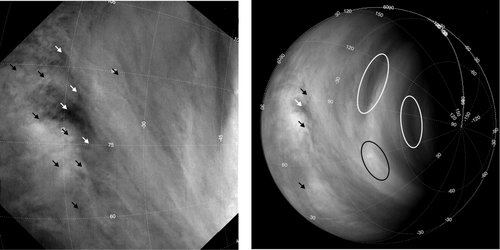
    Mysterious ultraviolet markings on the clouds

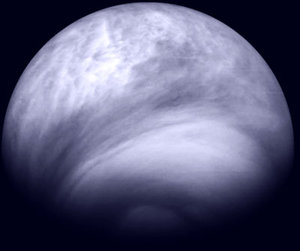
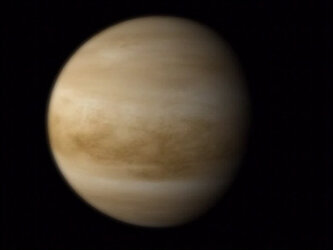
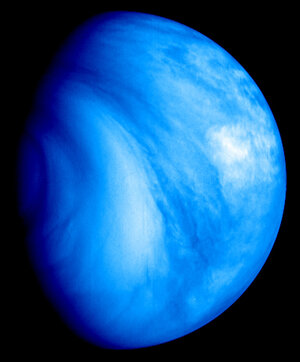
    Looking at Venus’s thick cloud layer in visible wavelengths would not reveal much. However, by looking at the clouds in other wavelengths, like infrared and ultraviolet light, a very different world appears.

    The clouds on Venus are very inhomogeneous in all directions. This is possibly due the formation of enormous cumulus-type clouds.

    Furthermore, the upper clouds are marked by areas visible in the ultraviolet light that mysteriously absorb half of the whole solar energy received by the planet.

    What is the origin of these ultraviolet markings? What makes their absorption power so high?


    Hurricane winds and huge atmospheric vortexes

    The lower atmosphere of Venus has a dramatic and peculiar behaviour. At the level of the cloud tops, the atmosphere rotates at a formidable velocity, with wind speeds up to 360 kilometres per hour.

    The speed of the winds then progressively decreases to almost zero at the planet surface, where it becomes a gentle breeze, only able to raise dust. What mechanisms cause this ‘zonal super-rotation’?

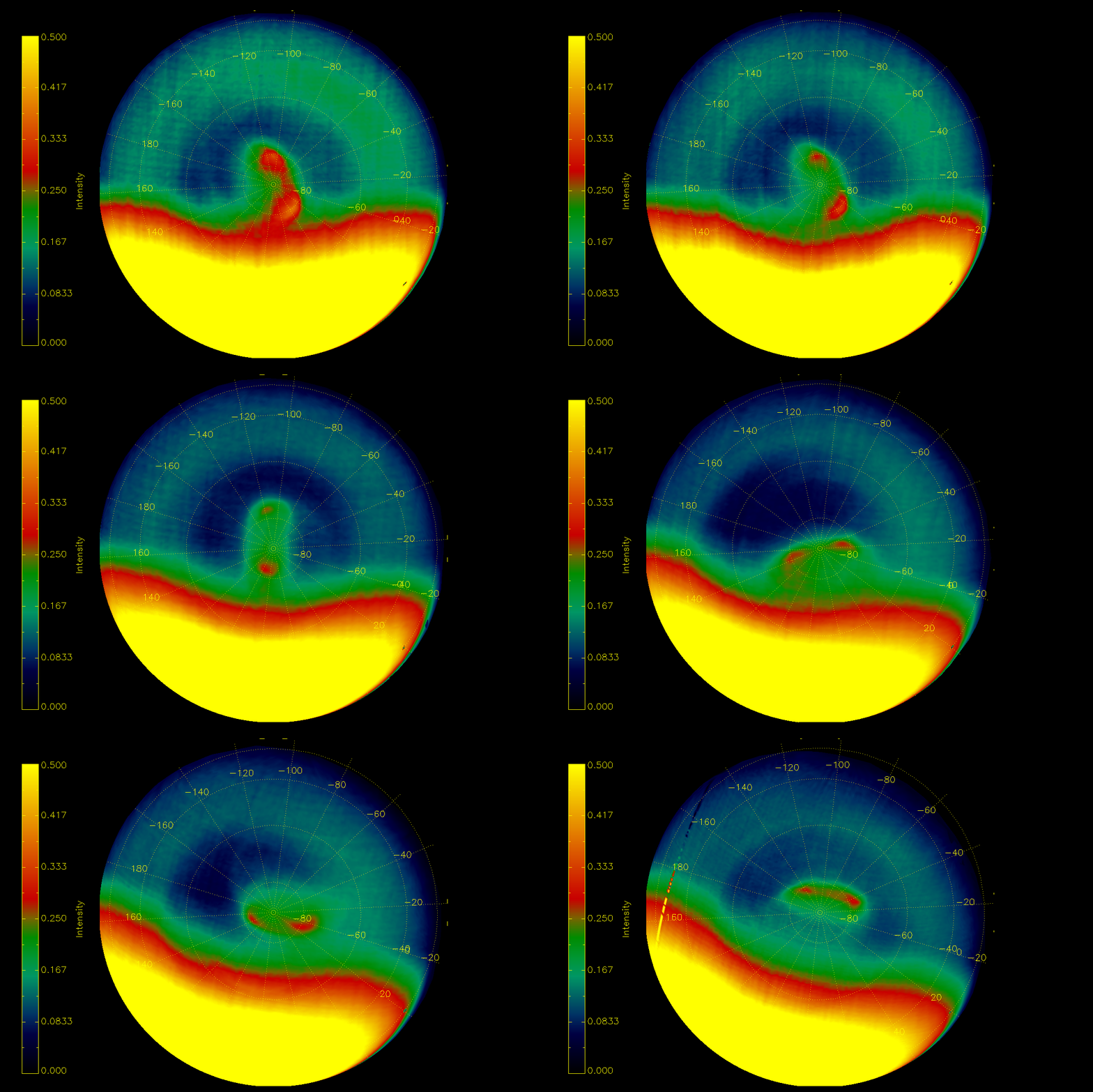
    Furthermore, two enormous vortices, with very complex shapes and behaviours, rotate vertically over the poles, recycling the atmosphere downwards. The vortex at the north pole, the only one previously observed in some detail, has a peculiar double ‘eye’ shape, surrounded by a collar of cool air. It completes a full rotation in only three Earth days.

    How are the super-rotation and the polar vortices linked? How does the global atmospheric circulation on Venus work? No model is able to simulate so far the dynamics of the atmosphere of Venus as too few data are available.
    Rate this

    Views

    Share

    • Currently 2 out of 5 Stars.
    • 1
    • 2
    • 3
    • 4
    • 5
    Rating: 2/5 (1 votes cast)

    Thank you for rating!

    You have already rated this page, you can only rate it once!

    Your rating has been changed, thanks for rating!

    97
    facebook
    twitter
    reddit
    google plus
    digg
    tumbler
    digg
    blogger
    myspace
    • Looking at Venus
    • Launch replay
    • Venus Express launch
    • Related articles
      • Venus Express performs flawlessly, LEOP complete
        • Venus Express mission operations update
          • "Venus Express, give me a GO/NO GO for launch..."
            • Venus Express: ready for lift-off
              • Green light for Venus Express launcher fuelling
                • Venus Express countdown activities started
                  • Venus Express moved back to launch pad
                    • Venus Express set for transport to launcher assembly building
                      • Venus Express mated with upper-stage
                      • More about...
                      • Status reports
                      • Launch in detail
                        • Venus Express factsheet
                        • Related links
                        • Starsem - the Soyuz
                        • Venus Express operations
                        • Cebreros station webcam

    Connect with us

    • RSS
    • Youtube
    • Twitter
    • Flickr
    • Google Buzz
    • Subscribe
    • App Store
    • LATEST ARTICLES
    • · CryoSat hits land
    • · Ariane 5 completes seven launches …
    • · Measuring skull pressure without t…
    • · Malargüe station inauguration
    • · The solar wind is swirly
    • FAQ

    • Jobs at ESA

    • Site Map

    • Contacts

    • Terms and conditions