Venus's surface
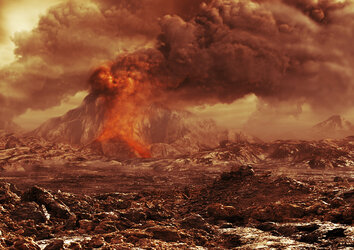
Venus is a hot, dry world, with landscapes shaped by volcanoes and intense geological activity. Picture vast plains marked by lava flows, bordered by highlands and mountains.
The surface of Venus is a scorching 464 °C on average, with a crushing air pressure 92 times bigger than we experience on Earth’s surface.
Alien volcanoes
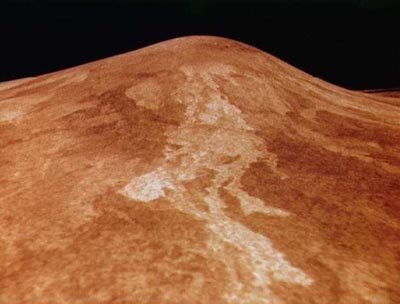
Venus appears to have been among the most geologically active planets in the Solar System. The surface doesn’t record any signs of its past history earlier than 500 million years.
It is as if the planet got an entirely new surface not long ago by some massive planetary crust phenomenon. Moreover, it also seems that some surface features have formed only recently. This may suggest that the planet may be still be internally active.
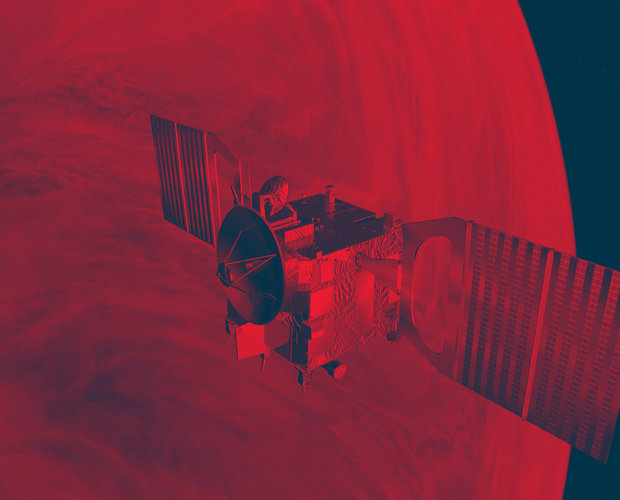
ESA's Venus Express mission addressed this question from several points of view, by analysing gases in the planet's atmosphere, and looking for temperature variations on its surface. For a summary of the mission's findings with respect to the prospects of recent volcanism, click here.
Envision, ESA's next mission to Venus, will study the planet from its inner core to its outer atmosphere. It will make the highest-resolution map of the Venusian surface yet, revealing how volcanoes, plate tectonics and asteroid impacts have shaped the Venusian surface, and how geologically active the planet is today. The mission will also investigate the planet's insides, collecting data on the structure and thickness of Venus's core, mantle and crust. Lastly, it will study the weather and climate on Venus, including how they are affected by geological activity on the ground.

A dry planet with no magnetic shelter
Being similar in mass and density, Venus and Earth very likely used to contain the same amount of ‘volatile’ substances such as water. However, while our blue planet has vast oceans, the surface and atmosphere of Venus are remarkably dry.
It is possible that a primordial ocean was vapourised at a certain point in Venus’s history. Venus Express confirmed that a large quantity of water from the Venusian atmosphere has been lost into space over billions of years.
This depletion occurs because water molecules in the upper atmosphere are broken up by incoming ultraviolet radiation from the Sun. This process creates two hydrogen atoms and one oxygen atom for each dissociated molecule. The solar wind – a stream of charged particles from the Sun – then strikes the upper atmosphere and carries the hydrogen and oxygen atoms into space.
Unlike Earth, Venus does not have a magnetic field to protect it from the continuous attack of solar wind. The only magnetic fields detected at the planet are local ones induced by the solar wind itself and possibly by magnetic materials in the surface.
Apart from escaping to space, it is also possible that some volatile substances have moved from the atmosphere to underground after recombining with Venus's surface.
Water is easily lost, and hard to recover. Small amounts of water may be supplied by comets or brought up from underground by volcanic activity, but Venus will never become a wet world.
Surface and atmosphere are strongly linked
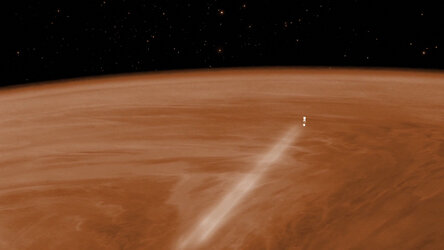
Venus’s atmosphere is extremely dense and strongly ‘coupled’ to the surface. Studying the atmosphere provides vasts amounts of information about Venus's surface, its geology and, indirectly, about the interior of the planet.
For example, gaseous emissions from the surface can tell us whether there are active volcanoes. We could look for a carbon dioxide (or even water) cycle, similar to the water cycle that moves water between Earth's surface and atmosphere. Or perhaps there is an important cycle of sulphuric acid and other sulphur compounds.
One may wonder: Is there any similarity between the ocean–atmosphere relationship on Earth and the surface–atmosphere relationship on Venus? Can mechanical waves propagating through the density of the atmosphere reveal to us the presence of seismic activity?