Where did Venus’s water go?
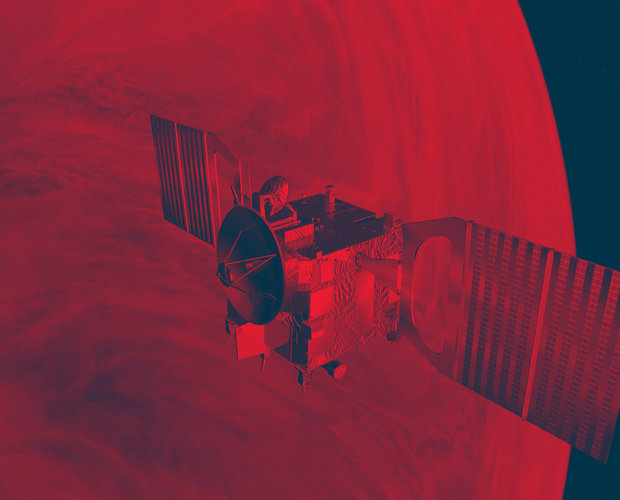
Venus Express has made the first detection of an atmospheric loss process on Venus's day-side. Last year, the spacecraft revealed that most of the lost atmosphere escapes from the night-side. Together, these discoveries bring planetary scientists closer to understanding what happened to the water on Venus, which is suspected to have once been as abundant as on Earth.
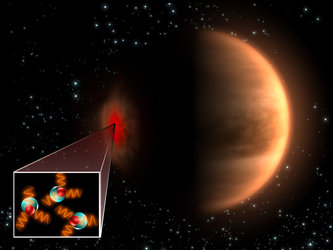
The spacecraft's magnetometer instrument (MAG) detected the unmistakable signature of hydrogen gas being stripped from the day-side. “This is a process that was believed to be happening at Venus but this is the first time we measured it,” says Magda Delva, Austrian Academy of Sciences, Graz, who leads the investigation.
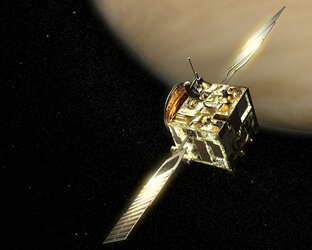
Thanks to its carefully chosen orbit, Venus Express is strategically positioned to investigate this process; the spacecraft travels in a highly elliptical path sweeping over the poles of the planet.
At Venus, the solar wind strikes the upper atmosphere and carries off particles into space. Planetary scientists think that the planet has lost part of its water in this way over the four and a half thousand million years since the planet’s birth.
Water is a key molecule on Earth because it makes life possible. With Earth and Venus approximately the same size, and having formed at the same time, astronomers believe that both planets likely began with similar amounts of the precious liquid. Today, however, the proportions on each planet are extremely different. Earth’s atmosphere and oceans contain
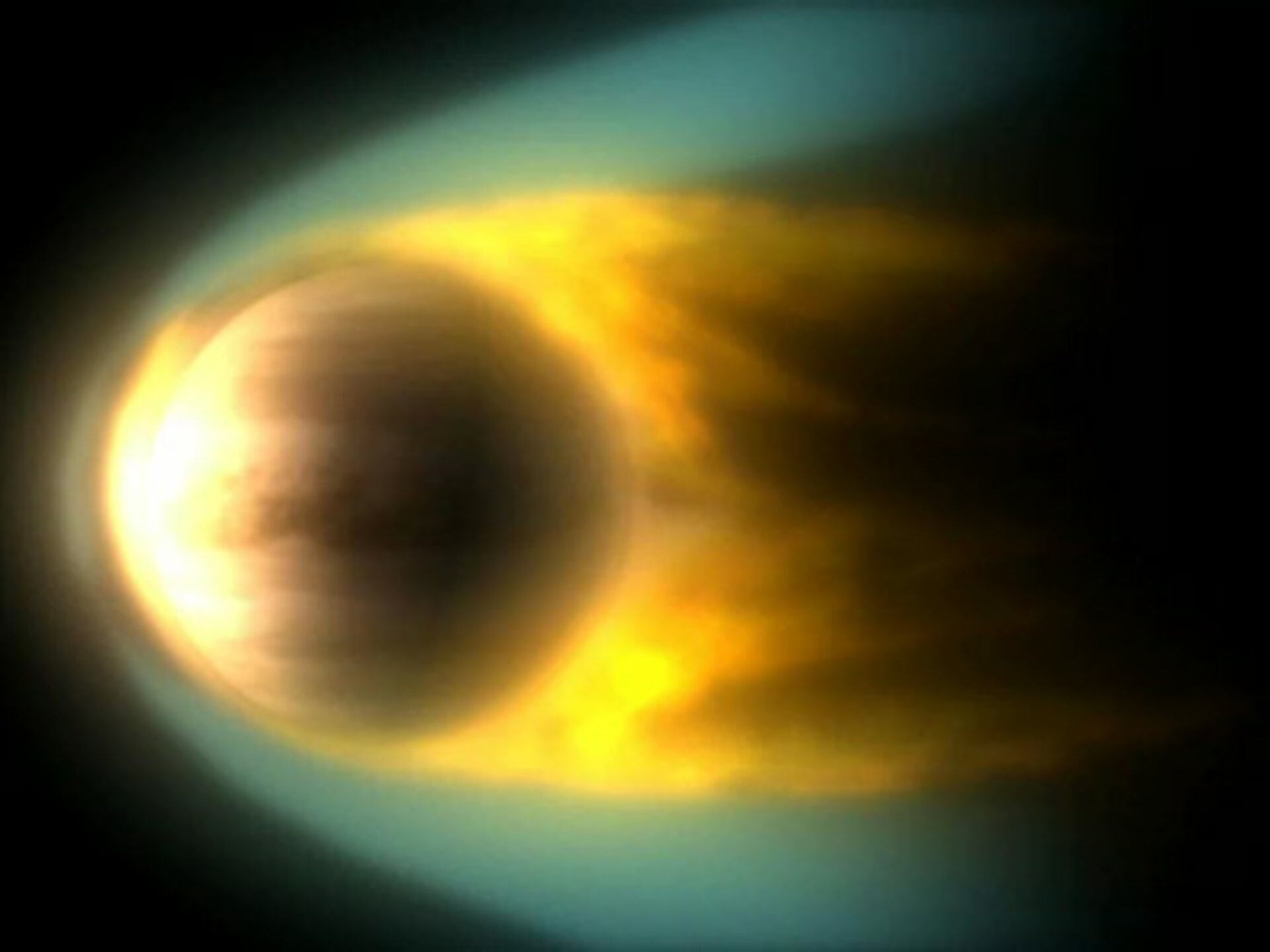
Last year, the Analyser of Space Plasma and Energetic Atoms (ASPERA) on board Venus Express showed that there was a great loss of hydrogen and oxygen on the night-side. Roughly twice as many hydrogen atoms as oxygen atoms were escaping. Because water is made of two hydrogen atoms and one oxygen atom, the observed escape indicates that water is being broken up in the atmosphere of Venus.
The Sun not only emits light and heat into space, it constantly spews out solar wind, a stream of charged particles. This solar wind carries electrical and magnetic fields throughout the Solar System and ‘blows’ past the planets.
Unlike Earth, Venus does not generate a magnetic field. This is significant because Earth’s magnetic field protects its atmosphere from the solar wind. At Venus, however, the solar wind strikes the upper atmosphere and carries off particles into space. Planetary scientists think that the planet has lost part of its water in this way over the four-and-a-half-thousand million years since the planet’s birth.

“We do see water escaping from the night-side but the question remains, how much has been lost in the past in this way,” says Stas Barabash, Swedish Institute of Space Physics, Kiruna and Principal Investigator of ASPERA, that looked at night-side data.
The discovery takes scientists a step towards understanding the details, but it does not provide the last piece of the puzzle. To be certain that the hydrogen is coming from water, Delva and colleagues must also detect the loss of oxygen atoms on the day-side and verify that there are approximately half as many leaving Venus as hydrogen.
So far, this has not been possible. “I keep looking at the magnetometer data but so far I can’t see the signature of oxygen escaping on the day-side,” says Delva.
It also highlights a new mystery. “These results show that there could be at least twice as much hydrogen in the upper atmosphere of Venus than we thought,” says Delva. The detected hydrogen ions could exist in atmospheric regions high above the surface of the planet; but the source of these regions is unknown.
So like a true lady, Venus still retains some of her mystery.
Notes for editors:
These findings appear in, 'First upstream proton cyclotron wave observations at Venus' by M. Delva, T. Zhang, M. Volwerk, W. Magnes, C. Russell and H. Wei, published in the Geophysical Research Letters.
For more information:
Magda Delva, Austrian Academy of Sciences
Email: Magda.Delva @ oeaw.ac.at
Stas Barabash, Swedish Institute of Space Physics
Email: Stas @ irf.se
Håkan Svedhem, ESA Venus Express Project Scientist
Email: Hakan.Svedhem @ esa.int