• → European Space Agency

      • Space for Europe
      • Space News
      • Space in Images
      • Space in Videos
    • About Us

      • Welcome to ESA
      • DG's News and Views
      • For Member State Delegations
      • Business with ESA
      • ESA Exhibitions
      • ESA Publications
      • Careers at ESA
    • Our Activities

      • Space News
      • Observing the Earth
      • Human Spaceflight
      • Launchers
      • Navigation
      • Space Science
      • Space Engineering
      • Operations
      • Technology
      • Telecommunications & Integrated Applications
    • For Public

    • For Media

      • Media
      • ESA TV
      • Videos for professionals
      • Photos
    • For Educators

    • For Kids

    • ESA

    • Space Science

    • Our Universe
    • About Space Science
    • ESA's 'Cosmic Vision'
    • Science missions
    • Mission navigator
    • Target groups
    • For Media
    • For Scientists
    • For Kids
    • Multimedia
    • Science images
    • Science videos
    • Animations
    • Downloads
    • Sounds from space
    • Resources
    • Reference section
    • Services
    • FAQs
    • Glossary
    • Help
    • Portal terms of use
    • Comments
    • Follow us
    • RSS feeds
    • ESA Sci on Twitter
    • ESA Space Science Images on Flickr
    • ESA 3D on Flickr

    ESA > Our Activities > Space Science

    What is the Universe made of?

    Galaxy cluster RXJ0847
    Distant galaxy cluster RXJ0847, as studied by XMM-Newton
    16 December 2003

    The Universe is thought to consist of three types of substance: normal matter, ‘dark matter’ and ‘dark energy’.

    Normal matter consists of the atoms that make up stars, planets, human beings and every other visible object in the Universe.

    As humbling as it sounds, normal matter almost certainly accounts for the smallest proportion of the Universe, somewhere between 1% and 10%.

    In the currently popular model of the Universe, 70% is thought to be dark energy, 25% dark matter and 5% normal matter. But ESA’s X-ray observatory, XMM-Newton, has returned new data about this content. XMM-Newton has found puzzling differences between today’s clusters of galaxies and those in the Universe around seven thousand million years ago.

    Some scientists interpret this to mean that the ‘dark energy’ which most astronomers now believe dominates the Universe simply does not exist.


    Clusters of galaxies emit lots of X-rays because they contain a large quantity of high-temperature gas. By measuring the quantity of X-rays from a cluster, astronomers can work out both the temperature of the cluster gas and also the mass of the cluster.

    XMM-Newton
    XMM-Newton

    Theoretically, in a Universe where the density of matter is high, clusters of galaxies would continue to grow and so, on average, should contain more mass now than in the past.

    Most astronomers believe that we live in a low-density Universe in which a mysterious substance known as ‘dark energy’ accounts for 70% of its content, and therefore, pervades everything.

    In this scenario, clusters of galaxies should stop growing early in the history of the Universe and look virtually indistinguishable from those of today.
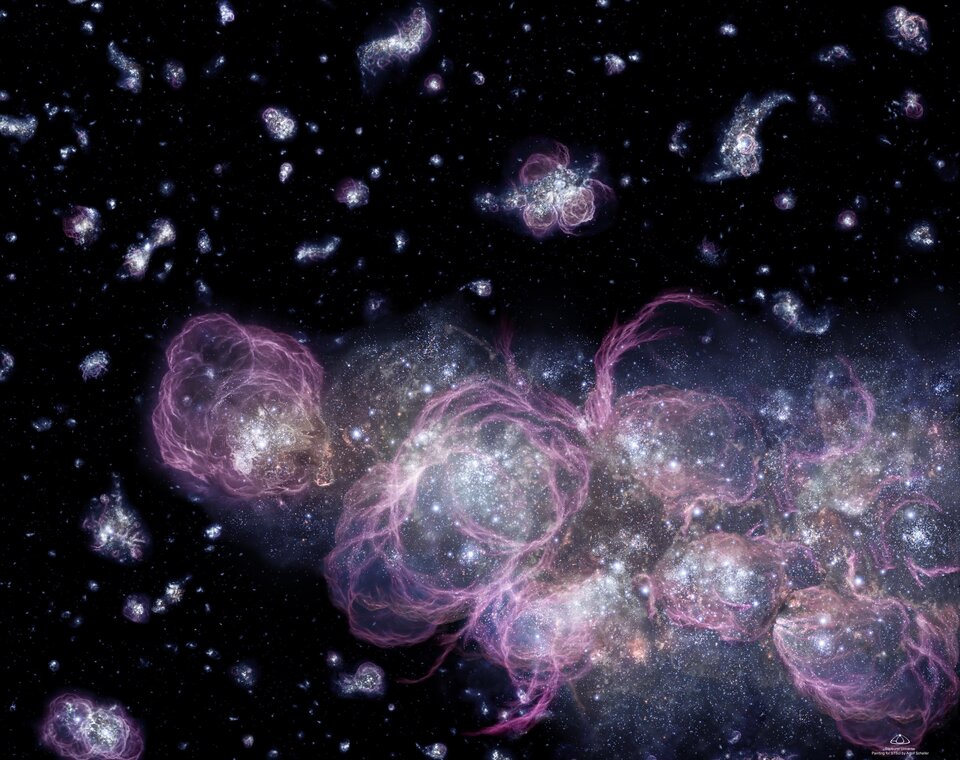
    Artist's impression of  very early Universe
    Artist's impression of how the very early Universe might have looked

    Astronomers using ESA’s XMM-Newton have shown that clusters of galaxies in the distant Universe are not like those of today. They seem to give out more X-rays than expected.

    These clusters of galaxies have changed their appearance with time, and calculations also show that in the past there were fewer galaxy clusters.

    This indicates that the Universe must be a high-density environment, contradicting current ideas. This conclusion is highly controversial, because to account for these results you have to have a lot of matter in the Universe and that leaves little room for dark energy.

    XMM-Newton has given astronomers a new insight into the Universe and a new mystery to puzzle over. These results are being confirmed by other X-ray observations and, if these return the same answer, we might have to rethink our understanding of the Universe.

    Rate this

    Views

    Share

    • Currently 3.5 out of 5 Stars.
    • 1
    • 2
    • 3
    • 4
    • 5
    Rating: 3.5/5 (2 votes cast)

    Thank you for rating!

    You have already rated this page, you can only rate it once!

    Your rating has been changed, thanks for rating!

    1134
    Tweet
    • More about...
      • XMM-Newton overview
      • Related articles
        • Observations: Seeing in X-ray wavelengths
          • So, how did everything start?
            • What are 'dark matter' and 'dark energy'?
              • Observations: Seeing in the gamma-ray wavelengths

    Connect with us

    • RSS
    • Youtube
    • Twitter
    • Flickr
    • G+
    • Facebook
    • Livestream
    • Subscribe
    • App Store
    • ESA Science Twitter

    Follow ESA science

    • LATEST ARTICLES
    • · Rare merger reveals secrets of gal…
    • · Watching for hazards: ESA opens as…
    • · ESA astronaut Timothy Peake set fo…
    • · Space drives e-mobility
    • · Proba-V opens its eyes
    • FAQ

    • Jobs at ESA

    • Site Map

    • Contacts

    • Terms and conditions