2010 campaign schedule
A. Project definition and writing of proposal by selected applicants
During this phase, the applicants will compose their team, find an endorsing professor or academic supervisor and start to think about their project.
After defining their project, the students must consider in detail how the experiment will be realised. At the end of this process, they will be expected to have a very accurate knowledge of the scientific theory related to their project, as well as the way they will realise their experiment – both in a qualitative and quantitative way.
The experiment proposal will focus on the scientific and technical aspects of the project. Through this document, the students will show that they have a very good knowledge of their project topic, using references to bibliography and scientific literature in the field and giving the details of the results expected.
Documents expected: Experiment proposal
Deadline: 21 January 2010
B. Review of the proposal and selection of the winning teams
The Review Board will select the best experiments to be performed in the LDC and propose some support from a microgravity expert through a mentorship programme, in collaboration with ELGRA. Final selection of four teams and the allocation of ELGRA mentors are expected respectively end of February 2010 and mid-March 2010.
C. Experiment preparation
Based on the proposal, the selected teams start to implement and build their experiment rack, helped by qualified professionals and their ELGRA mentor. The cost of the building will be partly supported by ESA Education Office. The students should prepare the experiment by taking into account the "LDC Experimenter User Manual" and by consultation with LDC engineers.
D. Education Hyper-Gravity Campaign
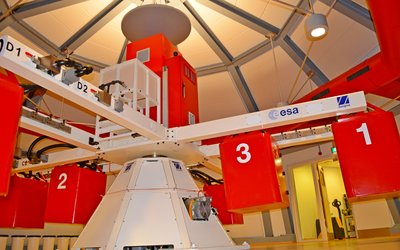
Selected teams will realise their experiment during spring or summer 2010. ESA’s first Student Large Diameter Centrifuge campaign will take place in ESTEC, Noordwijk, The Netherlands. This campaign will last two weeks and each week there will be two student teams using the LDC for a few hours or days.
E. Analysis of results
The teams will analyse the results obtained during the hypergravity campaign and send a report to the ESA Education Office with their feedback on the programme and their results within 3 months of performing their experiments. Eventually, they will write a scientific paper co-authored by their ELGRA mentor. Some students may also be sponsored to attend international conferences (such as the ELGRA Biennial Symposium) and present their results to the scientific community.