Student teams selected for 'Spin Your Thesis!'
Four teams of university students have been selected to develop and perform their hypergravity experiments during ESA’s first ‘Spin your Thesis!’ campaign.
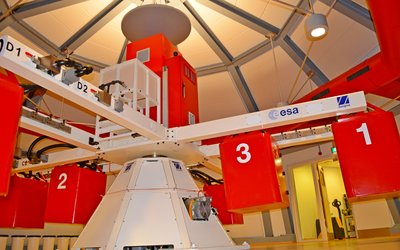
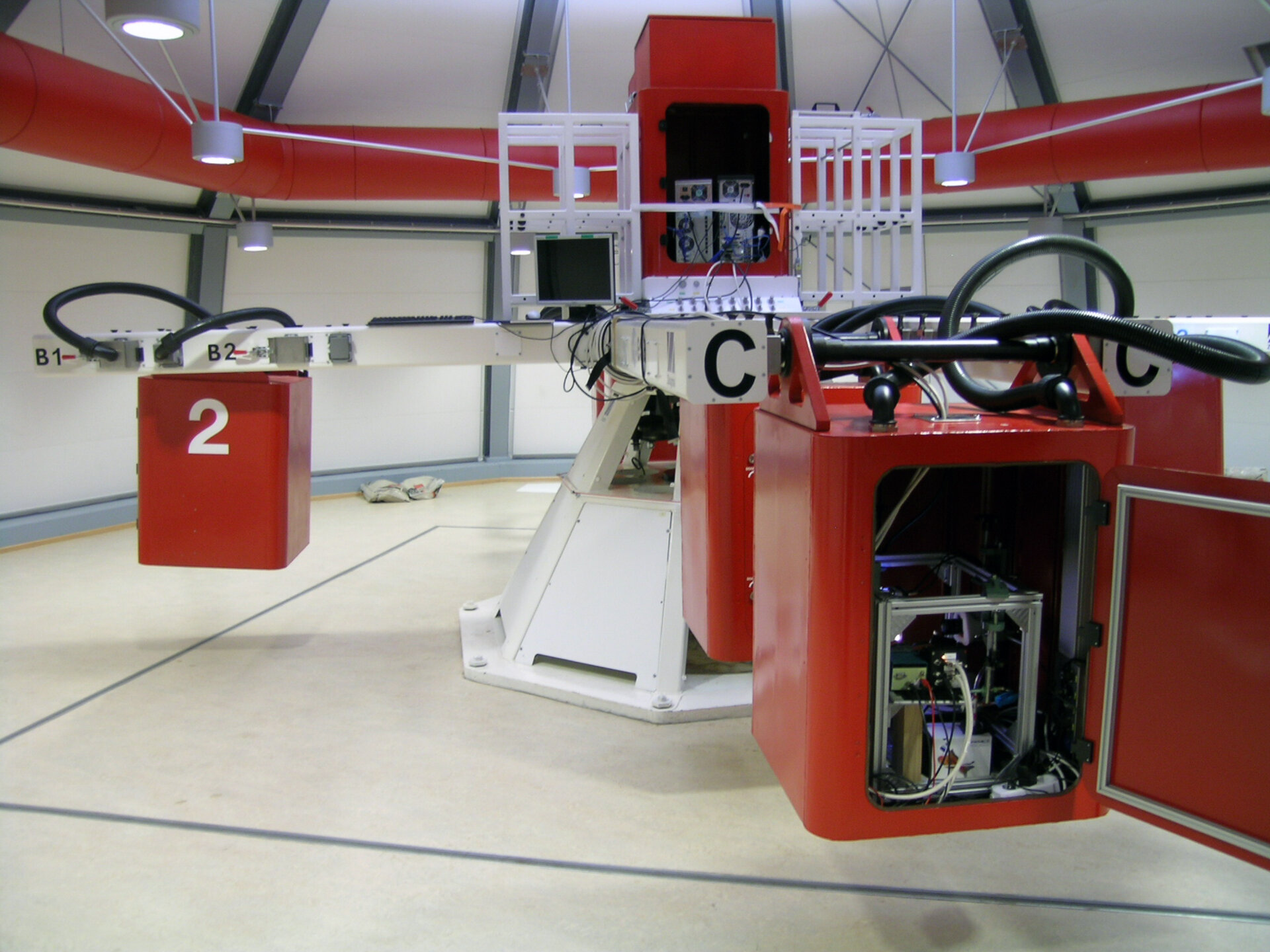
The programme will enable the students to carry out experiments using the Large Diameter Centrifuge facility at ESA’s European Space Research and Technology Centre (ESTEC) in Noordwijk, the Netherlands.
After careful evaluation of the experiment proposals, a review board comprising experts from ESA’s Education Office, ESA’s Directorate of Technical and Quality Management and the European Low Gravity Research Association (ELGRA) finally selected four student teams.
The chosen teams are:
HyperMuscle Three students from the Scuola Superiore Sant’Anna in Pisa, Italy, will investigate the effects of hypergravity on the proliferation, metabolism and differentiation of muscle cells. The results could improve our understanding of potential modifications in the skeletal muscle physiology of astronauts during the hypergravity phases of their mission.
LINV-UNIFI Three students from the University of Florence in Italy will study the effect of a period of acclimation to a higher gravity level on the physiological response of root apices that are subjected to different levels of hypergravity. This study is intended to confirm and improve our understanding of the role of hypergravity as a source of stress for plants.
Team Impact Four students from the University of Glasgow in the United Kingdom will reproduce and investigate the physical conditions during large scale, low velocity cratering impact events on highly porous asteroids and other small bodies. The data collected from this experiment may be applicable to the design of future asteroid impactors and sample return mechanisms.
ETH Space Biology Two students, one from the ETH Zurich in Switzerland and another from the University of Konstanz in Germany, will investigate the behaviour of cell models under hypergravity conditions, using electrophysiological methods to find out which transport mechanisms are affected by gravitational change. Studies of this type will be the basis for effective countermeasures against muscle atrophy under microgravity.
The first ‘Spin your Thesis!’ campaign is scheduled to take place in spring or summer 2010 and will last two weeks, with two teams using the equipment each week. During the preparation of the experiments, the student teams will be supported by an ELGRA mentor, who will share his expertise in gravity-related research.