ESAExhibitions
   
Thematic minigalleries
The Enigma of Life, texts and imagesBest of Science
Posters
ESA Science VisualsEurope lifts the veil on Venus
Science Posters Archive
Europe goes to MarsJourney to TitanEurope goes to the MoonExoMars
Magic Books
The Secrets of the Universe, interactive bookThe Enigma of Life, interactive book
Slideshows
Astronomy slideshowSolar System slideshowEurope goes to MarsEurope discovers a new world Bookmark and Share


ESA Science Visuals

These three visuals give an overview of past, current and future ESA missions to explore the Solar System and study the Universe.

Files below are available in print-ready version for the following formats:

Horizontal: 400x200 cm

Vertical: 98x247 cm

The images can be also be downloaded separately from the Best of Science images gallery, using the link on the left menu.

Use the links on the left menu to see extracts and download all ESA material for exhibitions during IYA2009.

To thumbnails
prev page1 | 2 | 3 | 4 | 5 | 6next page
HI-RES JPEGHI-RES TIFF
Caption:
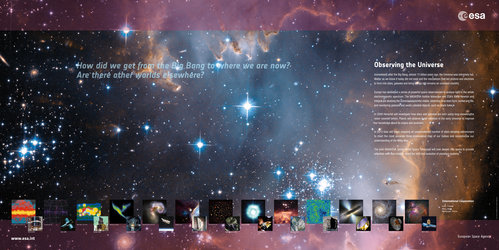
Observing the Universe
Credits:
ESA, NASA/ESA, ESA / V. Beckmann (NASA-GSFC)
ID number:
SEMEPFITYRF
HI-RES JPEG size:
1326 kb
HI-RES TIFF size:
160 831 kb
Description
Observing the Universe

Immediately after the Big Bang, almost 15 billion years ago, the Universe was extremely hot. Matter as we know it today did not exist and the mechanism that led protons and electrons to form into stars, galaxies and living beings still remains an unsolved mystery.

Europe has developed a series of powerful space observatories to analyse light in the whole electromagnetic spectrum. The NASA/ESA Hubble telescope and ESA’s XMM-Newton and Integral are studying the Universe beyond the visible, observing how stars form, evolve and die, and monitoring galaxies and exotic celestial objects, such as black holes.

In 2009 Herschel will investigate how stars and galaxies are born using long-wavelengths never covered before. Planck will observe fossil radiation in the early Universe to improve our knowledge about its origins and evolution.

In 2013 Gaia will map an unprecedented number of stars allowing astronomers to chart the most accurate three-dimensional map of our Galaxy and revolutionise our understanding of the Milky Way.

The joint NASA/ESA James Webb Space Telescope will look deeper into space to provide scientists with new insights about the birth and evolution of planetary systems.

To thumbnails
prev page1 | 2 | 3 | 4 | 5 | 6next page


   Copyright 2000 - 2010 © European Space Agency. All rights reserved.