Ariane 5 ES

| Main data | Ariane 5 ES Galileo |
|---|---|
| Height | up to 50 m |
| Diameter | up to 5.4 m |
| Liftoff mass | 760 t |
| Payload mass (including dispenser) | 3400 kg (2950 kg + 450 kg for dispenser) |
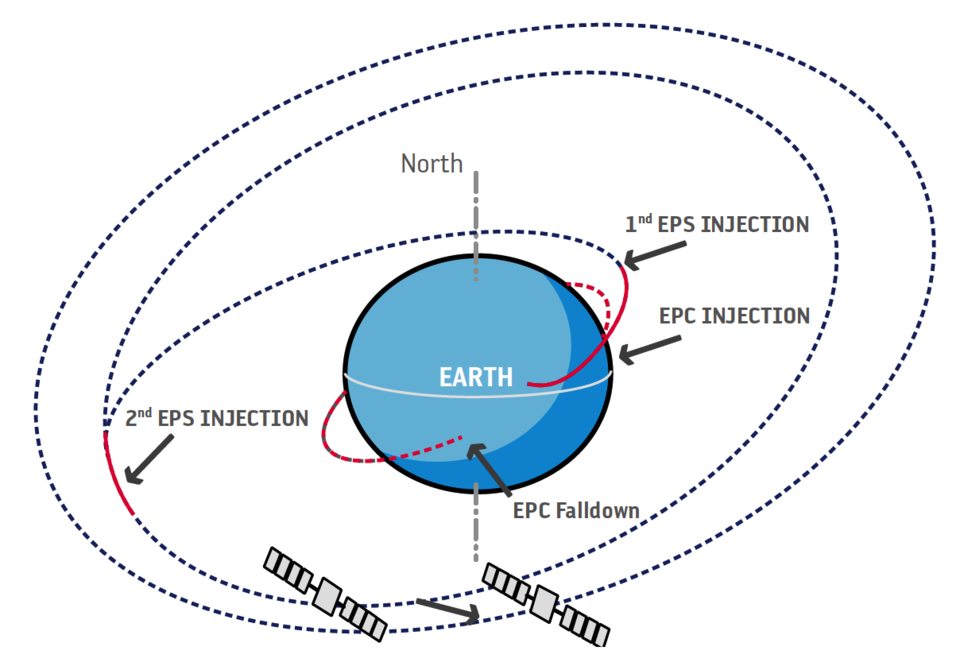
The Ariane 5 ES (Evolution Storable) was derived from the generic Ariane 5 but used a more powerful lower composite and a small upgraded storable propellant stage, allowing reignition and long coast phases.
This reignition capability enabled the injection of a cluster of Galileo satellites into their operational orbit.
After releasing its payload, a final burn allowed the empty upper stage to deorbit and burn up in the Earth’s atmosphere or move into another safe ‘graveyard orbit’.
Ariane 5 ES missions
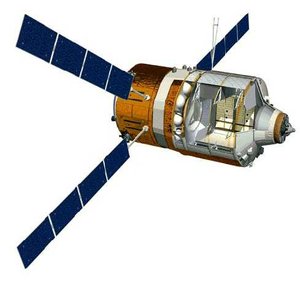
The inaugural flight of the Ariane 5 ES took place on 9 March 2008 with the first Automated Transfer Vehicle (ATV) mission, Jules Verne.
This was followed by four more: Johannes Kepler on 16 February, 2011; Edoardo Amaldi in 2012; Albert Einstein in 2013; and Georges Lemaître in 2014. Each ATV weighed more than 20 tonnes and carried supplies to the International Space Station.
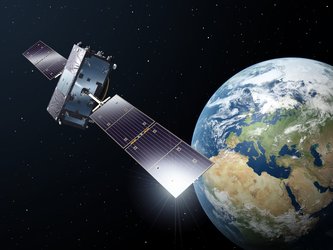
On 17 November 2016, the Ariane 5 ES Galileo was used to accelerate the deployment of Europe’s new satellite navigation system, Galileo.
In development since 2012, this new Ariane variant evolved from the version used to place ESA’s 20 t ATV supply vehicle into low orbit.
The new launcher had to carry a lighter payload (about three tonnes) but needed to take it up to the much higher altitude of 23 522 km.
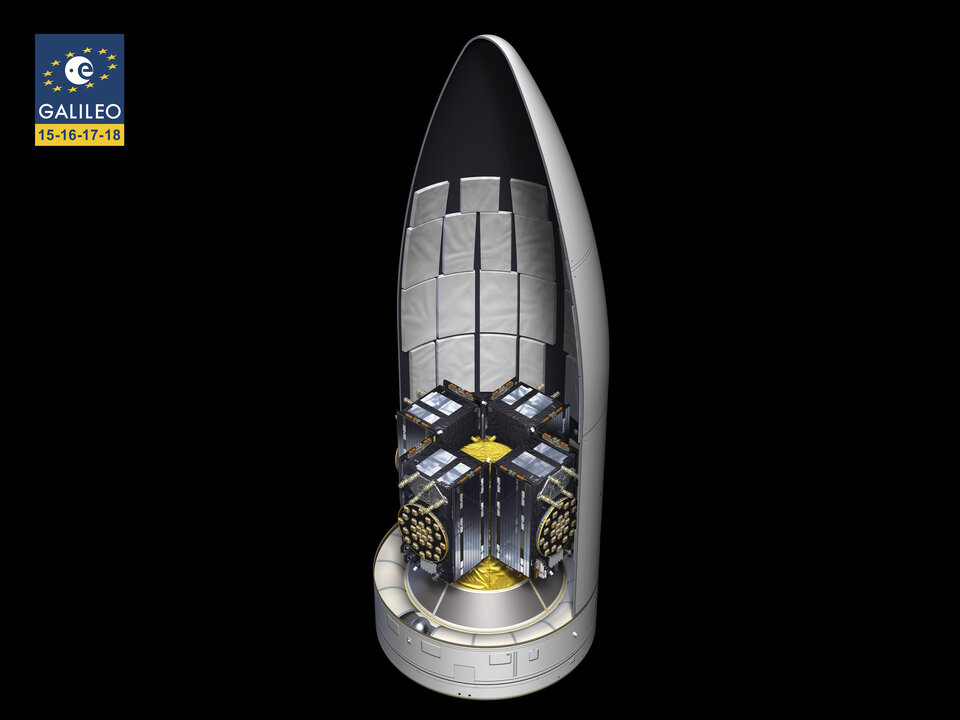
The dispenser built for Galileo missions had a double role. Firstly it had to hold the quartet of satellites securely in place during the loads induced by the liftoff, and then the nearly four-hour long flight to medium-Earth orbit.
Once the Ariane 5 EPS upper stage reached its target altitude, the dispenser had to release the four Galileo satellites smoothly in pairs with a 20-minute interval using a pyrotechnic release system triggered by separate igniters, each one firing half a second after the other.
While the four Galileos manoeuvred themselves down to their final set height, Ariane’s upper stage was left in a stable ‘graveyard orbit’ which does not interfere with the Galileo operational orbit.
Ariane 5 ES elements
The Ariane 5 ES had three parts:
- The launcher upper part comprised of:
- Fairing (long version for ATV and medium version for Galileo);
- Launch vehicle payload adaptor accommodating one heavy payload or a dispenser with multiple satellites.
- The upper composite comprised of:
- Storable propellant stage (EPS) containing 10 t of propellant (MMH: monomethyl hydrazine and N2O4: dinitrogen tetroxide) with the Aestus engine providing 2.7 t of thrust;
- The Vehicle Equipment Bay (VEB), ‘the brain’, providing autonomous control of all the systems during all mission phases;
- The lower composite was identical to the one used on Ariane 5 ECA.
The Ariane 5 ES Galileo was derived from the Ariane 5 ES. The main differences were:
- the mission reached medium-Earth orbit for Galileo;
- the medium fairing size;
- a dispenser developed for Galileo carrying four satellites;
- a lighter Vehicle Equipment Bay (VEB) structure improving launcher performance;
- the EPS tank loading (full for Galileo; half-full for ATV)
- thermal and electrical adaptations of equipments in order to comply with long ballistic phase at high altitude (more than four hours in total compared to ATV which was about one hour) and with the specific upper part.