ESAESA ScienceMars Express
   
Contents
Water and life
Europe goes to Mars
About Mars Express
About Mars
Meet the team
Multimedia
VideoTalkMars Express imagesMars Express videosHRSC videosAnimation in 11 languagesDownload wallpapersDownload screensavers3D Flash 'model'Make a model
Services
Comments


printer friendly page
Topography of Mars
Topography of Mars
A small planet with dramatic landscapes
 
Although Mars is a small planet – its radius is just a little over half the Earth's – we now know that it boasts scenery on a scale that makes Mount Everest and the Grand Canyon seem unimpressive by comparison.
 
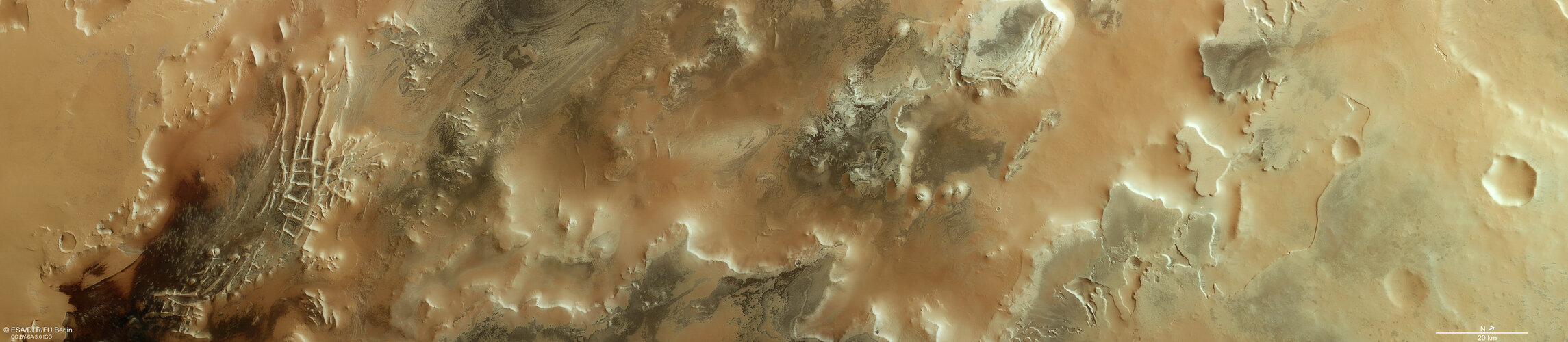
It has the highest volcano in the solar system, Olympus Mons which stands at 26 km above the surrounding plain: Mount Everest is only one third as high. Olympus Mons lies at the western edge of another gargantuan feature, the Tharsis dome which is a 10 km high, 4000 km wide bulge in the martian surface.

Running from the eastern flanks of the rise, roughly along the equator, is Valles Marineris, a split in the martian crust 4000 km long (about a fifth of the martian circumference), up to 600 km wide and 7 km deep. The Grand Canyon is a mere 450 km long, up to 29 km wide and 1.6 km deep.

Then there is the Hellas Basin in the southern hemisphere, which is an enormous impact crater 2300 km in diameter and more than 9 km deep. But perhaps most striking of all is the general difference in height and surface roughness between the northern and southern hemispheres. The northern hemisphere is smooth and flat and on average 6 km lower than the rugged highlands of the south.  
 
Olympus Mons volcano
Olympus Mons, 25 kilometres high, is the highest volcano in the Solar System
Water and life
 
Three decades of space exploration have also revealed that Mars is a cold, dry place with a thin atmosphere, consisting mainly of carbon dioxide. There is evidence, though, that conditions were very different early in the planet's history (3.8 billion years ago). Mars may once have been warm and wet.

If liquid water did flow on early Mars, could life have evolved there? The more we know about life on Earth, the more likely it seems that life could exist elsewhere. Over recent years, micro-organisms have turned up in the most inhospitable niches on Earth, where nobody previously thought anything could survive.
 
 
An energy source and water seem to be the only two essential prerequisites for life common to these niches. Water may once have flowed freely on Mars and, like the Earth, the planet receives sunlight and has its own internal energy source. So the odds on primitive life thriving for at least some time during the planet’s history are reasonably good.


The martian meteorite ALH 84001
 
 
This image may show evidence of recent underground water seepage
 
 
Frozen water and carbon dioxide over Martian poles
 
 
Could these layers, recently identified by MGS, be sediments deposited on ancient lake or ocean beds?
 
 
The splatter marks surrounding this impact crater suggest that the ground was water


   Copyright 2000 - 2009 © European Space Agency. All rights reserved.