ESA and the EU
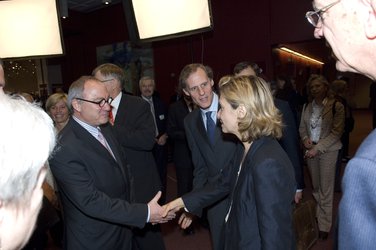
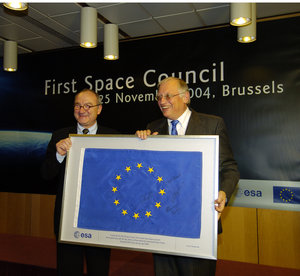
The European Commission (EC) and ESA share a common aim: to strengthen Europe and benefit its citizens. The two organisations are linked by a strong and growing relationship and a Framework Agreement providing the legal basis for cooperation between the two institutions entered into force in May 2004, for a period of four years.
ESA is an intergovernmental organisation with no formal organic link to the EC, indeed the two institutions have different Member States and are governed by different rules and procedures. However, in recent years the ties between the two institutions have been reinforced by the increasing role that space plays in strengthening Europe’s political and economic role, and in supporting European policies. To facilitate relations between the two organisations, ESA set up a liaison office in Brussels, the site of the EC.
Raising political awareness

The need to reinforce Europe’s capabilities in space is becoming ever more apparent as Europeans rely on satellites for communication, navigation, monitoring the environment, developing innovative technology and increasing scientific knowledge.
Beyond the development of joint initiatives between the two institutions, the EC has a major role to play in heightening political awareness of space and in ensuring a regulatory framework to support the development of space activities.
Increasing cooperation

Closer ties and an increase in cooperation between ESA and the EC will bring substantial benefits to Europe by guaranteeing Europe’s full and unrestricted access to services provided by space systems for its policies, and encouraging the increasing use of space to improve the lives of its citizens.
Recent joint initiatives include the European global navigation satellite system called Galileo, as well as the Global Monitoring for Environment and Security services, known as GMES, that was endorsed by ESA’s December 2005 Ministerial Council in Berlin.
New European dimension
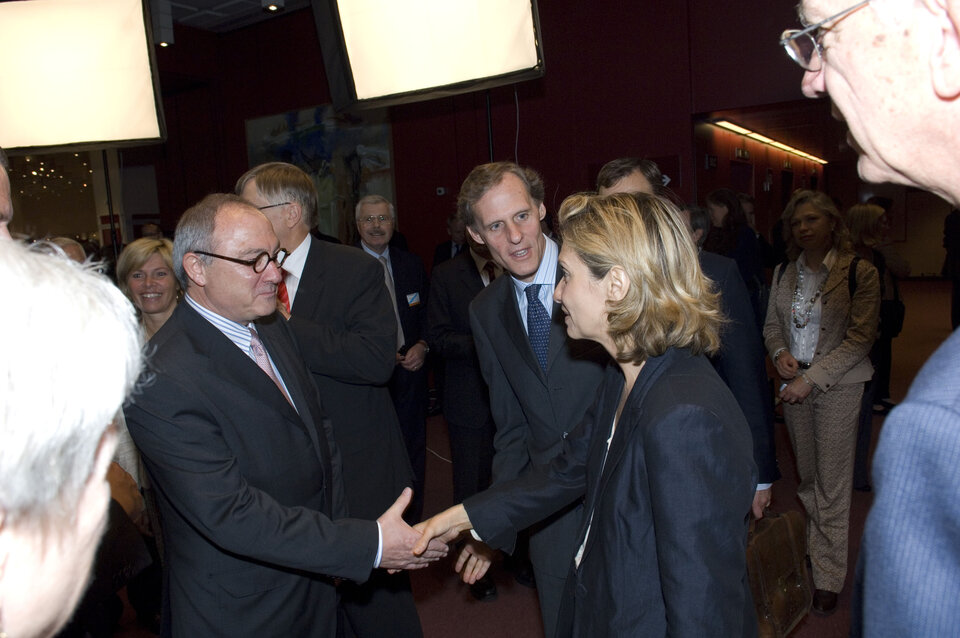
In May 2007, 29 European countries unveiled the new European Space Policy, unifying the approach of ESA with those of the individual European Union member states.
Jointly drafted by the European Commission and ESA’s Director General, Jean-Jacques Dordain, the European Space Policy sets out a basic vision and strategy for the space sector, and tackles issues like security and defence, access to space and exploration.
This approach will better equip Europe for space exploration and bring a new dimension to the EU's international relations. Through this document, the EU, ESA and its Member States all commit to increasing coordination of their activities and programmes and to organising their respective roles relating to space.