Herschel operations
Editor's note: This page is no longer being updated, but will be preserved as a record. Click here for the latest information on Herschel.
Herschel was the largest space telescope of its kind; its 3.5 m-diameter mirror collected long-wavelength infrared radiation from some of the coolest and most distant objects in the Universe. During its mission, Herschel was the only space observatory that covered the spectral range from far-infrared to sub-millimeter wavelengths.
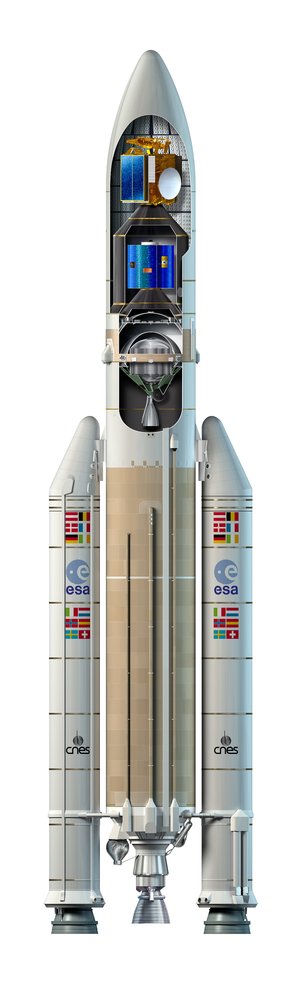
Herschel was launched on 14 May 2009, 13:12 CEST, together with another satellite, Planck, which is studying the Cosmic Microwave Background radiation, on an Ariane 5 ECA launcher. Almost 26 minutes after launch, and about two minutes from each other, they were released separately (Herschel first) on a trajectory toward a virtual point in space, called L2, some 1.5 million kilometres from Earth in the direction opposite to the Sun.
The mission
The satellite was a tall 'tube' 7.5 m high and 4 m wide, with a launch mass of around 3.3 tonnes; it carried an infrared telescope and three scientific instruments. The bulk of the spacecraft consisted of a liquid helium thermos bottle inside which the instrument detectors sat to be cooled down to only a few degrees above absolute zero, some of them even to a fraction of a degree.
Herschel was designed to perform routine science operations for a minimum of three years at its orbit around L2. The mission ended on 29 April 2013 when the helium used to cool the focal plane of the scientific instruments was depleted. After a series of thruster burns to move the satellite into a safe disposal orbit, the spacecraft was shut down. The last command was sent at 14:25 CEST, 17 June 2013.
The Herschel Mission Operations Centre (MOC) was located at ESOC, Darmstadt, Germany.
| ROLE | Space observatory |
| LAUNCH DATE | 14 May 2009 |
| LAUNCHER/LOCATION |
Ariane 5 ECA (dual-launch w/Planck) Kourou, French Guiana |
| LAUNCH MASS | 3400 kg |
| ORBIT | Lissajous orbit at the second Lagrange point (L2) |
| PERIOD | Annual |
| NOMINAL MISSION | Three years; completion on 29 April 2013 - shut off on 17 June 2013. |
| + The largest space telescope of its type ever flown in space + | |
The Flight Control Team

The Flight Control Team worked from the Herschel Dedicated Control Room located at ESOC. Spacecraft Operations Manager Micha Schmidt, from Germany, was assigned to Herschel in 2002.
In the two-year period prior to launch, he assembled and trained the FCT and worked with the team and other experts at ESOC to develop the mission control system and practise and perfect flight operations processes and procedures. After launch, the team was actively engaged in operating the satellite and commissioning systems and instruments.
Mission operations overview
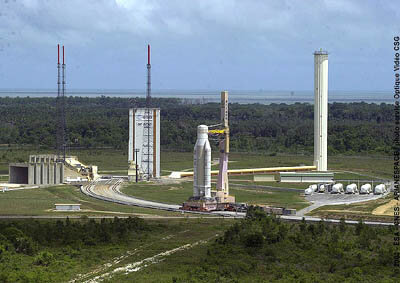
The Ariane 5 ECA launcher burned its solid boosters for slightly less than 2½ minutes and its main engine for about nine minutes to lift Herschel and Planck into a ballistic coast orbit. After coasting for 107 minutes, the Ariane 5 upper stage ignited for just over 17 minutes to inject Herschel and then Planck into separate transfer trajectories. After separation, Herschel entered free flight as a three-axis stabilised satellite (Planck, in contrast, rotates to perform its scientific mission).
Herschel will take between four and six months to reach its orbit around L2, the second Lagrange point of the Earth-Sun system, 1.5 million km from the Earth. During the journey Herschel will perform a number of manoeuvres.
|
Time |
Manoeuvre |
|
Launch plus one days |
Perigee velocity correction and trajectory correction to remove launch dispersion (change in speed of 8.7 m/s) |
|
Launch plus twelve days |
Fine correction to launch dispersion manoeuvre dispersion |
|
-- |
Mid course correction manoeuvre, if needed |

At L2, Herschel entered a large Lissajous orbit about the Lagrange point.
Lissajous orbits are the natural motion of a satellite around a collinear libration point in a two-body system and require less momentum change (i.e. thruster firings) to be expended for station keeping than halo orbits, in which the satellite follows a simple circular or elliptical path about the libration point.
While complex, this orbit will provide an ideal environment for a space observatory: far from the Earth and its magnetic field (which traps the solar wind) and far away from both the Sun and Earth, whose emitted or reflected light can damage sensitive optical instruments.
The ground station - New Norcia - DSA 1
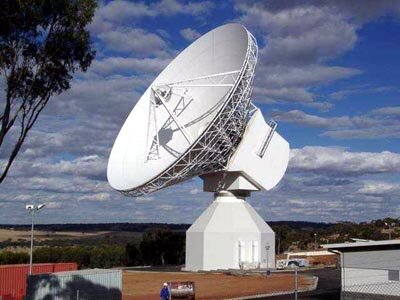
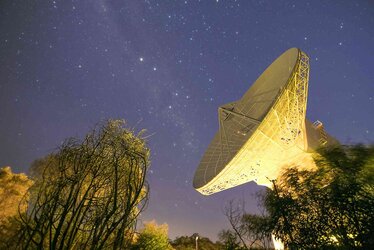
DSA 1 is designed for deep-space satellite missions and provides daily support to Mars Express, Rosetta and Venus Express for routine operations.
DSA 1 (Deep Space Antenna 1), located at New Norcia, Australia, hosts a 35m deep-space antenna with transmission and reception in both S- and X-band. The town of New Norcia is 140 km north of Perth, Western Australia.
For Herschel, the Earth-to-spacecraft distance varied between approximately 1.2 to 1.8 million km. Note that the Estrack stations at Kourou and at Maspalomas and Cebreros, Spain, also supported Herschel during the Launch and Early Orbit and commissioning phases.
Ground segment & mission control system

Herschel used the SCOS-2000 mission control system.
In addition to the MOC at ESOC, the ground segment comprised the Herschel Science Centre (HSC), located at ESA's European Space Astronomy Centre (ESAC), Madrid, supported by NASA's Herschel Science Center (NHSC), located at the agency's Infrared Processing and Analysis Centre (IPAC, JPL, California), which acted as the point of interface to the American science community.
There were also three dedicated Instrument Control Centres (ICCs), one for each instrument on board the spacecraft, provided by the respective principal investigators.
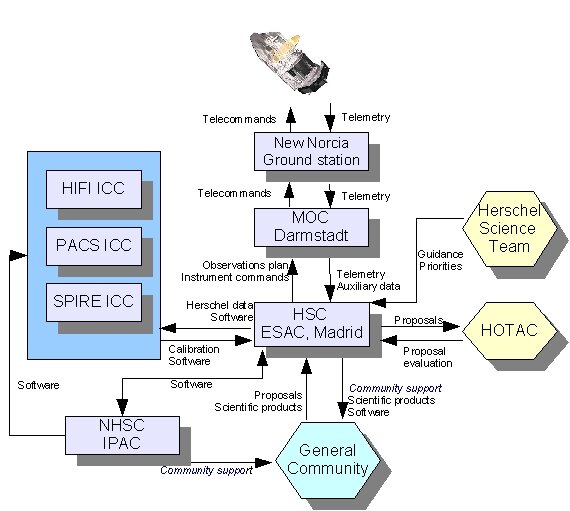
The observatory schedule was based on a database of accepted observations, fed by requests from the scientific community. The long-term mission plan – plus short-term observing schedules – together with the corresponding instrument commands was produced in the mission planning system at the HSC, and transferred to the MOC at ESOC. The MOC added in the current required satellite commands and produced the final detailed mission timeline that was uplinked to the spacecraft.
Observational data were stored on board, and downlinked to the New Norcia station (backed-up by DSA 2, Cebreros station) during passes lasting approximately three hours. The satellite was capable of storing two operational days of observational data in the on-board computer in case any downlink passes were missed. The down-linked satellite telemetry was transferred from the ground station to the MOC, where it was consolidated and transferred to the HSC.
The platform and payload
The platform
The Herschel spacecraft had a modular design, comprising the Extended Payload Module (EPLM) and the Service Module (SVM). The EPLM consisted of the PLM 'proper' with a superfluid helium cryostat housing the Herschel optical bench (HOB), and supporting the telescope, the sun-shield/shade and payload associated equipment.
The SVM housed 'warm' payload electronics and provided the necessary 'infrastructure' for the satellite such as power, attitude and orbit control, the on-board data handling and command execution, communications and safety.
The payload
The Herschel science payload comprised three instruments that perform a combination of spectrometry, imaging spectrometry and imaging photometry covering a wavelength range from 60 to 670 µm.

- Photodetector Array Camera and Spectrometer (PACS), a camera and a low- to medium-resolution spectrometer for wavelengths up to about 205 micrometres. It uses two bolometer detector arrays in the camera and two photo-conductor detector arrays in the spectrometer.
- Spectral and Photometric Imaging Receiver (SPIRE), a camera and a low- to medium-resolution spectrometer for wavelengths longer than 200 micrometres. It uses five detector arrays: three to take images of infrared sources in three different infrared 'colours' and two to fully analyse the longer infrared light being released from the source.
- Heterodyne Instrument for the Far Infrared (HIFI), a highly accurate spectrometer that can be used to obtain information about the chemical composition, kinematics, and physical environment of infrared sources.