The long trek
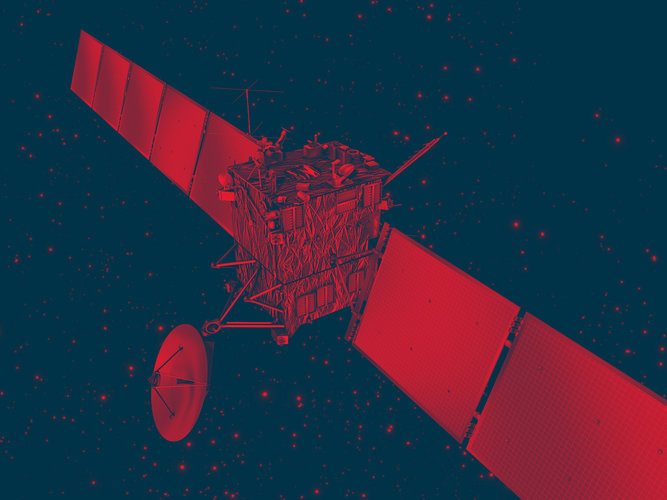
Rosetta's ten-year expedition began in March 2004, with an Ariane-5 launch from Kourou in French Guiana.
The three-tonne spacecraft was first inserted into a parking orbit, before being sent on its way towards the outer Solar System.
The cosmic billiard ball
Unfortunately, no existing rocket, not even the powerful European-built Ariane-5, had the capability to send such a large spacecraft directly to Comet 67P/Churyumov-Gerasimenko.
Instead, Rosetta had to bounce around the inner Solar System like a ‘cosmic billiard ball’, circling the Sun almost four times during its ten-year trek to Comet 67P/Churyumov-Gerasimenko.
Along this roundabout route, Rosetta entered the asteroid belt twice to gain velocity from gravitational ‘kicks’ provided by close fly-bys of Mars (2007) and Earth (2005, 2007 and 2009).
Earth fly-bys (2005, 2007 and 2009)

Rosetta first traveled away from its home planet and then encountered Earth again, a year after launch, in March 2005.
Rosetta remained active during the cruise to Earth. The flyby distance was between 300 and 14 000 kilometres. Operations mainly involved tracking, orbit determination and payload check-out.
After the first flyby of Earth in March 2005, Rosetta head towards Mars and then returned to Earth twice in November 2007 and November 2009 for its second and third flybys of our planet.
Mars flyby (February 2007)

Rosetta flew past Mars in February 2007 at a distance of about 200 kilometres, obtaining some science observations.
Asteroids flybys
The spacecraft was put into passive cruise mode on the way to the asteroid belt. Rosetta observed asteroids Steins (September 2008) and Lutetia (July 2010) on its journey. Science data recorded on board were transmitted to Earth after the flyby.
Deep-space hibernation (May 2011 - January 2014)


Access the video
After a large deep-space manoeuvre, the spacecraft was put into hibernation. During this period, Rosetta recorded its maximum distances from the Sun (about 800 million kilometres) and Earth (about 1000 million kilometres). Rosetta woke up from deep space hibernation on 20 January 2014.
Arrival

In May 2014, Rosetta’s thrusters began to brake the spacecraft, so that it could match Comet 67P/Churyumov-Gerasimenko’s speed and orbit.
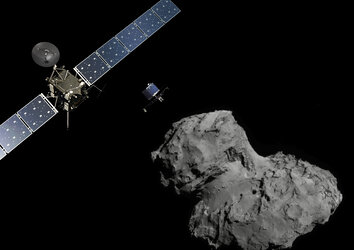
Rosetta finally arrived at the comet on 6 August 2014. It made the exciting transition to global mapping, lander deployment and the comet chase towards the Sun, before moving back out towards the outer Solar System again, concluding its mission in September 2016.