


Solar Orbiter factsheet
Mission: To study the Sun up close and from high latitudes, providing the first images of the Sun’s poles and investigating the heliosphere
Partnerships: Solar Orbiter is an ESA mission with strong NASA participation
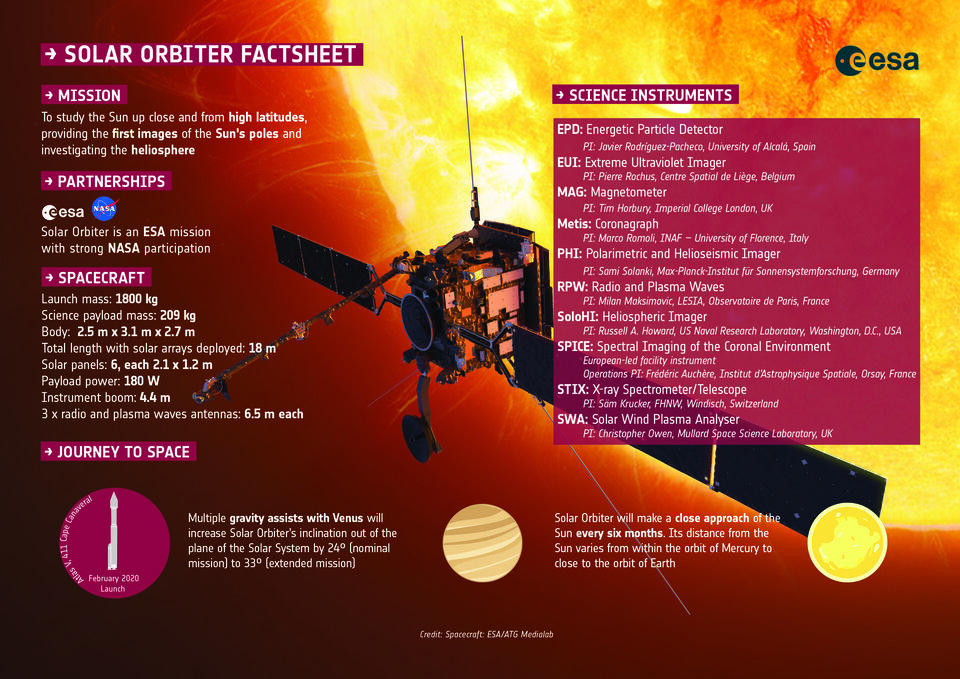
Spacecraft
Launch mass: 1800 kg
Science payload mass: 209 kg
Body: 2.5 x 3.1 x 2.7 m
Total length with solar arrays deployed: 18 m
Solar panels: six, each 2.1 x 1.2 m
Payload power: 180 W
Instrument boom: 4.4 m
Radio and plasma wave antennas: three, each 6.5 m
Journey
Launch: February 2020
Vehicle: Atlas 5, Cape Canaveral
Flybys: Multiple gravity assists with Venus will increase Solar Orbiter’s inclination out of the plane of the Solar System by 24º (nominal mission) to 33º (extended mission)
Closest approaches: Solar Orbiter will make a close approach of the Sun every six months. Its distance from the Sun varies from within the orbit of Mercury to close to the orbit of Earth.
Science instruments
EPD: Energetic Particle Detector – PI: Javier Rodríguez-Pacheco, University of Alcalá, Spain
EUI: Extreme Ultraviolet Imager – PI: Pierre Rochus, Centre Spatial de Liège, Belgium
MAG: Magnetometer– PI: Tim Horbury, Imperial College London, United Kingdom
Metis: Coronagraph – PI: Marco Romoli, INAF – University of Florence, Italy
PHI: Polarimetric and Helioseismic Imager – PI: Sami Solanki, Max-Planck-Institut für Sonnensystemforschung, Germany
RPW: Radio and Plasma Waves– PI: Milan Maksimovic, LESIA, Observatoire de Paris, France
SoloHI: Heliospheric Imager – PI: Russell A. Howard, US Naval Research Laboratory, Washington, D.C., USA
SPICE: Spectral Imaging of the Coronal Environment – European-led facility instrument
STIX: X-ray Spectrometer/Telescope – PI: Säm Krucker, FHNW, Windisch, Switzerland
SWA: Solar Wind Plasma Analyser – PI: Christopher Owen, Mullard Space Science Laboratory, United Kingdom

Mission facts
- Solar Orbiter is helping us understand how our star creates and controls the giant bubble of plasma that surrounds the whole Solar System and influences the planets within it
- Solar Orbiter is taking the first images of the Sun’s poles from high latitudes
- Solar Orbiter is combining in situ measurements of the solar wind around the spacecraft with remote sensing, looking at the Sun’s features from afar, to connect the two together
- At closest approach, Solar Orbiter will be about approximately 42 million km from the Sun
- The spacecraft has been tested to withstand temperatures up to 500 ºC – it endures thirteen times the amount of solar heating that satellites in Earth’s orbit experience
- A specially designed black heatshield protects the spacecraft and its instruments from the heat of the Sun
- Solar Orbiter is providing context information for NASA’s Parker Solar Probe, which collects data closer to the Sun, but does not have any Sun-pointing cameras
Sun facts
- Our Sun is one of billions of stars that exist in our Milky Way galaxy
- The Sun contains 99.9% of all matter in our Solar System
- We live in the extended atmosphere of the Sun, a region of space known as the heliosphere
- The primary energy the Earth receives from the Sun is light
- During a single second, the Sun converts four million tonnes of matter into energy
- The Sun rotates on its axis approximately once every 27 days
- The Sun’s surface rotates at different speeds in different latitudes. The fastest rotation is at the equator and takes about 25 days; the slowest rotation is at the poles and takes about 36 days
- The Sun sometimes ejects large packets of plasma from its surface; when directed towards Earth we experience ‘space weather’ which can disrupt satellites and critical infrastructure like power grids