Solar storm blasts Cluster
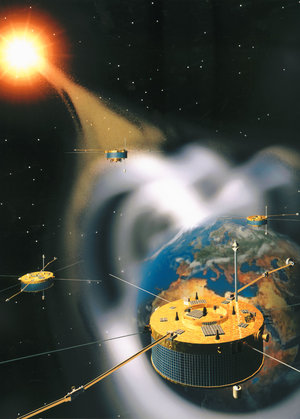
Activity on the Sun may be declining after last year's peak, but, as the four Cluster spacecraft can testify, our nearest star can still pack a hefty punch.
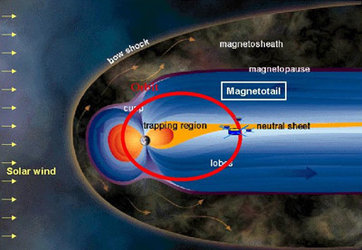
During last week's solar storm, the Cluster quartet was temporarily disabled by a peppering of high-energy protons. Two days later, once normal service had been restored, the Earth's magnetosphere - the invisible magnetic bubble that surrounds and protects our planet - was dramatically squeezed by the impact of a huge cloud of matter ejected from the Sun. As a result, the spacecraft made an unexpected journey into interplanetary space, where they were exposed to the full blast of the supersonic solar wind.

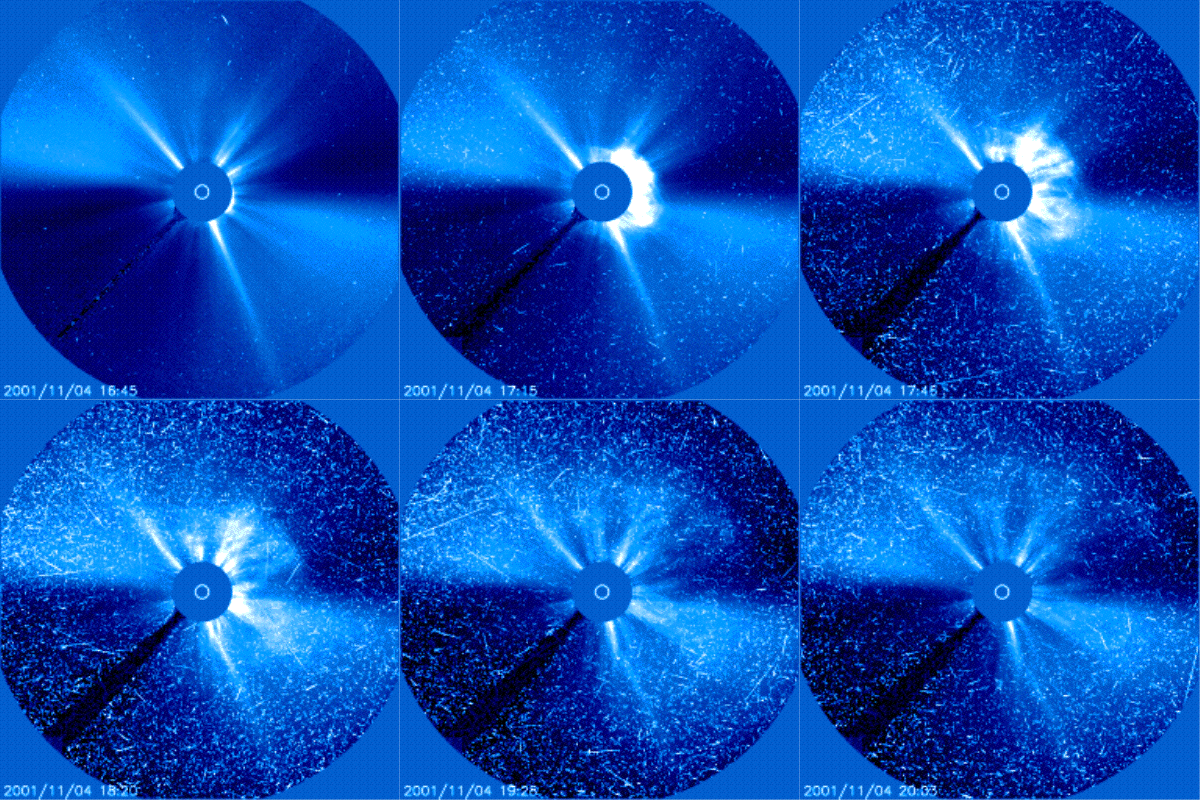
The onset of the storm was recorded by another ESA spacecraft, the Solar and Heliospheric Observer (SOHO), which continually monitors events on our turbulent Sun.
Images from SOHO show that a huge cloud of gas (known as a Coronal Mass Ejection or CME) erupted from the Sun at around 17:00 GMT (18:00 CET) on 4 November. A shower of high-energy protons was also emitted by the Sun during this event. Travelling at almost the speed of light, the protons swept past SOHO at 18:37 GMT (19:37 CET), causing a 'snowstorm' on the spacecraft's imaging instruments.
Minutes later, these damaging particles caused a computer glitch on the third Cluster spacecraft (Samba), which meant that the satellite could not be commanded in the normal way. During the complex recovery procedure, all of the instruments on the spacecraft had to be switched off and reset using well-rehearsed back-up procedures.
By 6 November, all four Cluster spacecraft were up and running again and SOHO data showed that the number of incoming protons was decreasing, but another dramatic series of events was about to unfold.
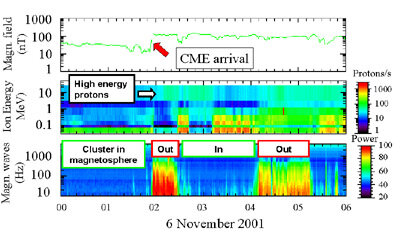
At about 02:00 GMT (03:00 CET), the huge cloud of electrified solar gas that had exploded from the Sun on 4 November swept past our planet. The collision between the CME and the Earth's magnetic field was detected by various instruments on the Cluster quartet.
Sudden jumps in the strength of the magnetic field and the number of magnetic waves were recorded by the FGM and STAFF instruments.
At the same time, the number of energetic protons recorded by the RAPID instrument also increased once more. Unlike the first burst of high-energy protons, which were produced by the initial explosion on the Sun, these particles were created at the CME while it was travelling towards the Earth.
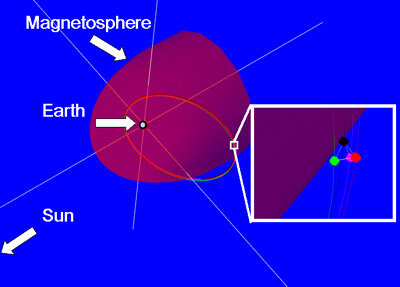
"This CME was magnetised in the opposite direction to the Earth's magnetic field, so it produced a big shock when it struck the magnetosphere," said Cluster project scientist, Philippe Escoubet.
"The Cluster instruments showed a rapid rise in the strength of the magnetic field, as well as marked increases in the density and velocity of the particles - evidence that the sudden squeezing of the magnetosphere had left the spacecraft 'adrift' in the solar wind," he said. "In fact, the spacecraft data show that the boundary region - the magnetopause - crossed Cluster twice," he explained. "This means that the magnetic field was squeezed, expanded, squeezed again, and then expanded once more over a period of less than four hours."

"The collision had a very strong energising effect on the magnetosphere, which resulted in a marvellous display of auroras to low latitudes in Scotland and North America," he said.
"This is the first time that Cluster has crossed the boundary of the magnetosphere since June," commented Philippe Escoubet. "We had not expected the spacecraft to enter the solar wind for several weeks."
"This event is very interesting for us because a similar solar storm took place almost exactly one year ago, on 11 November 2000," he said. "On that occasion, too, a CME squashed the Earth's magnetic bubble and caused Cluster to be exposed to the charged particles in the solar wind."
For more information, please contact:
Dr. Philippe Escoubet
Cluster project scientist
ESTEC
Netherlands
Tel: +31 71 565 3454
E-mail: Philippe.Escoubet@esa.int