Las primeras imágenes de Herschel auguran un futuro brillante
Herschel ha llevado a cabo las primeras observaciones de prueba con todos sus instrumentos, con resultados espectaculares. Galaxias, regiones de formación estelar y estrellas moribundas han sido los primeros objetivos del telescopio. Los instrumentos han proporcionado datos magníficos ya en sus primeras observaciones, detectando agua y carbono y revelando docenas de galaxias lejanas.
Estas observaciones demuestran que los instrumentos de Herschel están funcionando incluso mejor de lo esperado, y para los expectantes astrónomos confirman la perspectiva de una misión rica en descubrimientos.
SPIRE, ojos que ven como nunca antes
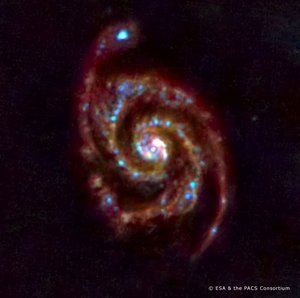
On 24 June, Herschel’s Spectral and Photometric Imaging Receiver El 24 de Junio el instrumento SPIRE (Spectral and Photometric Imaging Receiver) de Herschel recibió su primera luz. Las dos galaxias a las que apuntó el telescopio se mostraron en todo su brillo, proporcionando a los astrónomos las mejores imágenes jamás obtenidas a estas longitudes de onda y revelando otras galaxias, más lejanas, en el fondo de la imagen.
En las imágenes de abajo se ve a las galaxias M66 y M74 a 250 micras, una longitud de onda más larga que las detectables por todos los telescopios espaciales infrarrojos que han precedido a Herschel, pero aún así la más corta que detecta SPIRE.
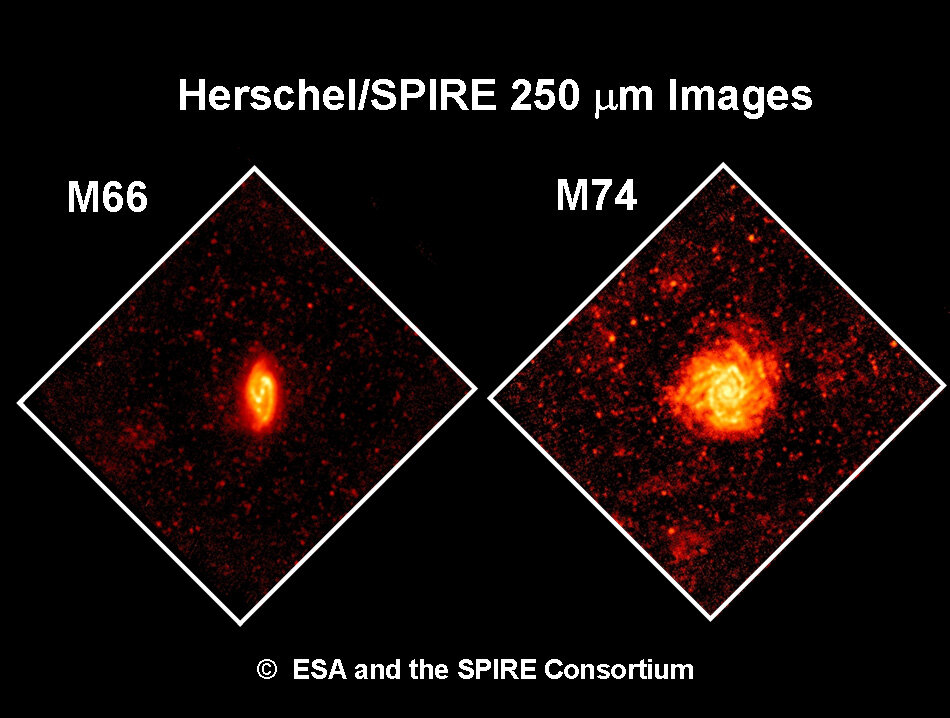
SPIRE está diseñado para observar formación estelar en nuestra galaxia y en las galaxias más próximas. No obstante, buscará también galaxias con mucha formación estelar en el universo muy lejano. Como estas galaxias están tan distantes su luz ha necesitado mucho tiempo para llegar hasta nosotros, así que al observarlas estamos retrocediendo al pasado y estudiando cómo y cuándo se formaron las galaxias como la nuestra.
El espejo primario de Herschel tiene 3,5 metros de diámetro, casi cuatro veces más que cualquier otro telescopio espacial infrarrojo. Estas imágenes demuestran que Herschel permitirá avanzar mucho en la capacidad de estudiar objetos celestes en el infrarrojo lejano.


La galaxia Messier 74 (M74), en dos longitudes de onda distintas.
El telescopio Spitzer, de la NASA, observa en longitudes de onda infrarroja más cortas que Herschel, de forma que ambos telescopios son complementarios.
Las imágenes de abajo muestran la galaxia M74 tal como la ve SPIRE en tres longitudes de onda distintas, de infrarrojo lejano.
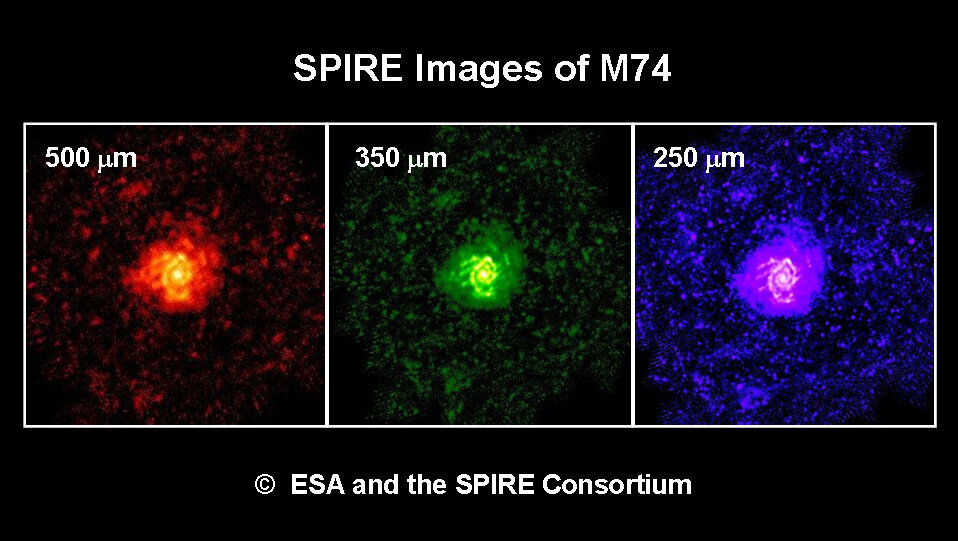
Todas estas observaciones fueron realizadas el día del estreno de SPIRE, y son una clara prueba de que los principales estudios científicos para los que ha sido diseñado este instrumento serán un éxito.
HIFI, el buscador de agua, acierta a la primera
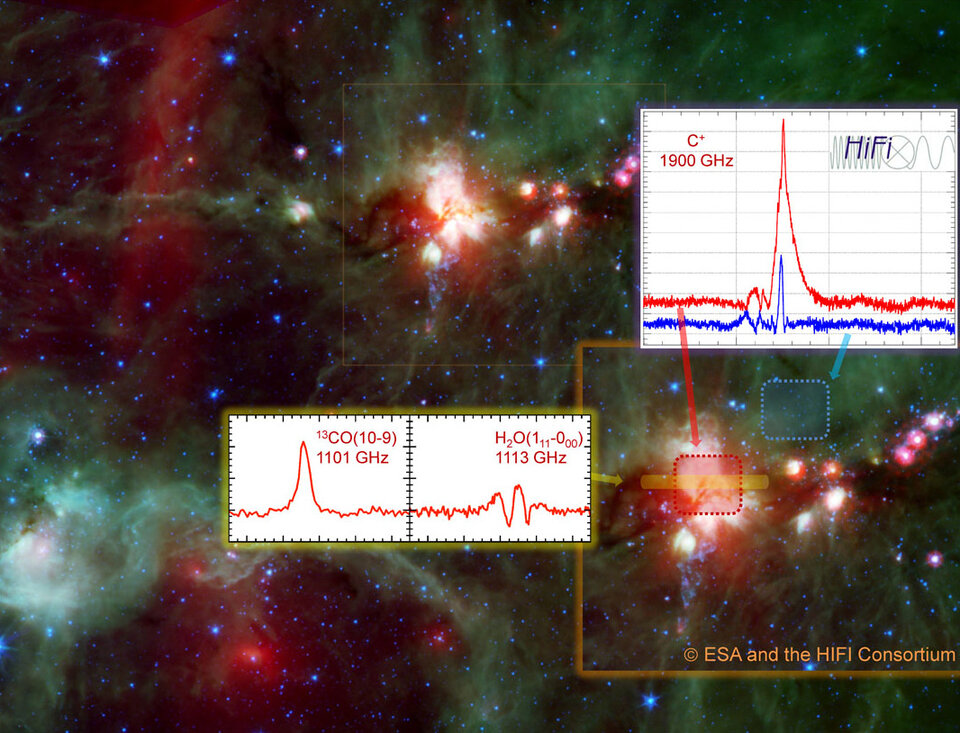
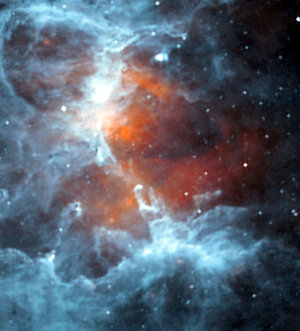
Los científicos recurrieron al instrumento HIFI (Heterodyne Instrument for the Far-Infrared) de Herschel el pasado 22 de Junio para buscar gas molecular templado, calentado por estrellas masivas recién nacidas, en la región de formación estelar DR21 en el Cisne.
HIFI ha proporcionado datos excelentes en dos modos de observación distintos, que informan sobre la composición de la zona con una precisión y una resolución sin precedentes. HIFI funciona ‘haciendo zoom’ en longitudes de onda específicas, revelando diferentes líneas espectrales que representan las huellas digitales de átomos y moléculas e incluso las condiciones físicas del objeto observado. Esto convierte a HIFI en una poderosa herramienta para estudiar el papel del gas y el polvo en la formación de estrellas y planetas, y en la evolución de las galaxias.
Usando HIFI los científicos han detectado carbono ionizado, monóxido de carbono y agua en DR21. Estas líneas moleculares diferentes contribuyen a entender mejor lo que está ocurriendo en el espacio profundo.
La alta calidad de estas observaciones iniciales sugiere que Herschel será clave para investigar a fondo el proceso de formación estelar.
PACS se adentra en el Ojo de Gato
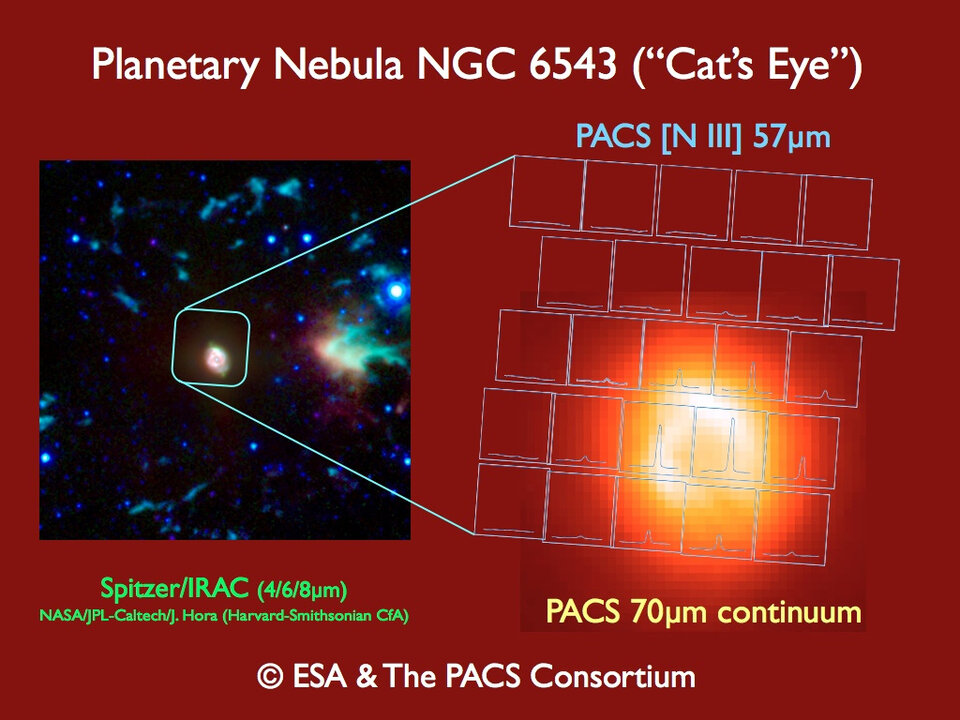
La primera observación con el instrumento PACS (Photodetector Array Camera and Spectrometer) de Herschel fue llevada a cabo el pasado 23 de Junio.
El primer objetivo fue la estrella moribunda conocida como la nebulosa de Ojo de Gato. Descubierta por William Herschel en 1786, esta nebulosa consiste en una compleja envoltura de gas expulsado por una estrella próxima al final de su vida. Las estrellas que mueren crean nebulosas espectaculares, enriqueciendo el medio interestelar con elementos químicos pesados. Pero, ¿cómo una estrella inicialmente esférica genera una nebulosa tan compleja? Para resolver esta cuestión es necesario estudiar lo que ocurre cerca de la estrella, donde es expulsada la materia.
Con el espectrómetro PACS por primera vez es posible obtener líneas espectrales que muestran en tres dimensiones cómo el viento procedente de la estrella confiere su forma a la nebulosa. PACS fue usado para observar ‘dentro’ del Ojo de Gato. Este modo de observación registra la composición y las condiciones de los objetos celestes a longitudes de onda definidas de forma muy precisa.
PACS observó la nebulosa en dos líneas espectrales de nitrógeno ionizado y oxígeno. Para orientarse mejor, el espectrómetro PACS obtuvo un pequeño mapa de la nebulosa de Ojo de Gato a 70 micras, revelando la estructura de un disco de polvo con una abertura lateral.
Una vez obtenidas estas imágenes Herschel entra ahora en la fase de comprobación de su funcionamiento, en la que los instrumentos seguirán siendo probados y calibrados. Esta fase se prolongará hasta finales de Noviembre, y después comenzará las observaciones científicas. Estas imágenes demuestran que hay mucha ciencia por llegar.
Nota a los editores:
HIFI ha sido desarrollado por un amplio consorcio. 25 institutos de 13 países han puesto en común sus conocimientos tecnológicos para construir HIFI, que ha exigido el desarrollo de tecnologías clave por parte de todo el consorcio.