Ariane 5 technology turns the lights on
Soon we may be able to fill the bath, turn the lights on and play our favourite CD without moving from our chair or pressing a button. Technology, developed by ESA for European spacecraft, is now being used to create small sensors that can make any flat surface – walls, windows or tables – interactive.
"The idea is to use an accelerometer to determine the exact position of touch on an object,” says Nicolas Delorme from Nodal Consultants, part of ESA's Technology Transfer Programme's (TTP) network of technology brokers. “For example, an accelerometer can determine exactly which part of the interactive surface on a window or a door has been touched, making the surface as sensitive as keys on a keyboard."

Accelerometers are used in combination with gyroscopes onboard Ariane launchers for the inertial positioning system and to kick-off the pyro-technic switches that control the fuelling of the boosters. They are also used on satellites to determine the exact position of the spacecraft. As they are used in space, these systems have to be extremely accurate.
"This technology is at the heart of ReverSys, an innovation which could revolutionise how we consider the objects around us and how we use them,” Nicolas Delorme adds.
ReverSys

Ros-Kiri Ing, President and Founder of Sensitive Object, the company that developed and patented ReverSys, received assistance from ESA's TTP technology broker Nodal Consultants who carried out market research for them and identified technology and partners.
"Our patented technology is based on recognising the sound waves propagated in an object when it is tapped at a precise location," says Ros-Kiri Ing.
Just as fingerprints are unique, a tap on a flat surface gives an acoustic signature that is unique for the specific point of impact, as the waves emitted are diffused differently from a tap even a few centimetres away. This property was discovered thanks to a physical process called 'temporal reversal' which precisely identifies the point of source of emitted waves.

"I had the idea of associating this signature with an action and creating a sort of virtual command table. The association is managed by a computer programme that links touch at a specific location to a specific action. A small sensor, the accelerometer, placed nearby, then detects the sound waves and analyses their acoustic signature. If the signature is recognised, the intended action is executed, if not, nothing happens," Ros-Kiri Ing explains.
ReverSys technology can be used with most solid materials: glass, wood, steel, even a brick wall. Sensitive control panels can be placed at any location on a surface to create an interactive human-machine interface. It also has a number of important advantages:
- it is wireless and cable-free and can be integrated onto any surface
- it does not require any modification to the surface
- it is aesthetic and fits with any decor
- it can easily be re-programmed to reposition the sensitive zones
- it is simple to operate
- it can be easily moved
Ros-Kiri Ing explains: "In a bathroom, for example, ReverSys could be used to put a control panel on the edge of the bath or even in the shower, with the sensor placed nearby, away from the water. If the control panel needs to be moved to a new position or a new command needs to be added then it’s no problem. There is no need to touch the sensor, with the help of computer it is a simple matter to modify the system and define new sensitive zones.”
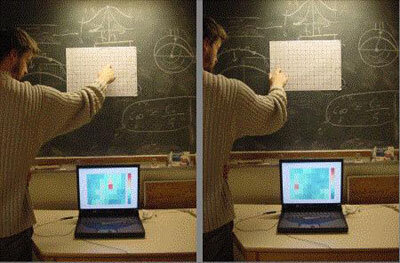
This certainly has many advantages for home owners; for instance, the controls for the lights in a room could be moved without having to change the wiring. A big advantage when fixing up an old house or changing the way a room is used.
"When I first saw Ros-Kiri Ing demonstrating his system I was really impressed. In just minutes, he managed to turn a simple white-board into an interactive device, controlling the playback of music on the computer," says Pierre Brisson, who as head of ESA's Technology Transfer and Promotion Office has seen hundreds of examples of how well space technology can be used to make life on Earth easier.
"Who would have thought that the technology we use in the Ariane launchers could simplify the way we turn on a light?”