Last hardware needed for ATV arrival installed during ISS spacewalk
The last outstanding hardware needed before arrival of the Automated Transfer Vehicle (ATV), the European-built ISS supply ship due for launch in 2006, has been installed outside the International Space Station (ISS) during a 4 1/2 hour Extra Vehicular Activity (EVA) on Monday 28 March.
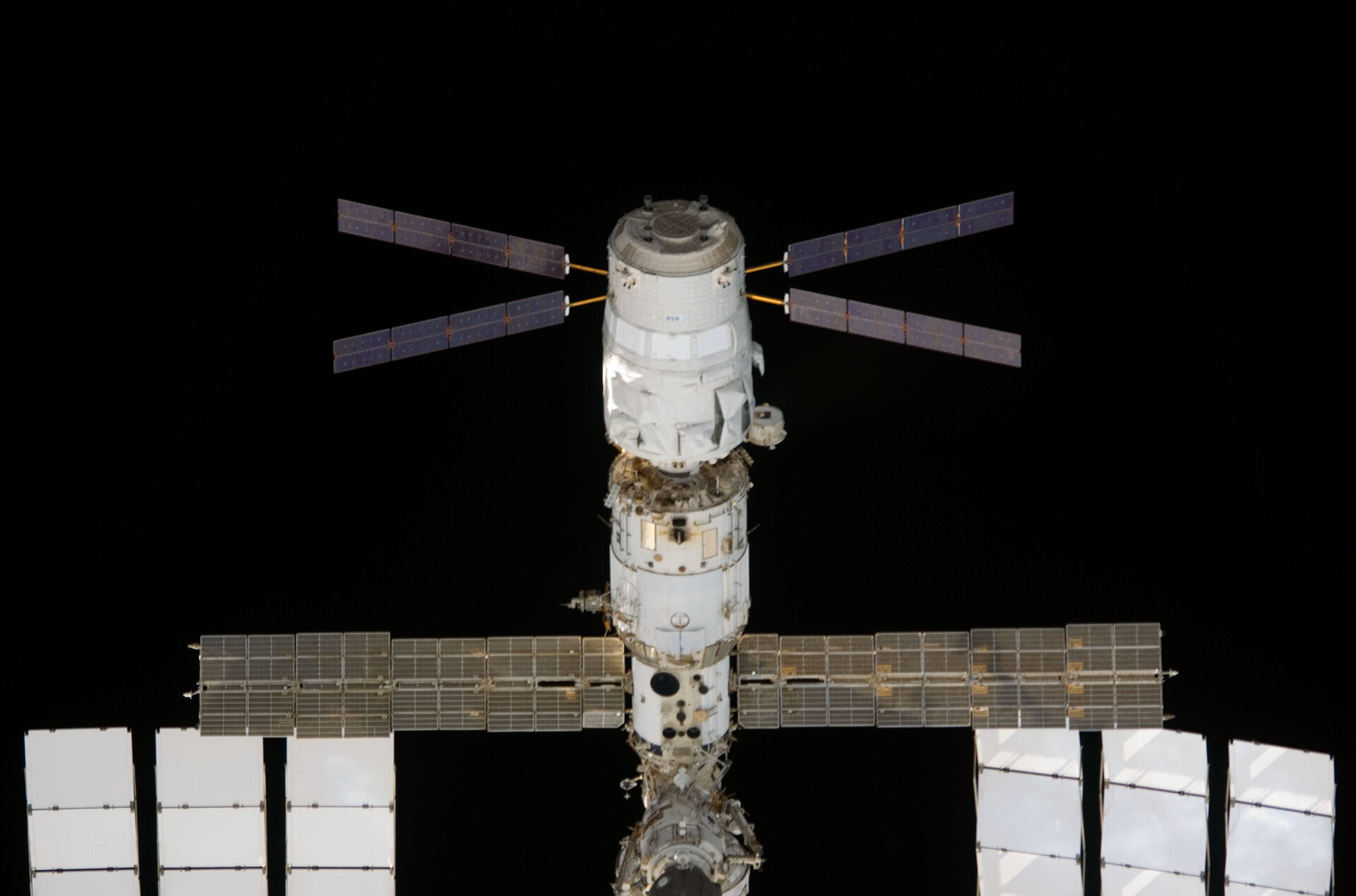
The two ISS Expedition 10 crewmembers, Commander NASA astronaut Leroy Chiao and Flight Engineer Russian cosmonaut Salizhan Sharipov, who was the operational lead for the EVA, installed the last three of six S-band low gain antennas. The antennas, called WAL 4, 5 and 6, will be used for data transfer between the European ATV and the Russian Zvezda module of the ISS. The antennas were part of a consignment delivered to the ISS by the Progress M-52 spacecraft, which arrived at the Station on 2 March.
Chiao and Sharipov installed the three antennas on the smaller-diameter forward end of Zvezda, with antenna WAL 5 pointing towards the Earth and WAL 4 and 6 upwards. The first three antennas, WAL 1, 2 and 3, were installed by the Expedition 9 crew during a previous EVA on 3 September 2004.
Together, the six antennas are part of ESA's Proximity Communication Equipment (PCE) for the ATV, which will enable the ATV and Zvezda to communicate with each other during the automatic rendezvous and docking operations. PCE will also allow the ISS crew to see telemetry information from the ATV and send appropriate commands to the ATV should this be necessary.
After installation of the antennas and the associated cabling, which took approximately two hours, Salizhan Sharipov released a very small Russian satellite (approx. 30 cm long, with a mass of 5 kg) by hand from the Pirs docking module and pushed it towards the aft end of the Station. This nanosatellite will be used to develop small satellite control techniques, monitor satellite operations and develop new attitude system sensors.

The two Expedition 10 crewmembers then moved further backwards to the larger-diameter aft end of Zvezda where they installed more hardware for use by the ATV: an antenna, called ASN-M, for the Global Positioning System (GPS), together with the associated cabling. The GPS equipment will provide the approaching ATV with data about its position relative to the Zvezda module with which it will rendezvous and dock. The ASN-M antenna was installed on the upwards-looking surface of Zvezda.
While they were in this area of Zvezda, Chiao and Sharipov inspected and photographed an already installed antenna used for communications with Zvezda to confirm its configuration for Russian engineers on the ground. They then photographed a European laser reflector that will also be used by the ATV. The reflector was installed during a previous EVA.
After this task, the two astronauts returned inside the ISS through the Pirs docking and airlock module. On their way back, they verified some cabling on Zvezda. The whole EVA lasted just 4 1/2 hours. The astronauts opened the airlock hatch of Pirs and left the Station in their Russian Orlan spacesuits at 08:25 h Central European Summer Time (06:25 h UTC), leaving the ISS unmanned. They returned to Pirs and closed the hatch at 12:55 h CEST (10:55 h UTC), more than one hour ahead of schedule.
The Expedition 10 crew will perform the first electrical tests - from inside the Station - of the newly installed ATV communication equipment on 6 April. The next crew, Expedition 11, will install additional support equipment inside the Zvezda Service Module. After that, the ISS will be ready to welcome the first ATV, named after French science fiction author Jules Verne, in 2007.
When the ATV comes into service next year it will act as a supply ship for the International Space Station, carrying up to nine tonnes of provisions, scientific payloads and propellant. The ATV will also be used to reboost the ISS to a higher orbiting altitude, and to remove waste and material that is no longer needed from the Station at the end of its mission when it leaves the Station and takes a planned self-destructive journey into Earth’s atmosphere.
The first ATV, Jules Verne, is currently at ESA's research and technology centre (ESTEC), in Noordwijk, the Netherlands, where it is undergoing final testing before being shipped to the European launch site at Kourou in French Guiana for its launch on an Ariane 5 launcher.
More information about the ATV, and in particular on the launch, rendezvous and docking operations, together with a computer animation of the whole mission cycle, can be found at www.spaceflight.esa.int/atv.