Mars Express puts craters on a pedestal


Arabia Terra on Mars
 
Arabia Terra on Mars
 
4 February 2011
 
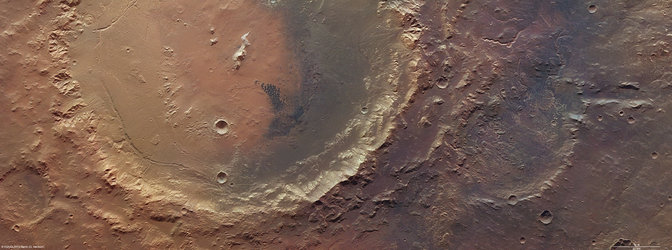
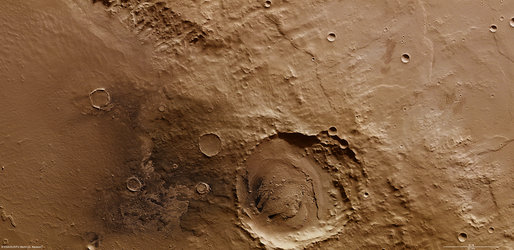
ESA’s Mars Express has returned new views of pedestal craters in the Red Planet’s eastern Arabia Terra.
 
Craters are perhaps the quintessential planetary geological feature. So much so that early planetary geologists expended a lot of effort to understand them. You could say they put craters on a pedestal. This latest image of Mars shows how the Red Planet does it in reality.
 
 
Arabia Terra in context
   
Arabia Terra in context
 
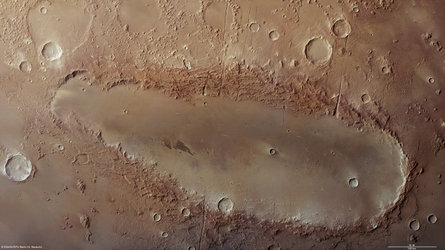
Craters are the result of impacts by asteroids, comets and meteorites. In a pedestal crater, the surrounding terrain is covered by pulverised rock thrown out of the crater. This material creates a platform or pedestal around the crater often with steep cliffs, and is usually rich in volatile materials such as water and ice.

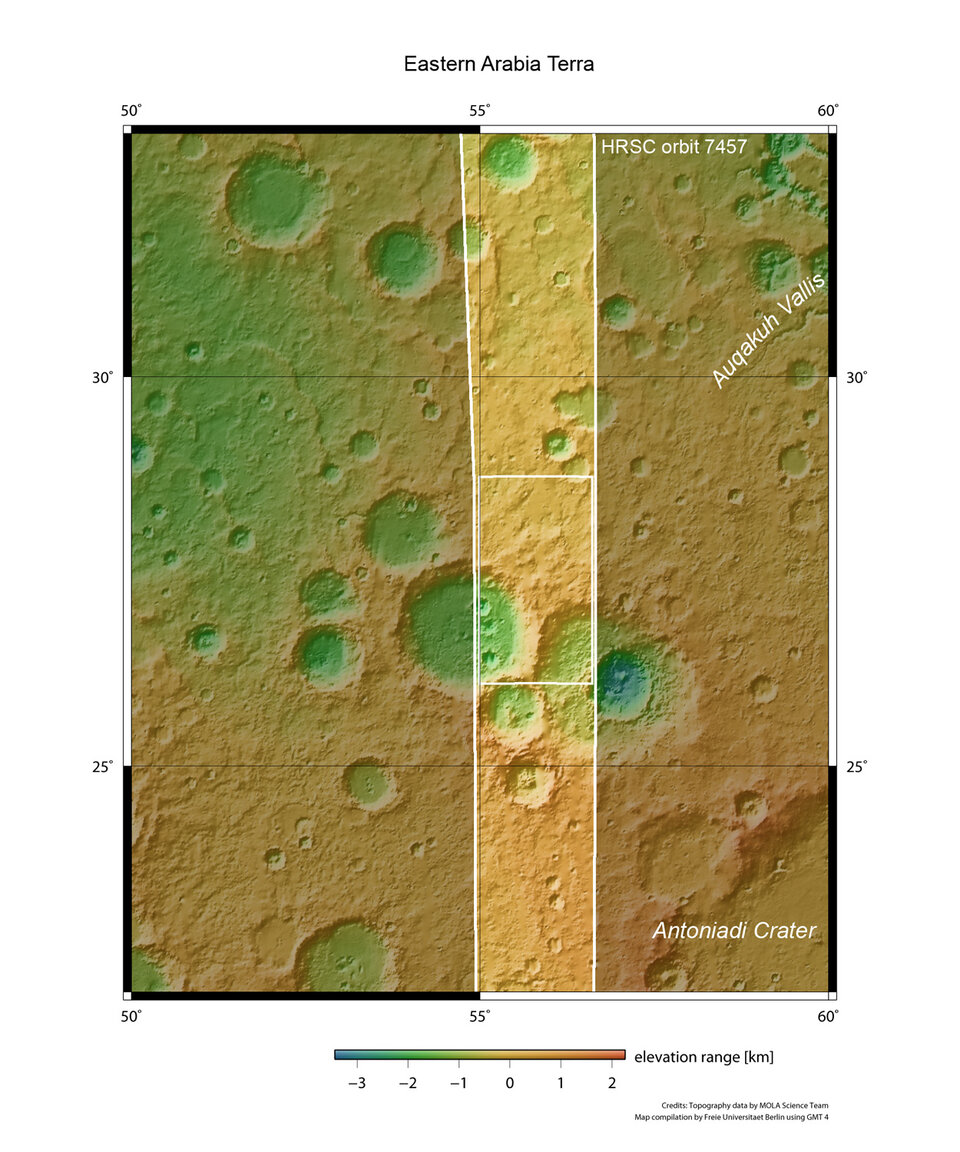
Arabia Terra is part of the highlands of Mars, stretching east to west across 4500 km in the northern hemisphere, and named for a feature drawn on Giovanni Schiaparelli’s 19th-century map of Mars.

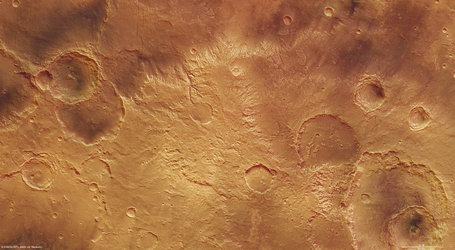
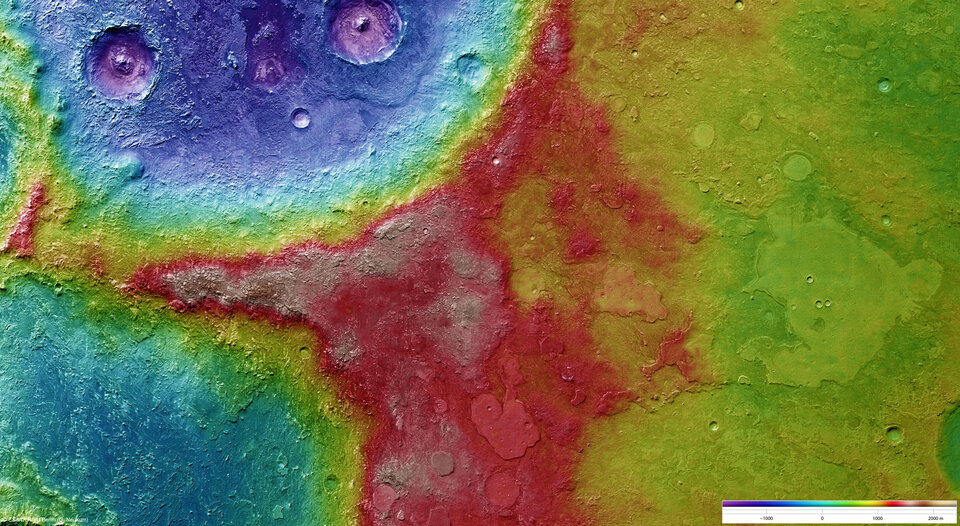
The whole area is characterised by steep-sided hills, valleys and ancient impact craters that have been extensively resurfaced by old lava flows and modified by profound erosion over millions of years. The eastern areas rise up to 4 km above the low-lying north-western parts. To the north, Arabia Terra drops and blends into the northern lowlands.

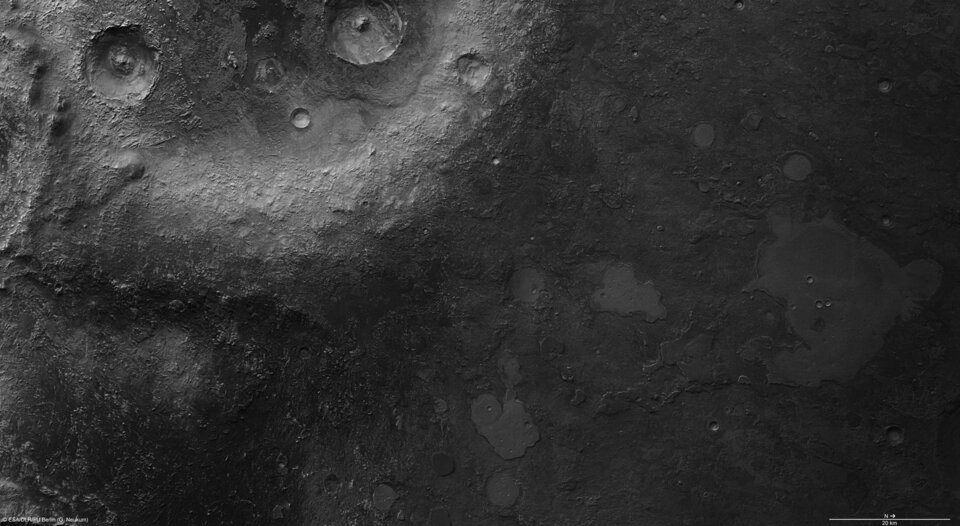
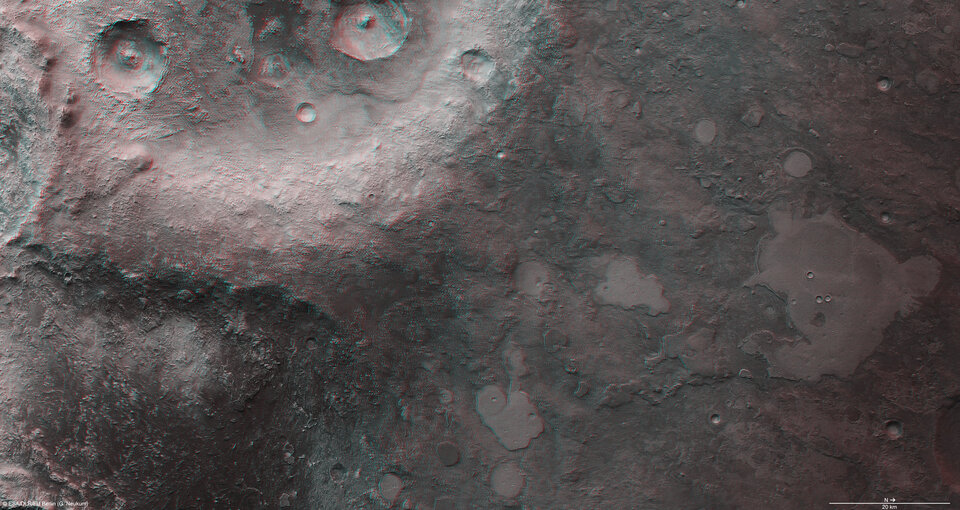
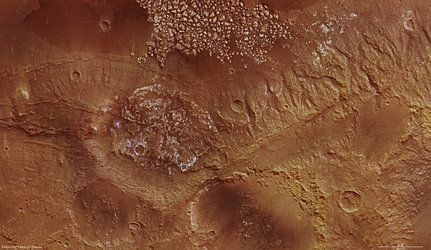
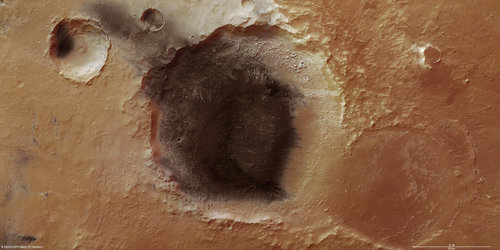
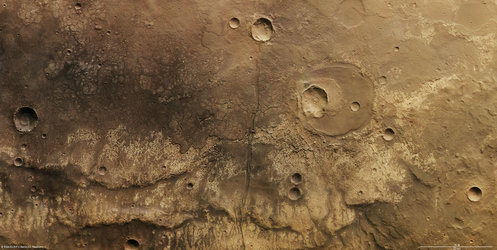
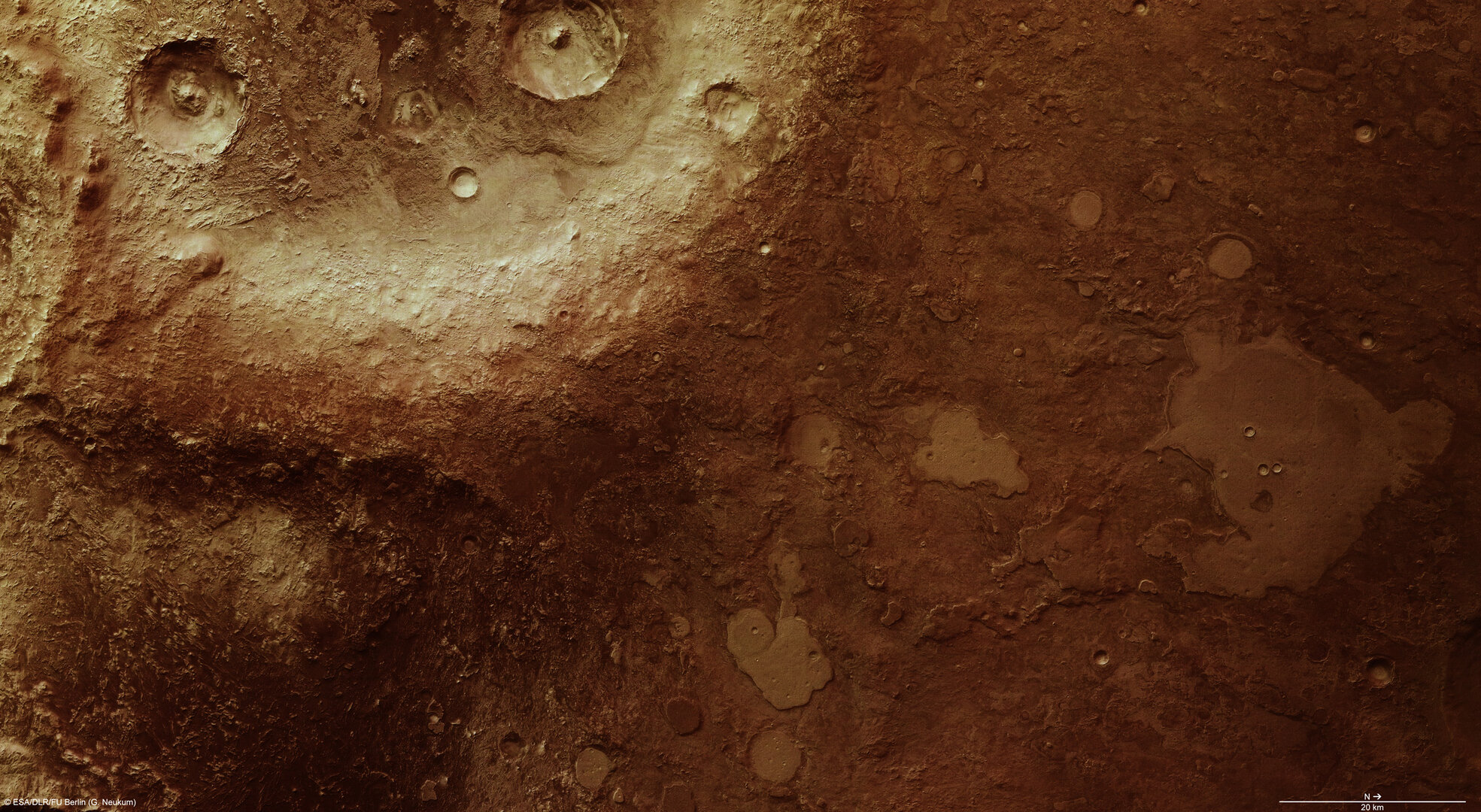
Pedestal craters are visible in this new view of a 159 km by 87 km region of eastern Arabia Terra, taken by the High Resolution Stereo Camera on ESA’s Mars Express orbiter.

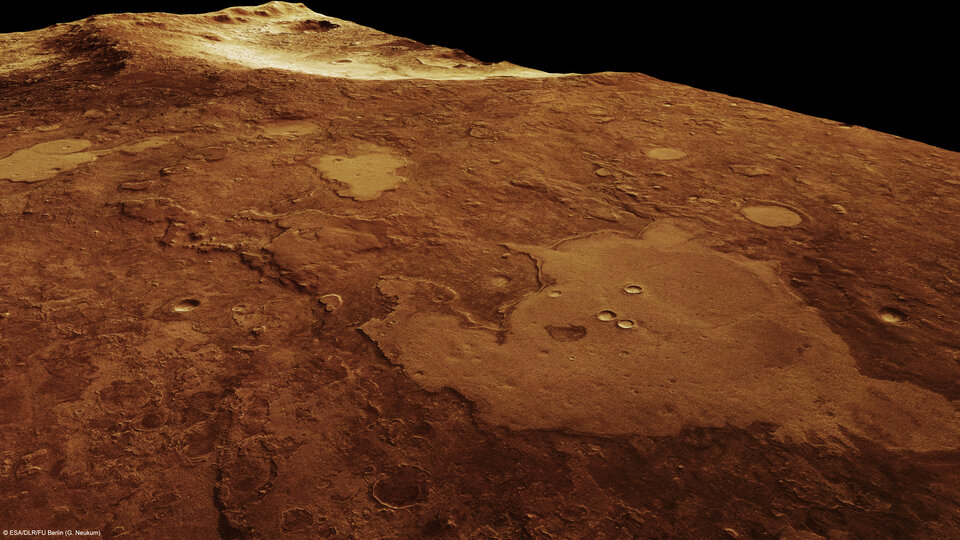
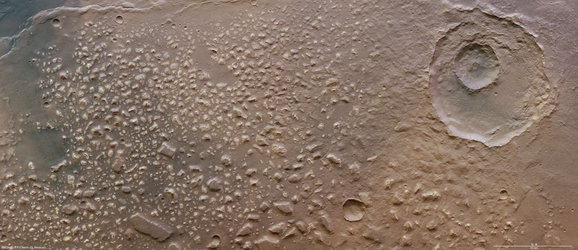
The large crater to the top centre has a pedestal that looks like a skirt, rising almost up to the crater rim. Mounds and table mountains on the floors of the larger craters show layered deposits that could be the result of volcanic processes, or that may have been deposited by wind or water.

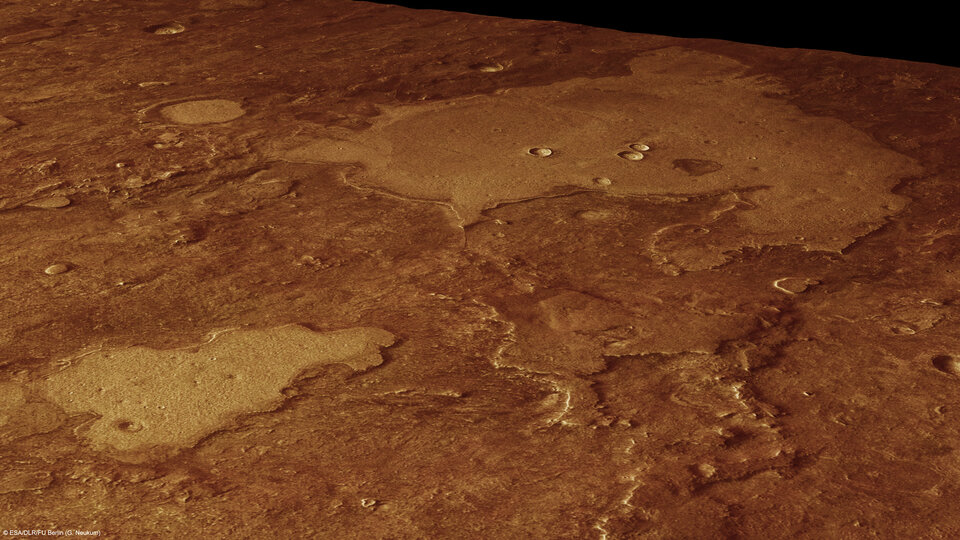
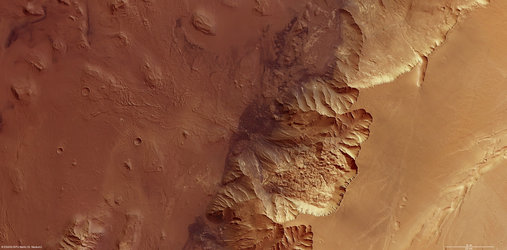
In the north (right), layered deposits appear as smooth plains covering the highlands. These were thought to have formed during the Late Noachian and Early Hesperian eras, about 4 billion years ago.

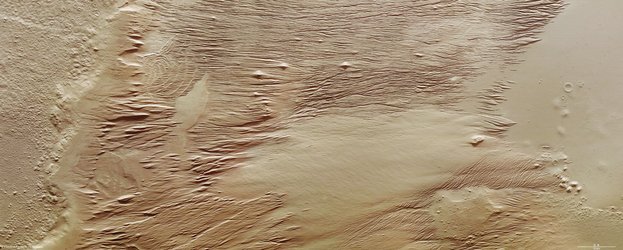
Later, the deposits experienced heavy erosion by wind and partially by water, leading to the variety of landscapes seen in this region today.
 
 
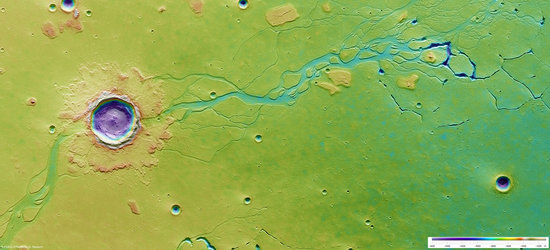
Arabia Terra Elevation
 
Arabia Terra Elevation


Arabia Terra in high resolution
 
Arabia Terra in high resolution


Arabia Terra in perspective
 
Arabia Terra in perspective


Arabia Terra in perspective


Arabia Terra in 3D


Mars Express on YouTube

 •  Traces of Martian life (http://www.youtube.com/watch?v=McdmMMoy730)

Related articles

 •  Rare martian lake delta spotted by Mars Express (http://www.esa.int/esaCP/SEMM71VTTRG_index_0.html)
 •  Mars’ northern polar regions in transition (http://www.esa.int/esaCP/SEMA4VITPQG_index_0.html)
 •  Phobos slips past Jupiter (http://www.esa.int/esaSC/SEMHGWD1XOG_index_0.html)
 •  Springtime at Mars’ south pole (http://www.esa.int/esaCP/SEMZBQJ4LOG_index_0.html)
 •  Mars Express sees deep fractures on Mars (http://www.esa.int/esaSC/SEMT4TZ57NG_index_0.html)
 •  Neighbouring volcanoes on Mars (http://www.esa.int/esaSC/SEMOX27UPLG_index_0.html)
 •  The scars of impacts on Mars (http://www.esa.int/esaSC/SEMTK5VTLKG_index_0.html)
 •  Mars Express close flybys of martian moon Phobos (http://www.esa.int/esaCP/SEMIPY6SXIG_index_0.html)
 •  Wind and water have shaped Schiaparelli on Mars (http://www.esa.int/esaCP/SEMEEYOR9HG_index_0.html)
 •  Light and dark in the Phoenix Lake (http://www.esa.int/esaCP/SEMYQ1DR5GG_index_0.html)
 •  Mars: how low can you go? (http://www.esa.int/esaSC/SEM8PWSOREG_index_0.html)
 •  Mars’s mysterious elongated crater (http://www.esa.int/esaSC/SEMDV9BO3DG_index_0.html)
 •  Rocky mounds and a plateau on Mars (http://www.esa.int/esaCP/SEMZ1FOZVAG_index_0.html)
 •  Wet era on early Mars was global (http://www.esa.int/esaCP/SEMU70MZLAG_index_0.html)
 •  Volcanic ash in Meridiani Planum (http://www.esa.int/esaSC/SEMOSA19Y8G_index_0.html)
 •  Craters young and old in Sirenum Fossae (http://www.esa.int/esaCP/SEMJLFSJR4G_index_0.html)
 •  Craters, lava flows and tectonic features near Ma'adim Vallis (http://www.esa.int/esaSC/SEMQU2E3GXF_index_0.html)
 •  Craters and channels in Hephaestus Fossae (http://www.esa.int/esaSC/SEMSKCVTGVF_index_0.html)
 •  Chaotic terrain in Ariadnes Colles (http://www.esa.int/esaSC/SEM8JKANJTF_index_0.html)
 •  Ice-covered martian North Pole (http://www.esa.int/esaSC/SEMMQQCDNRF_index_0.html)
 •  The Euminedes Dorsum mountains on Mars (http://www.esa.int/esaSC/SEMRS2AWYNF_index_0.html)
 •  Lava deposits in Mangala Fossae (http://www.esa.int/esaCP/SEMB4QQ4KKF_FeatureWeek_0.html)

Related links

 •  High Resolution Stereo Camera (http://berlinadmin.dlr.de/Missions/express/indexeng.shtml)
 •  Behind the lens... (http://www.esa.int/SPECIALS/Mars_Express/SEMSXE1PGQD_0.html)
 •  Frequently asked questions (http://www.esa.int/SPECIALS/Mars_Express/SEM76D9OY2F_0.html)

For specialists

 •  ESA Planetary Science archive (PSA) (http://www.rssd.esa.int/PSA)
 •  NASA Planetary Data System (http://pds-geosciences.wustl.edu/missions/mars_express/hrsc.htm)
 •  HRSC data viewer (http://hrscview.fu-berlin.de)