GOCE's electric ion propulsion engine switched on
GOCE's sophisticated electric ion propulsion system has been switched on and confirmed to be operating normally, marking another crucial milestone in the satellite's post-launch commissioning phase.
The success of GOCE's ultra-sensitive gravity measurements depends on finely controlling the satellite's orbit and speed. The push from the thruster must be just enough to compensate for the tiny amount of drag generated by the few wisps of atmosphere at GOCE's orbital height.
No normal jet engine could do this, but GOCE's sophisticated electric ion propulsion system can.
This cutting-edge system does not burn fuel like a regular rocket motor. Instead, it is supplied with xenon from a 40-kg tank, which is converted to fast-moving ions - naked xenon atoms that have had some of their electrons stripped away by an electric discharge generated from solar energy. The ions are ejected toward the rear, giving a very gentle, steady and smooth thrust.
The electric ion propulsion system comprises two redundant thruster units mounted externally on the last panel of the satellite. The thrusters can be throttled between 1 and 20 millinewtons (mN), which will be set automatically, depending on the actual real time drag that the satellite experiences once GOCE is in routine operations.

This is a fantastically small force - a thrust of a few mN is similar to the weight of a few drops of water on Earth. Yet, by thrusting continuously during GOCE's routine operations, it is sufficient to maintain a 'freefall' orbit.
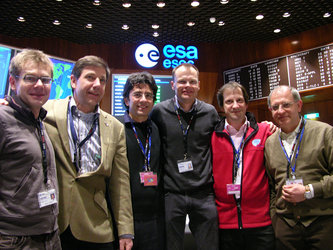
"On Tuesday last week, we fired the B-unit of the electric ion propulsion, stepping it through 1, 3 and 8.3 mN of thrust. On Thursday, we fired the A-unit. Both are performing nominally," said Spacecraft Operations Manager Juan Piñeiro, speaking at, ESA's European Space Operations Centre (ESOC) in Darmstadt, Germany.
"Next comes the 'wake up' for the instruments, which puts us in the position to start operating the first-ever gradiometer to be flown in space. After confirming they work, we will be ready for intensive testing of the satellite and of the scientific data-processing system on the ground, which will be managed at ESA's Earth Observation Centre in Frascati, Italy," said Rune Floberghagen, GOCE Mission Manager.
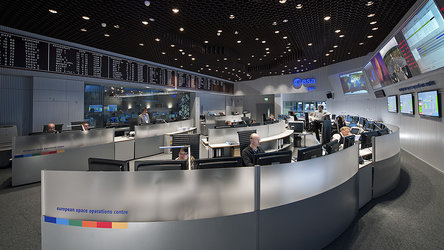
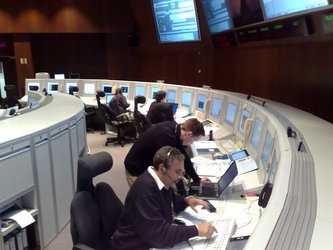
The Flight Control Team is now working from the GOCE Dedicated Control Room at ESOC, and has continued with a series of operational checks since the end of the critical Launch and Early Orbit Phase on 20 March.

Prior to commissioning the electric ion propulsion, GOCE was in free flight (not powered) and is now at an altitude of approximately 280 km, gently decaying at a rate of about 190 m/day.
GOCE is the first ESA satellite employing drag-free control, in which the satellite is in pure freefall around Earth, and is one of the first-ever satellites to use electric ion propulsion to continually compensate for atmospheric drag. The Drag-Free and Attitude Control Subsystem (DFACS) performs autonomous determination and control of the satellite’s attitude pointing, angular movements and linear and angular accelerations.
The DFACS uses, among other inputs, signals from the Electrostatic Gravity Gradiometer (EGG) - the primary on board scientific instrument - to provide information on the drag experienced by GOCE. The propulsion is then varied automatically to maintain the required velocity and altitude.
GOCE also orbits at an extremely low altitude, so atmospheric drag and solar activity have important effects on the trajectory. Solar heating causes the upper atmosphere to expand, increasing the amount of drag that GOCE experiences at a given altitude.
"Solar activity is now in an extended minimum period, so the atmosphere is actually less thick and GOCE is experiencing less drag than forecast," says Marco Antonio Garcia Matatoros, GOCE Lead Flight Dynamics Coordinator.