
How to drop in on Titan
You need to have thought of almost every eventuality when landing on a distant moon in a remote corner of the Solar System. You must have tested your spacecraft to its limits to be sure it will withstand the extreme conditions expected on Titan, a moon of Saturn.
Moreover, you have to gather in advance as much information as you can about the way your instruments will work in those conditions. It is only when the scientific instruments work properly that you can say your mission has been successful.
Descending through poisonous gas

In early 2005, ESA's Huygens probe will descend through the cloak of noxious gases surrounding Titan, Saturn's largest and most mysterious moon.
An Italian-led team of European scientists and engineers have ingeniously tackled the challenges of testing the reliability, behaviour, and response of some of the probe's instruments in actual operation — not simulations.
Using a combination of balloon and parachute, the team had a creative way of testing a full-scale replica of the Huygens space probe — they dropped it from 33 kilometres above the Earth! The air we breathe on Earth is very different from the poisonous smog of Titan, but Jean-Pierre Lebreton, ESA Huygens Mission Manager, says that the way in which the properties of our atmosphere change are similar to the behaviour of Titan’s atmosphere.
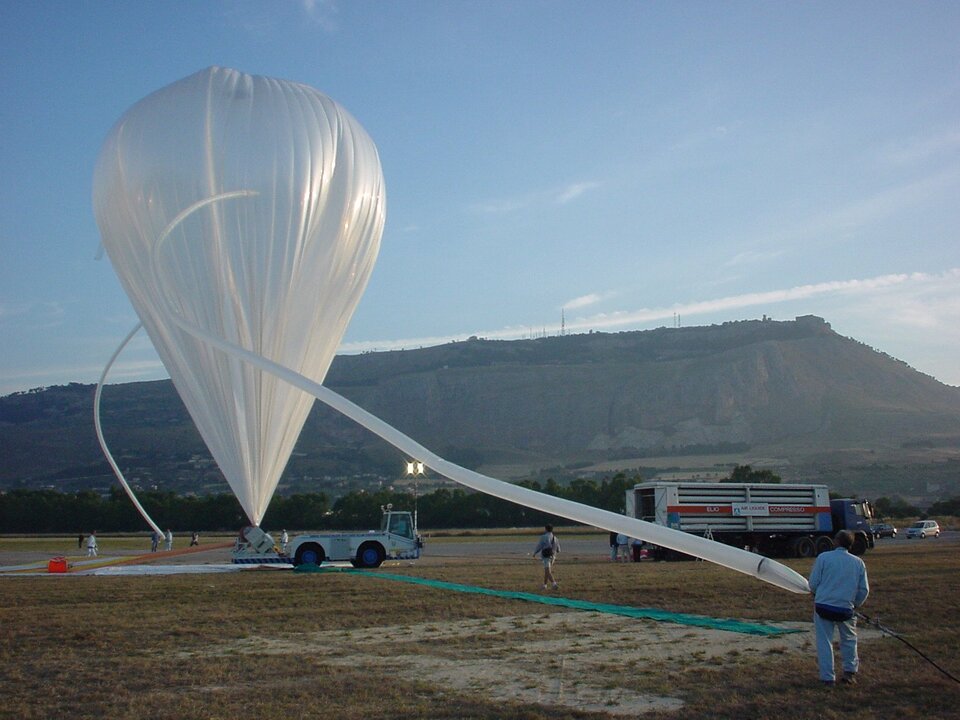
On 6 June 2003, the scientists gathered at the Italian Space Agency's Trapani balloon-launch facility in Sicily. To launch the 500-kilogram gondola carrying the mock-up Huygens space probe, they used a helium balloon that fully inflated to a diameter of 100 metres (corresponding to a total volume of 400 000 cubic metres) at its maximum altitude. When the balloon reached a height of 33 kilometres, a release mechanism opened and dropped the probe.
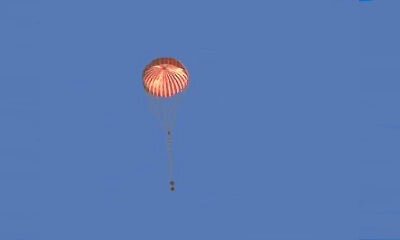
The on-board parachute deployed to slow the probe's fall from 40 metres per second to just 4 metres per second. At that speed, the probe floated gently back to Earth, taking about 30 minutes to complete its journey beneath the ten-metre-wide parachute. This parachute was designed to provide a fall speed very close to the one expected at Titan.
"Altimeter 1, are you receiving me?"
The flight allowed scientists to collect data under conditions which are as representative as possible in Europe of the future flight to millions of kilometres away from the Earth. In this way, they can really begin to understand the instrument characteristics very well. Scientists call this process 'calibration'.
Not only are these training exercises important to understand the behaviour of the instruments and the data, they also contribute to building team spirit for when the real thrills start at Titan!
This drop was the fourth test flight of the Huygens instruments on Earth (the first such test took place in Spain during 1995, the following two were done in Sicily). This flight was the first to have a fully equipped Huygens mock-up, including the complete Huygens Atmospheric Structure Instrument (HASI) provided by Italy. Once on Titan, the purpose of HASI will be to study the temperature, pressure, electrical properties, and the winds in this exotic atmosphere.
A mock-up of one of the two Huygens altimeters, mounted on the replica probe was also tested during this balloon flight. The altimeters measure the probe's height from the ground. "We have analysed the data. From what we have seen so far, the altimeter worked well," says Lebreton. "The test makes me very confident that the two altimeters on Huygens will work well at Titan."
"One of the other exciting and comforting aspects of this test flight was to see how good the probe was at stabilising itself during the descent when atmospheric turbulences disturbed the fall, thanks to its special parachute design. We can then confidently expect we will have a flawless drop through Titan’s atmosphere in early 2005," says Enrico Flamini, ASI Project Manager for Huygens, responsible for this test campaign.
The scientists are now considering a final drop during 2004 over Antarctica. This location is the one on Earth that best resembles Titan's atmospheric conditions, in terms of pressure, electrical properties, and temperatures. Titan's temperatures can drop to about –180°C!