About Observing the Earth How does Earth Observation work?How to get Earth Observation dataIntegrating Earth Observation in your jobEarth Observation users speakEO programmes The Living PlanetGMESESA's Earth Observing missions Envisat overviewERS overviewEarth Explorers overviewSentinels overviewMSG overviewMetOp overviewProba-1 overviewThird Party Missions overview Opportunities with us Multimedia Services CalendarSubscribe
|  |  |  |  | | | Envisat MERIS first check-up of the Earth - The story in pictures 28 March 2002
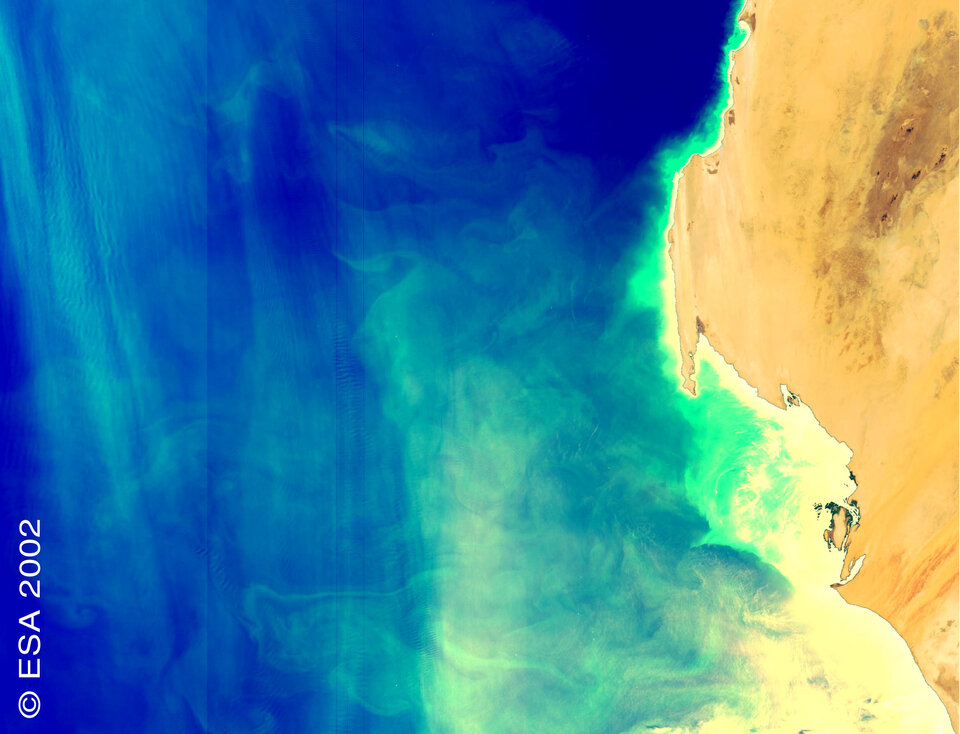
| | | |  | | Small, single-celled phytoplankton play a key role in the marine food chain. They convert sunlight, carbon dioxide and nutrients into carbohydrates on which nearly all life in the ocean depends.
In most parts of the Earth's ocean, phytoplankton concentration is extremely low. However, in “upwelling areas,” deep water is pumped up to the surface by strong winds, such as trade winds blowing parallel to the coast. This deep water is rich in nutrients and as this supplies phytoplankton with the nitrogen, phosphate and silicate they need for their growth, which supports the whole food chain.
The most important fishing grounds can be found in these upwelling areas. When this upwelling process collapses, as for instance off the Peruvian coast during El Nino events, the ecosystem is dramatically disrupted. Climate change has an impact on the intensity and geographical position of upwelling areas, which, in turn, has important consequences to fishing industries and those who depend on them.
Technical Information:
Instrument: MEdium Resolution Imaging Spectrometer (MERIS) on board Envisat
Date of Acquisition: 22 March 2002
Orbit number: 306
Instrument features: Full resolution image (300-meter resolution).
MERIS was designed to measure the concentration of phytoplankton. The colours seen by MERIS indicate the concentration of chlorophyll, the pigment that phytoplankton use for photosynthesis. MERIS can detect chlorophyll concentrations as low as 0.01 microgram, or 1/100 000 000 of a gram, per litre. MERIS data will be used to monitor the worldwide distribution of phytoplankton and to compute primary production.
Credits: ESA |  |  |  |  |
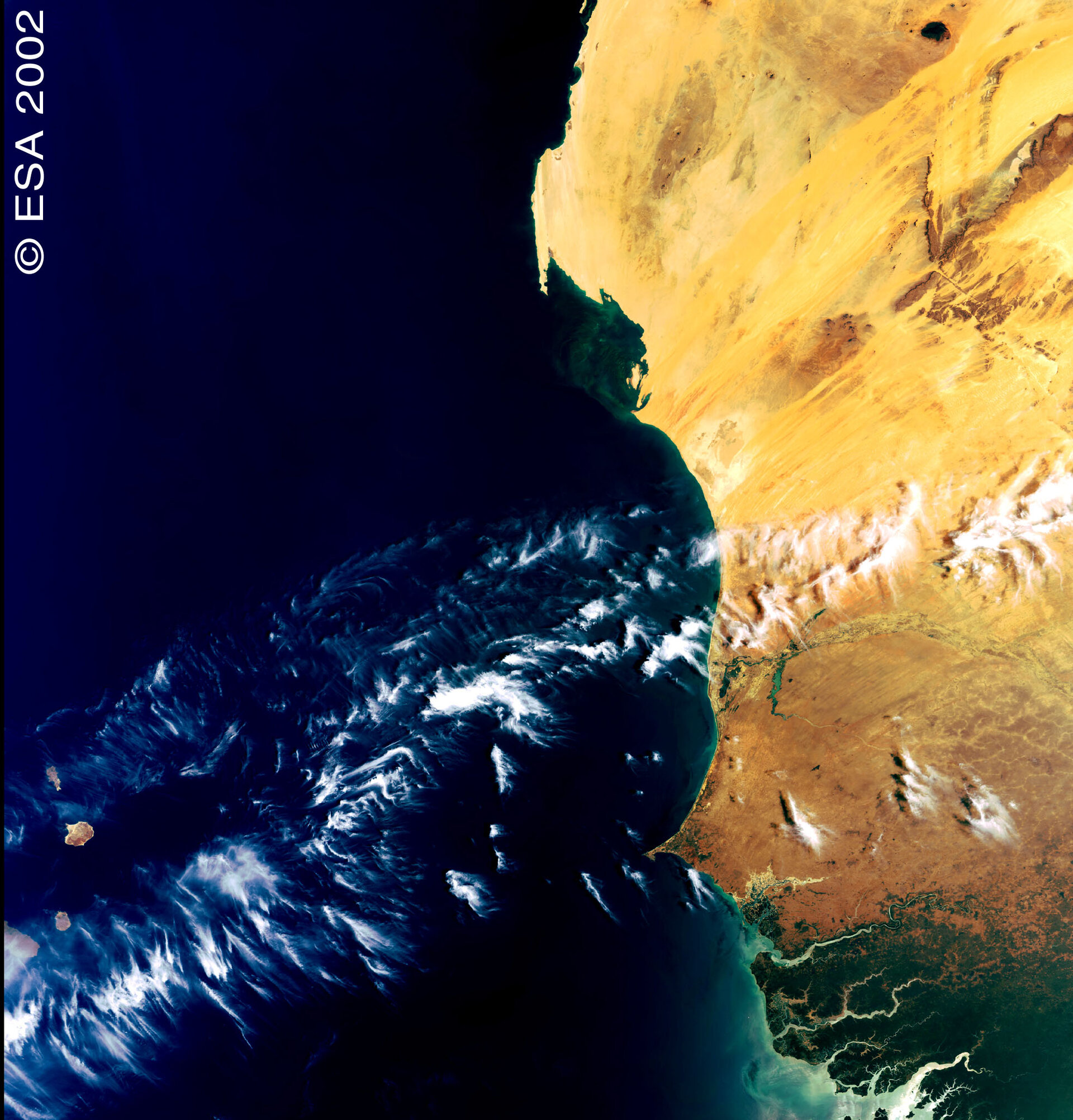
| | | |  | One of the first photos taken by Envisat, ESA's Earth observation satellite on 22 of March 2002.
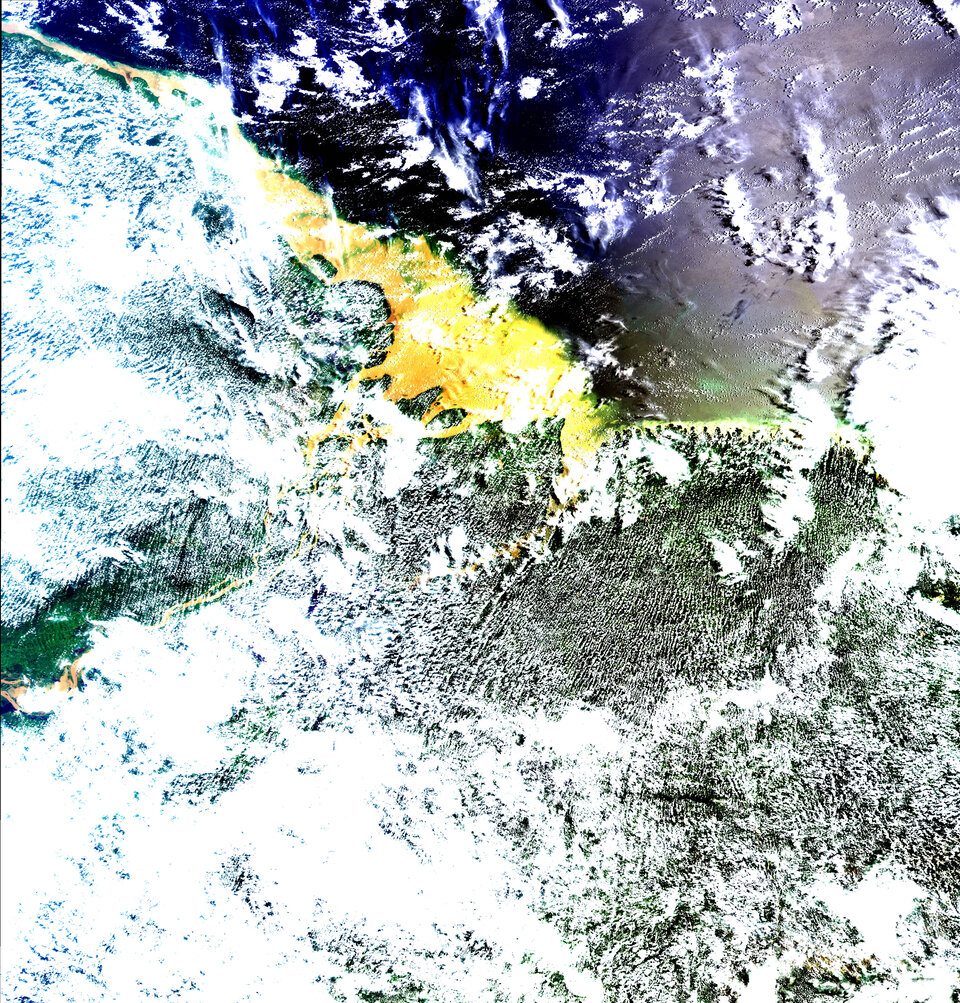
This MERIS image shows the complex river system inside Casamance with its heavy discharge into the sea. A series of such images are needed to monitor the transport of sediment which arises from inland soil erosion.
This scence covers the transition zone between savannah in the north and tropical vegetation in the south. MERIS can also monitor the intensification of land use which leads to increased erosion and soil loss.
Technical Information:
Instrument: MEdium Resolution Imaging Spectrometer (MERIS)
Date of Acquisition: 22 March 2002
Orbit number: 00306
Instrument features: Full resolution image (300-meter resolution).
MERIS was designed to measure the concentration of phytoplankton. The colours seen by MERIS indicate the concentration of chlorophyll, the pigment that phytoplankton use for photosynthesis. MERIS can detect chlorophyll concentrations of less than 1/10 000 000 of a gram per litre. MERIS data will be used to monitor the worldwide distribution of phytoplankton and to compute primary production.
Credits: ESA |  |  |  |  |
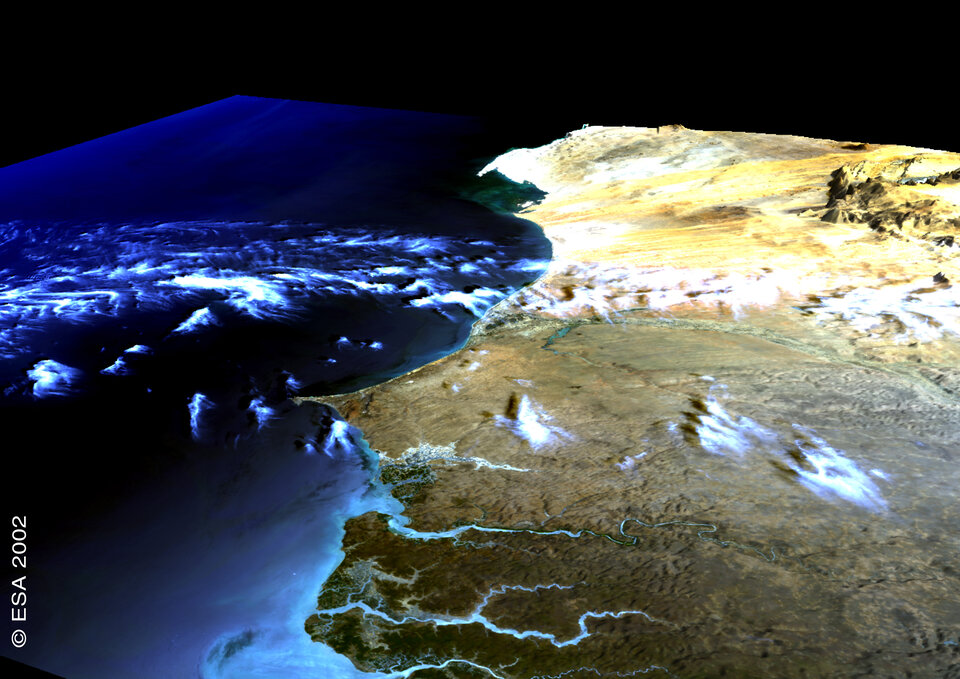
| | | |  | MERIS scene viewed in perspective, with African topography derived from ERS-2 altimeter data.
Credits: ESA |  |  |  |  |
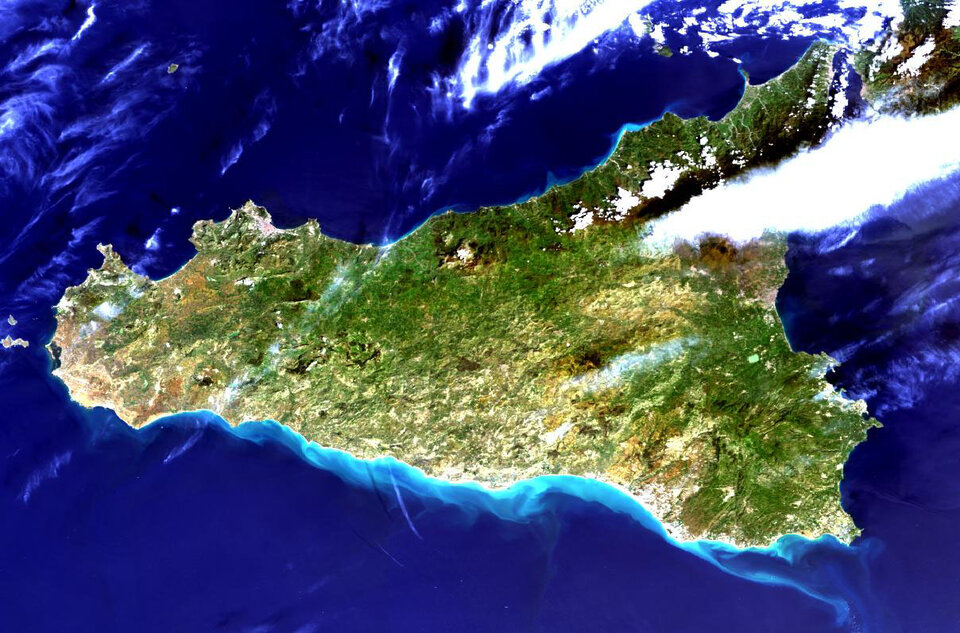
| | | |  | | One of the first photos taken by Envisat, ESA's Earth observation satellite in March 2002.
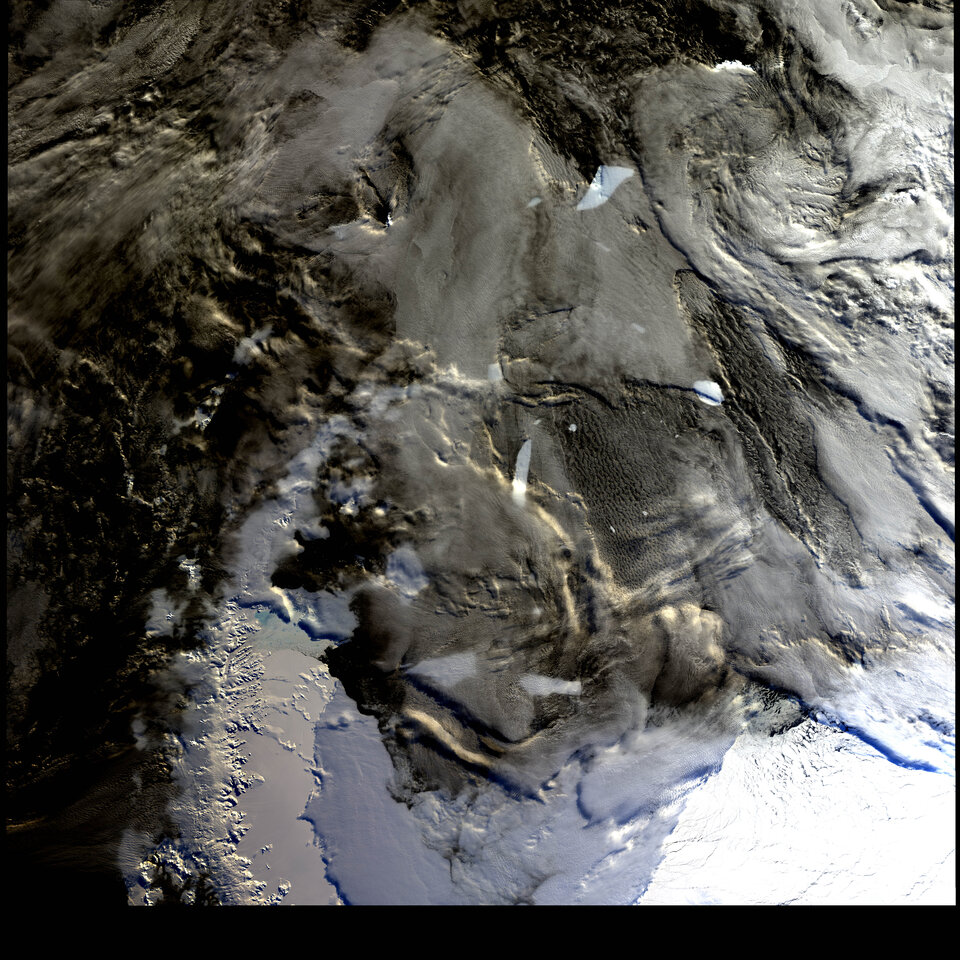
Just as some areas of land are more fertile than others, the same is also true of the Earth’s oceans, these are known as “upwelling areas”. Using ASAR and MERIS together, Envisat has imaged one such upwelling area off the coast of Mauritania, in northwest Africa. The Envisat ASAR image shown here illustrates how the upwelling formed. Upwellings are driven primarily by winds. On this image, a brighter water surface indicates a stronger wind, while surface line patterns indicate wind direction. In this case, trade winds blowing water to the continent’s edge pump deep water rich in nutrients to the surface, which causes a population explosion in local marine life, starting with the phytoplankton.
Credits: ESA |  |  |  |  |
| | | | | | | |  | One of the first photos taken by Envisat, ESA's Earth observation satellite on 22 March 2002.
MERIS has the capability to remote sense phytoplankton by observing their fluorescence. Phytoplankton pigments absorb light in short-wavelength radiation (blue) and partially reemit it at the fluorescence wavelength. This technique is of very high interest in coastal waters where turbidity makes chlorophyll retrieval more difficult than in the open ocean. This image is the very first attempt done to verify the capability of MERIS to detect fluorescence from space. It will take several months of intense field measurements to compare the satellite data to in situ measurements, to perfectly characterize the instrument and make sure high quality data are delivered to MERIS users. The first results are already fascinating and surprisingly rapid.
Credits: ESA |  |  |  |  |
| | | |  | One of the first photos taken by Envisat, ESA's Earth observation satellite, in March 2002.
Flowing more than 6400 km across Brazil, the Amazon River originates in the Peruvian Andes. It is second in length only to the Nile among the rivers of the world.
The Amazon discharge shows the huge amount of sediment it has taken away from the lands it has crossed. It deposits a daily average of 3 million tons of sediment near its mouth. The outpouring of water and sediment is so vast that the salt content and colour of the Atlantic Ocean are altered for a distance of several hundred kilometres from the mouth of the river.
Credits: ESA |  |  |  |  |
| | | | | |
|  |
|