Atmosphere
The Earth’s atmosphere supplies us with the air we breathe and protects us from the radiance of the sun. Recent years have seen much discussion about the changes taking place in the atmosphere surrounding the Earth.
Scientists agree that its composition is altering but are divided as to the extent of the changes and the reasons for them. Far more research and data is needed before we can fully understand whether the changes taking place are a natural ongoing process, the result of our actions here on Earth, or a mixture of the two.
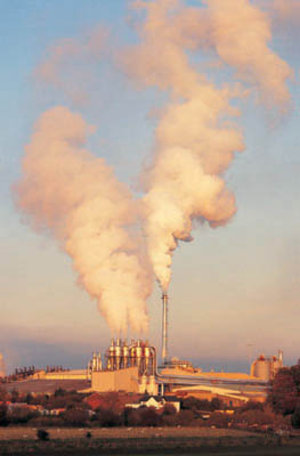
About 200 years ago, when the Industrial Revolution began, the human race inadvertently embarked on a gigantic chemical experiment, pumping massive amounts of carbon dioxide, nitrogen, sulphates, and other trace gases and dust into the air, without thinking of the consequences.

The most significant result so far has been global warming although we remain unsure just how high temperatures could rise. Other nasty surprises have been acid rain, depletion of the ozone layer and an increase in asthma rates. All of these phenomena still have to be fully analysed and further understood before effective remedies can be sought.
To know more we have to see more. For the first time in space history three instruments on board Envisat - MIPAS, SCIAMACHY and GOMOS - can simultaneously observe the atmosphere in ways the human eye cannot, producing detailed horizontal and vertical cross-sections of a series of chemical concentrations, dust particles and clouds, stretching from ground level to 100 km up, on a variety of scales.
This suite of sensors is able to see the holes in the thinning ozone layer, the plumes of aerosols and pollutants hanging over major industrial cities or burning forests, and the exhaust trails deposited in the high atmosphere by commercial airliners.
By witnessing how the atmosphere functions as a dynamic system and how this system reacts to human inputs, Envisat helps predict what the future consequences of our actions might be and provide reliable indicators to support the ongoing debate over global warming and its effects on the Earth.