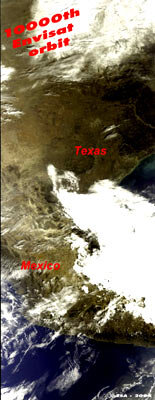
Envisat completes its ten thousandth orbit around Earth
Around 7pm CET on 28 January 2004, ESA's Envisat spacecraft completed its ten thousandth orbit of the Earth – travelling a distance of 450 million kilometres since launch, equivalent to taking a trip to Mars.
Envisat orbits our planet every hundred minutes, moving at a velocity of more than seven kilometres per second.
This lorry-sized spacecraft is the most complex environmental satellite ever launched, with ten different instruments mounted on its hull to study Earth's land, oceans and atmosphere.

These instruments were developed and built by scientists and industrial teams from all across Europe.
They include the Advanced Synthetic Aperture Radar (ASAR) that sees through clouds and darkness to continuously return radar pictures and the Medium Resolution Imaging Spectrometer (MERIS) imaging ocean colour and land cover.
Envisat's Advanced Along-Track Scanning Radiometer (AATSR) records global ground and sea surface temperature, while the Radar Altimeter-2 (RA-2) measuring surface height to an accuracy of a few centimetres. A trio of atmospheric instruments map trace gases and pollutants.
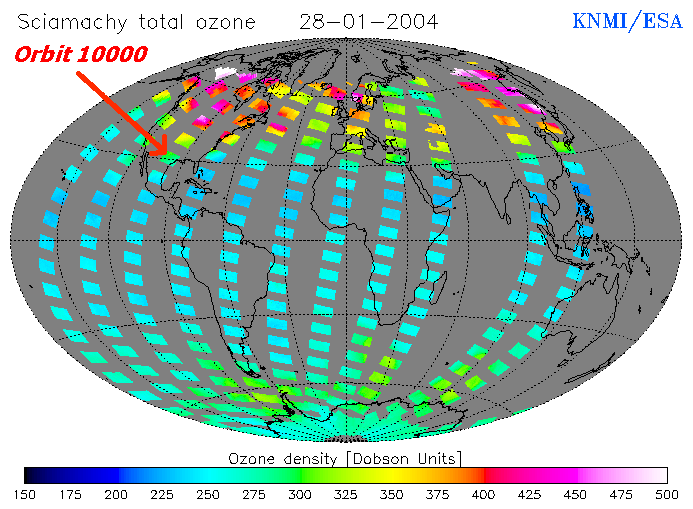
Envisat completed its latest milestone as it passed over the equator 800 km above the middle of the Indian Ocean.
During its ten thousandth orbit, as for any of its 14 daily orbits, Envisat was using all of its ten instruments to gather information about the world below it, and the satellite ground segment generated about ten gigabytes of data products.
Next month Envisat will have spent two years in orbit: it was launched on 28 February 2002 by Ariane-5 rocket from the Kourou spaceport in French Guiana.
Dozens of images acquired by Envisat instruments since then are collected in ESA's Multimedia Gallery.