FRINGE scientists use radar vision to see the Earth move
Tiny ground movements that occur too gradually to be seen by the human eye can nevertheless be detected by ESA satellites looking down to Earth from 800 km away.
At a workshop in Italy last week, researchers explained how they are using this ability to monitor volcanoes and earthquake zones, aid oil and gas prospecting, observe urban subsidence and measure the slow flow of glaciers.
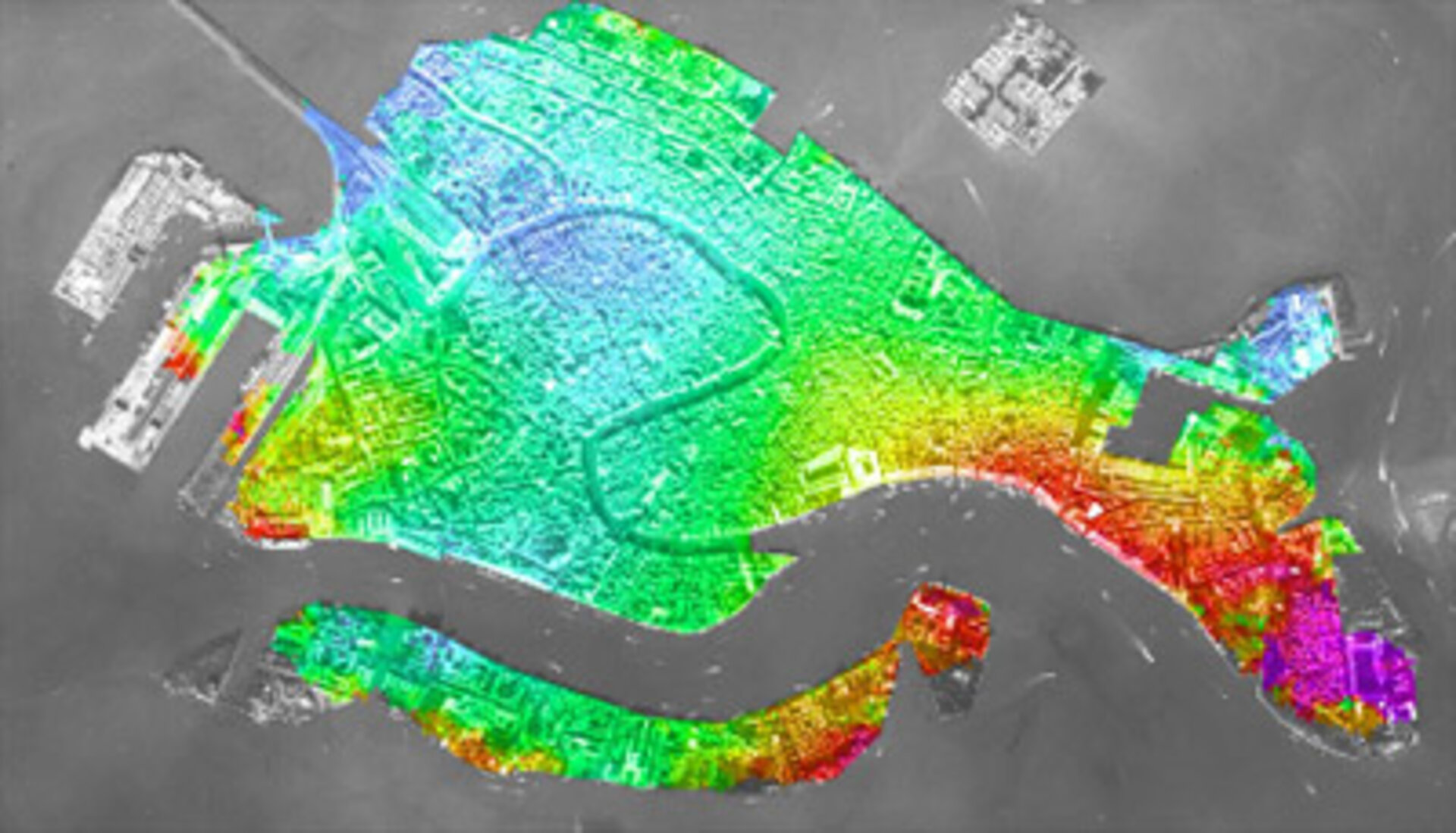
Data from Synthetic Aperture Radar (SAR) instruments like those flown aboard the ERS spacecraft and Envisat are the basis for a technique called SAR interferometry, or InSAR for short. InSAR involves combining two or more radar images of the same ground location in such a way that very precise measurements – down to a scale of a few millimetres – can be made of any ground motion taking place between image acquisitions.
Very small movements can potentially be detected across wide areas: tectonic plates grinding past one another, the slow 'breathing' of active volcanoes, the slight sagging of a city street due to groundwater extraction, even the thermal expansion of a building on a sunny day.
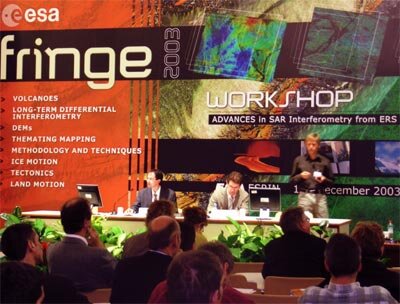
More than 230 researchers from all across Europe, plus the United States, Argentina, Korea, Indonesia and China met in Frascati near Rome from Monday 1 December. They were attending the third ESA International FRINGE Workshop, a five-day gathering devoted to InSAR advances from the ERS and Envisat missions.
More than 110 papers were presented by Principal Investigators during the Workshop, with dedicated sessions on specialist subjects including tectonics, land motion, volcanoes and ice movement.
Precise views of changing landscapes
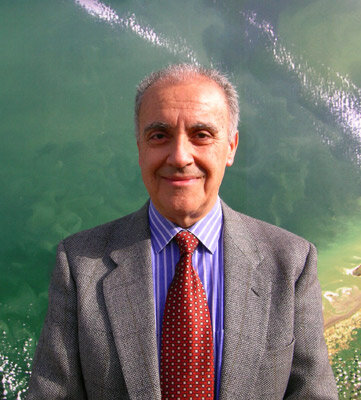
"Collecting multiple images of the same landscape might at first sound boring, until you realise the extraordinary level of precision with which InSAR shows us how that landscape changes," explained Prof. Fabio Rocca of the Milan Politecnico, who has worked in this field for the last two decades.
"The technique really came into its own since ESA launched its first ERS satellite in 1991. The decision was made to archive all ERS data, which was courageous as data storage was so much more expensive then. Now that decision is paying off because all the archive is available for InSAR use."
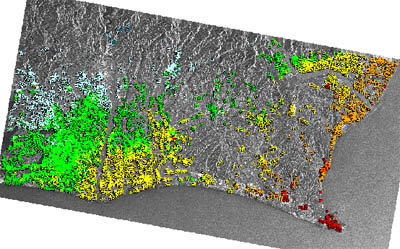
Radar images record the backscatter of microwave pulses reflected off the Earth's surface, and so measure relative surface roughness – the brighter a given point shows up, the higher its roughness, and backscatter. Smoother surfaces tend to bounce radar pulses away from the spacecraft's field of view.
"It is very different to looking at optical wavelengths, and one of the subjects we are discussing at the Workshop is how to work out more accurately what we are seeing," said Rocca. "We are looking with different eyes – think of it as like the eyes of the Terminator! At optical wavelengths the surface of a building reflects light, but at radar wavelengths we pierce through the walls of the building to the steel skeleton beneath – its sharp corners give it high radar reflectivity.
"Features like vegetation or loose soil can be difficult to image clearly, and can move between acquisitions causing an InSAR image to lose coherence. So for reference we use fixed and high reflecting points in a landscape like buildings, large rocks or even the poles holding up a tennis net. We call them permanent scatterers and they function in the same way as trig points for ground-level mappers."
Watching over a 'breathing' volcano
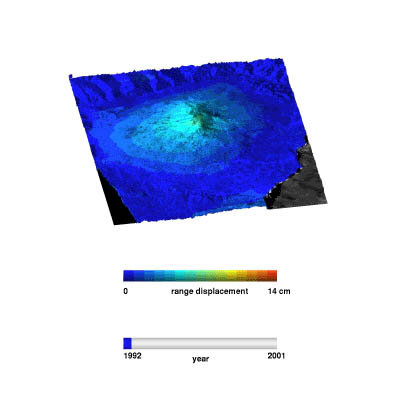
Researcher Paul Lundgren of the California-based Jet Propulsion Laboratory – working with Italy's National Research Centre Institute for Remote Sensing of the Environment (IREA-CNR) in Naples - has mined the ERS data archive to produce more than a hundred interferograms of Mount Etna. Acquired between 1992 and 2001 they reveal terrain shifts as large as 14 cm taking place between measurements.
The volcano appears to alternately inflate and deflate depending on the pressure of its underground magma chamber, and a gravity-driven spreading movement has also been observed. By turning the interferograms into an animation, the volcano appears to be breathing.
Lundgren's intention is to better understand the connection of surface deformation to subsequent volcanic activity, and increase our ability to predict volcano behaviour. He plans to make use of Envisat data in future to continue his survey.
"With ERS overflying it every orbit, Etna is a great volcano to study because there's lots of data, and there's lots of relatively new lava flows on its slopes which make for good InSAR coherence," said Lundgren. "It's not as dangerous as the likes of Vesuvius but while that volcano stays dormant for long periods Etna does a lot, and by measuring its displacement we've learned a lot about the complexity of its underlying structure and what is happening inside."
A lost world sealed off under tonnes of ice
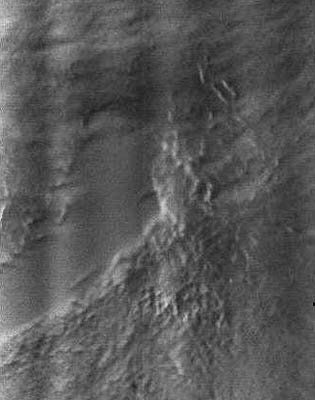
InSAR has also been used to look beneath a polar ice sheet four kilometres deep and learn more about conditions prevailing in one of the strangest environments on Earth. Lake Vostok in the East Antarctic is a 280-km-long freshwater lake that has been buried beneath the ice sheet for at least half a million years.
A combination of crushing pressure, geothermal heat and the insulation of the thick ice above it is thought to keep the waters of Lake Vostok liquid. What remains unknown is whether any life exists in this dark, cold, low-energy environment, entirely cut off from the rest of the world. Researchers have decided not to drill into the Lake until they can be certain they will not contaminate its pristine waters with topside bacteria.
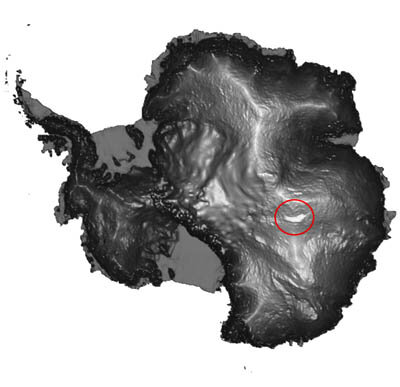
Although Lake Vostok is off-limits for now there are indirect ways of seeing beneath the ice. Back in 1993 ERS data was employed to help map the Lake's full extent, establishing the ice directly over it was much flatter than that around it. More recently, German researchers have used ERS interferograms to establish that - despite their distance from the surface - the waters of Lake Vostok are stirred by daily tides.
During the FRINGE ice session, Anja Poetzch of the Dresden Technical University presented details on how pair of interferograms acquired during ERS-1 and 2 tandem operations in 1996 demonstrated a maximum vertical displacement of 15 mm above Lake Vostok, corresponding to tidal motion. Results from in-situ GPS observations carried out during the last two Antarctic summers confirm the conclusion.
Missions to come

Future planned radar satellites were discussed on the final day of FRINGE, and high on the list of recommendations from participants was the need for to ensure continuity of coverage so ESA's SAR data archive will extend well into the 21st century.
Both ERS and Envisat have identical orbits and their radar instruments are based around C-band wavelengths (code letters are an inheritance from radar's early use in World War Two). For a future spacecraft's radar imagery to be back compatible for InSAR, it would have to follow the same orbit and radar wavelength.
The importance of having a follow-on C-band mission to ensure continuity of both wide area SAR and InSAR capability was also a key finding of October's meeting of ten consortia developing services within Global Monitoring for Environment Security (GMES) Service Element programme. GMES is a joint venture between ESA and the European Union to use satellite data to gather global environmental and security intelligence.
Radar missions that go beyond C-band were also discussed during FRINGE. A proposed ESA Earth Watch mission called TerraSAR-L is currently in the study phase. It is so named because it would employ longer wavelength L-band radar, of greater use over vegetated surfaces.
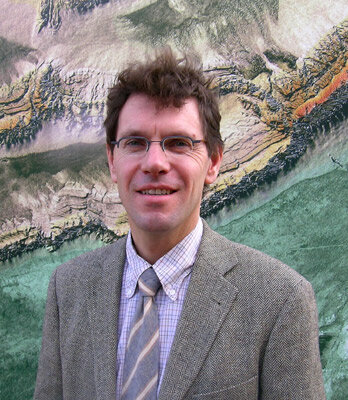
Dr. Richard Bamler of the German Aerospace Centre DLR explained how TerraSAR-L could work in concert with TerraSAR-X, a German mission using the short wavelength X-band wavelength to resolve objects as small as one metre and intended for launch in spring 2006.
" Potentially our spacecraft might map the corners of a field while TerraSAR-L identifies its contents," said Bamler. "X-band can map the layout of suburban roads, or see details of forests that appear greyed out on longer wavelengths. There is also experimental instrumentation to measure fast velocities on the ground – we will track the speed that cars on a motorway move."
The mission is an indication of the growing market for InSAR data, Bamler added: "It is a public-private partnership between Astrium, whose subsidiary Infoterra gets commercial rights to the data, and DLR, taking charge of scientific exploitation. We have a detailed business plan."
The increasing size of the market was a point also emphasised by Rocca: "A distinctive community of InSAR users has developed, and now we are coming back to ESA with our user requirements for further missions. The growing number of end users – including the insurance industry, railways and oil and gas companies – recognise the value of the technique and require its continuity into the future."