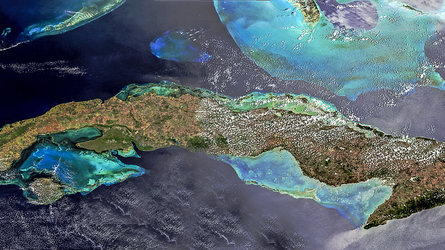
Earth from Space: 'Where good things grow'
This image captures the meticulously planned cultivated landscape of the autonomous communities of Aragon (west) and Catalonia in north-eastern Spain.
Many agricultural crops can be seen growing including wheat, barley, fruits and vegetables. The circular shape of many of the fields indicates central-pivot irrigation is being employed; a well drilled in the centre of each circle supplies water to a rotating series of sprinklers.
The black zigzag pattern in the bottom right represents thick, lush trees.
Earth observation satellites are used in agricultural monitoring for mapping and classifying land use, crop type, crop health, change detection, irrigated landscape mapping and crop area mapping.
This image from the Korea Multi-purpose Satellite (KOMPSAT-2) of the Korea Aerospace Research Institute was kindly provided under ESA Third Party Mission co-operation. Launched in 2006, Kompsat-2 was developed to ensure continuity with its predecessor, Kompsat-1.
ESA supports the Kompsat series as a Third Party Mission, meaning it distributes data to scientific users in Europe.