Satellites assist planners preventing floods
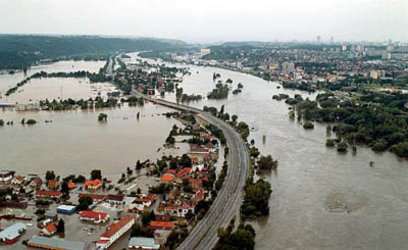
Virtual floods modelled inside computers are an increasingly useful means for authorities to prepare for genuine river surges. With flooding classed as the world's most costly natural hazard, an ESA project has assessed using satellite imagery to improve flood simulation models.
Flood control and management represents a major challenge for water authorities, and as the global incidence of flooding increases, it has also become a subject of concern for the global insurance industry.
The US Geological Survey estimates that flooding is the world's most costly type of natural disaster, costing €170 billion ($200 billion) between 1991 and 1995. Last year's European floods alone are reported to have caused more than €7 billion of damage.
Like everything linked to the weather, floods are difficult to predict – a few days of steady rainfall might be sufficient for a river to burst its banks.
What software-based flood simulation models can do is foretell how a river will behave if it does flood, and allow authorities to assess their best course of action.
"Here in Flanders, we are responsible for maintaining our many rivers and waterways, and are also tasked with preventing or controlling floods," explained Project Engineer Ingrid Boey of the Flemish Water Authority AWZ, end user for ESA's FAME (Flood risk and damage Assessment using Modelling and Earth observation techniques) project.
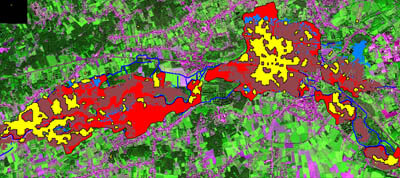
"A useful research technique for us is by creating hydrodynamic simulations of our various river basins. Originally these were physical scale models – we still have those - but numerical models running in computers are increasingly important. We can use them to see what actions should be taken in particular scenarios, such as employing controlled flooding areas, locally raising dikes higher, activating pumping stations or - in extreme situations - ordering evacuations.
"From next year our models are going to used operationally to make predictions in real time, so it is vital we are sure they are as close to the real world as possible."
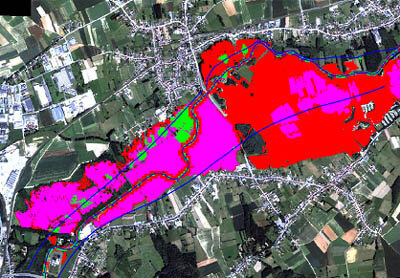
The problem comes in converting what are essentially one-dimensional computer models of water levels and flow into accurate depictions of the two-dimensional spatial extent of flooded areas. And when it comes to checking the models against historical floods, fully accurate spatial and temporal records can be hard to find.
"We find water levels have been recorded, but not always the full spatial extent," explained Boey. "Aerial photos are often not available, and even when they are, they don't always cover the whole of the flooded area. Also needed are hard facts on the duration of the flood. We end up with one person remembering three days, and one person recalling two."
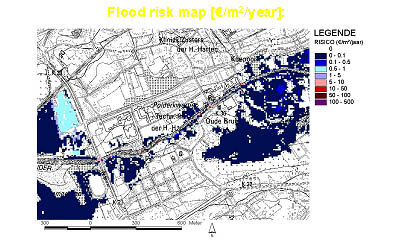
The idea behind the FAME project was to use satellite data as an additional means of mapping flood extent in zones close to rivers as well as creating more accurate flood risk maps and carrying out post-flood damage assessment. Project partners included SADL (Spatial Applications Division Leuven), Sarmap and D'Appolonia.
Project manager was Professor Patrick Willems of the University of Leuven's Hydraulics Laboratory: "Our lab oversees the creation of flood control models, so I came at the problem more from the side of the user than the service provider. We focused on two flood-prone rivers, the Dender and the Demer."
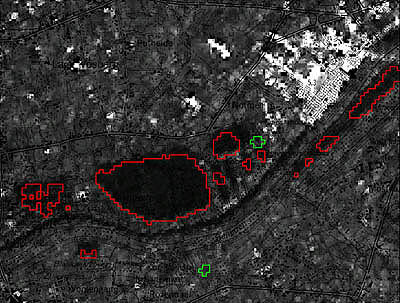
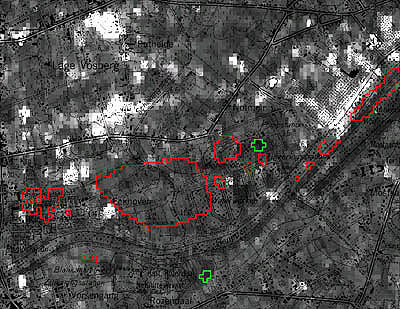
ERS and Envisat radar images were acquired for the rivers corresponding to historical floods that occurred in 1993, 1995, 1998 and 2003. Because radar imagery records surface roughness instead of reflected light, it is a good means of detecting flowing and standing water. High resolution IKONOS and Landsat-ETM optical imagery became the basis of risk maps; products valued by the insurance industry as well as water authorities.
"With risk mapping you are combining three different variables," explained Willems. "First is the spatial extent – which areas will flood. Then comes the type of areas will be affected; a flooded meadow won't cause as much damage as an inundated urban area. The final variable is the return period – will the flood recur once a year, every ten years or every 100 years?"
Combine them together and you can quantify how likely flood damage is for a given area, and be guided how much should reasonably be spent either to guard against it or insure against it. AWZ has already updated flood damage and flood risk maps in the two river basins based on the high-resolution imagery.
With historic flood mapping for simulation calibration, Envisat data was found to be more accurate than ERS. Envisat's Advanced Synthetic Aperture Radar (ASAR) instrument has several advantages over its predecessor, including beam steering capability for increased temporal coverage, a wide swath option and alternating polarisation modes – all of which give it an edge in flood detection.
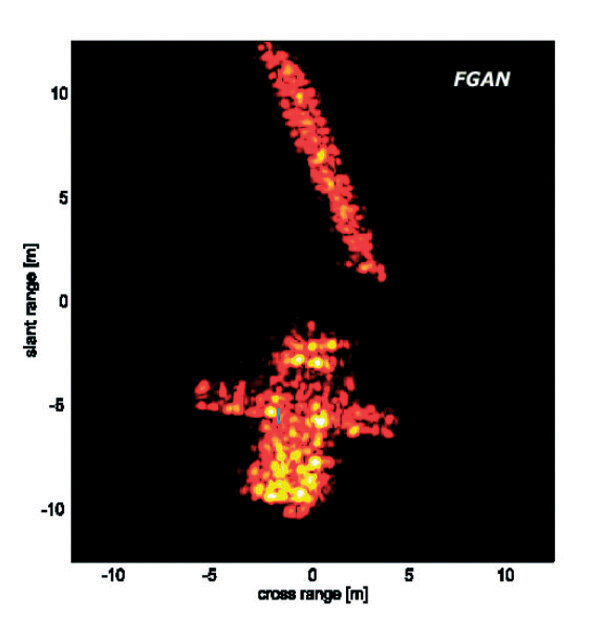
The FAME project is now formally concluded, although AWZ hopes to acquire Envisat and Radarsat data in tandem if further flooding occurs this winter, which would give an effective revisit time of one or two days. A decision has still to be made on extending the FAME service, which was funded by ESA's Data User Programme.
"Combined with other flood information sources, satellite data can definitely be effective," said Boey. "Flanders is not a big place, so a few satellite images have the potential to provide us with objective knowledge of the whole area.
"For us, a very useful part of the FAME project has been familiarising ourselves with the area of Earth Observation, and so making it much more likely we will make operational use of it in future."