Good vibrations
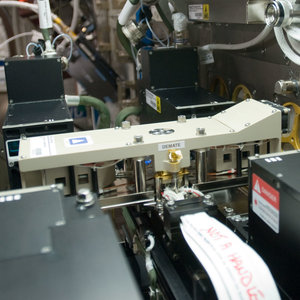
Scientific research is flying high on the International Space Station. The shoebox-sized 'SODI-IVIDIL' experiment in Europe’s Columbus laboratory module has already provided scientists with thousands of fascinating images of an everyday phenomenon: the behaviour of liquid mixtures under vibration.
As every cook and chemist knows from experience, if you want to mix different liquids you need to shake them. Left on its own, it is a very slow process. This 'natural' mixing is known as diffusion, and basically it is all about random movement of molecules from one area to another. Scientists are trying to understand how vibration influences diffusion by observing the behaviour of mixtures exposed to controlled vibrations in the laboratory and with simulations in supercomputers.
The trouble is that, here on Earth, gravity is a major player in this game of diffusion. As molecules have each their own weight, they act differently in gravity and this causes, for instance, movement of liquid from regions of higher to lower concentration, masking the effects of vibrations.
Removing the buoyancy force created by gravity makes the problem more interesting and easier to understand.
A whole lot of shaking
The Influence of Vibrations on Diffusion in Liquids (IVIDIL) experiment is looking at how vibrated fluid mixtures mix through diffusion and how they separate through a form of diffusion caused by temperature differences. This may not sound very exciting, but it goes right to the core of material physics and may advance many everyday chemical processes.
According to theories first proposed by scientists at the Institute of Continuous Media Mechanics in Perm, Russia, vibrations can create a flow when the temperature or concentration is not the same everywhere. This vibrational convection flow is very faint and hard to observe because buoyancy tends to dominate it. Weightlessness is the perfect environment for experiments about mixing induced by vibration.
Valentina Shevtsova, Professor at Université Libre de Bruxelles in Belgium and coordinator of the project, is excited about the preliminary results. "The experimental results have surpassed our expectations. The data received so far allow us to see, for the first time, the flow patterns generated exclusively by controlled vibrations."
The experiment has been able to trace the variation of concentration of about 0.03% from the initial composition. Getting such good results is possible only in long-duration spaceflight conditions.

"Moreover, we can demonstrate the vibrational effects and quantify their impact on the measurement of thermodiffusion coefficients," continues Prof. Shevtsova. "This is a really solid scientific finding and we are really proud of it."
Paradoxically, IVIDIL might also discover some secrets of microgravity. There is always some unavoidable jitter of microacceleration aboard space vehicles that interferes with experiments, and now researchers might be able to see how these 'g-jitters' affect the measurements.
Thousands of images

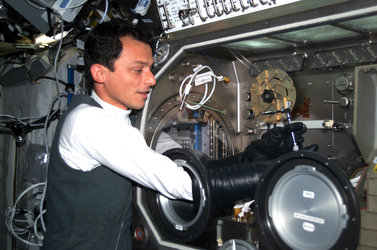
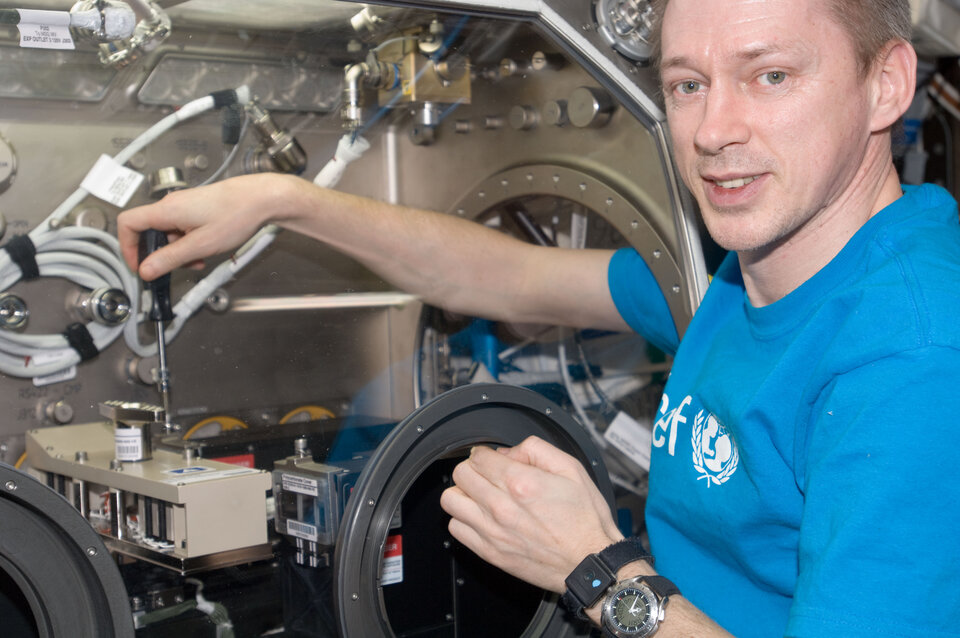
IVIDIL uses the Selectable Optical Diagnostics Instrument (SODI), launched to the International Space Station (ISS) last August. ESA astronaut Frank De Winne and his Canadian crewmate Robert Thirsk assembled it soon after arrival. IVIDIL has been under way since the beginning of October, operated remotely from the Spanish User Support Centre in Madrid, Spain.
In close coordination with the Spanish centre, the science teams are receiving and analysing images and telemetry on a daily basis during the experiment run. This is just for starters: thousands of images will be analysed after the data memory is returned to Earth aboard Space Shuttle Discovery next month, to be handed over to the scientists. "This will keep us busy for quite a while," says Prof. Shevtsova with a smile.

SODI-IVIDIL was proposed and defined by the Microgravity Research Centre of ULB, Institute of Continuous Media Mechanics and Ryerson University in Toronto, Canada as part of the 'European Life and Physical Sciences in space' (ELIPS) programme for the using the ISS.
The experiment is sponsored by ESA’s Directorate of Human Spaceflight, in collaboration with the Canadian Space Agency. It takes place in European-built Microgravity Science Glovebox in the Columbus laboratory.