Microgravity Science Glovebox
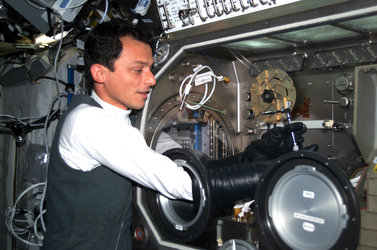
To most people a glovebox is a compartment in the dashboard of a car where manuals, road atlases, various oddments and even occasionally gloves are stored. ESA's Microgravity Science Glovebox is a far more complicated piece of equipment.
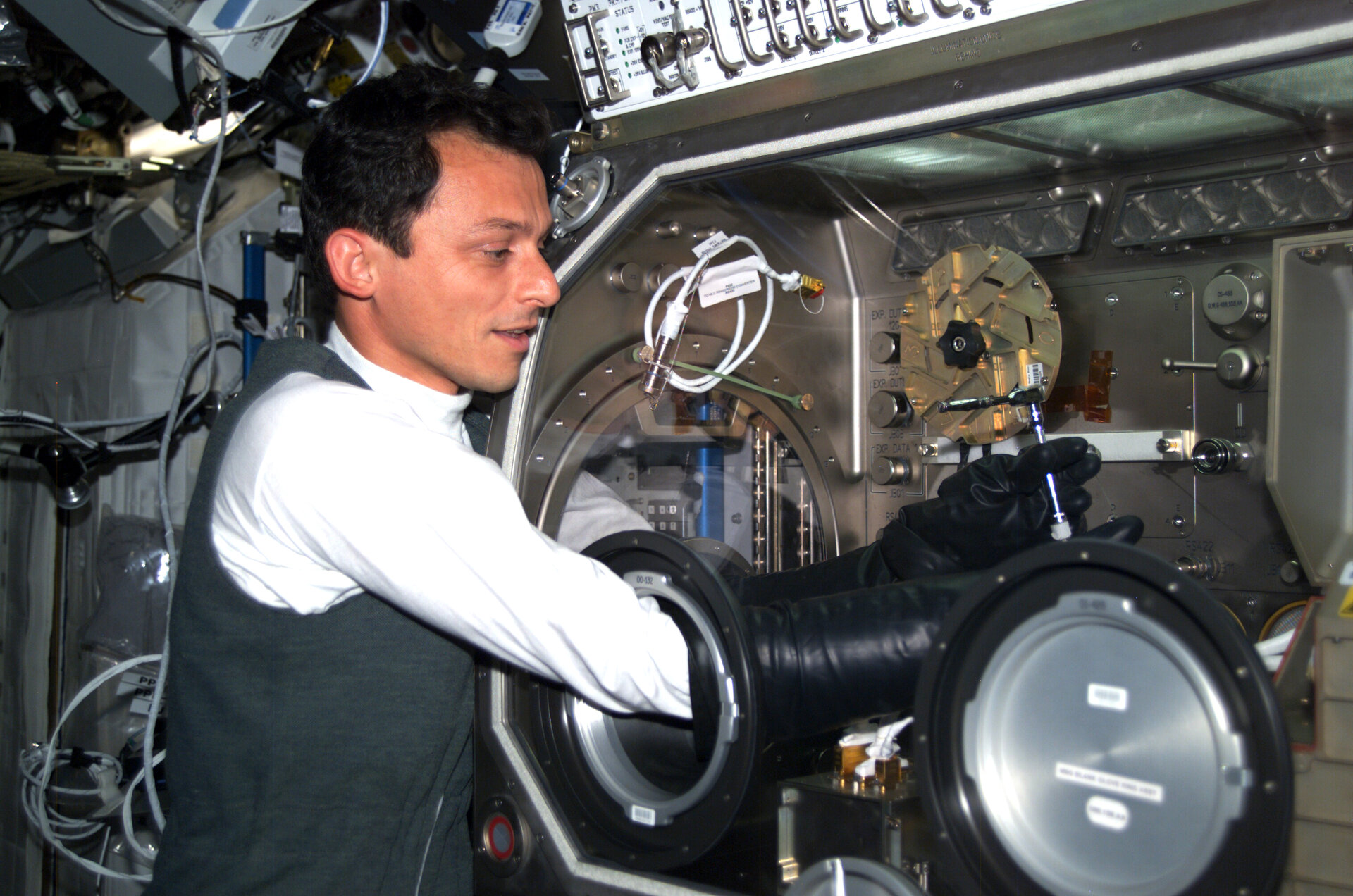
The device allows astronauts on the International Space Station to perform a wide range of experiments in a fully sealed and controlled environment, completely isolated from the rest of the Station. It shares nevertheless the weightlessness of orbit.
The gloves are the access points through which astronauts manipulate experiments, in the field of material science, biotechnology, fluid science, combustion science and crystal growth research.

Scientific gloveboxes are common on Earth. To build a glovebox that will last at least ten years in weightlessness, however, was a much tougher proposition. The Microgravity Science Glovebox had to fit in a standard International Space Station equipment rack and be versatile enough to accommodate a huge range of experiments and materials - including a few that no one had thought of during the design stage.
After being carried into space inside the Multi Purpose Logistics Module Leonardo in the cargo bay of Space Shuttle Endeavour in June 2002, the Microgravity Science Glovebox was installed in the US Destiny lab. The Microgravity Science Glovebox was subsequently moved to ESA's Columbus laboratory after the European module was installed in February 2008. Since then the module has been returned to the Destiny laboratory.
Microgravity Science Glovebox was built by Astrium in Bremen, Germany.
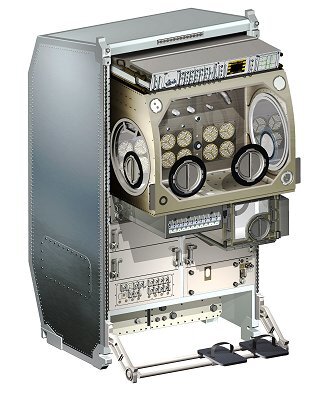
| Microgravity Science Glovebox | |
|---|---|
| Working volume | 255 litres |
| Largest access volume | 40 cm diameter |
| Pressure environment in cabin | Negative pressure with air circulation and filtration |
| Airlock module capability for transfer of payload and equipment | Maximum 40 litres |
| Power |
+ 120 Vdc, + 28 Vdc, +/- 12 Vdc, 5 Vdc |
| Video link (analogue) | Yes |
| Video cameras | 4 |
| Video recorder | 3 + 1 hard disc |
| Gaseous nitrogen | Yes |
| Vacuum and venting | Yes |
| Cooling |
Up to 200 W by air Up to 800 W by cold plate |