ESASSAESOCSpacecraft OperationsGround Systems EngineeringSpace DebrisESOC History
   
Background
About usProfile: The Right Stuff
SSA programme
Space Situational Awareness
Multimedia (click)
Ground Systems Engineering
Ground Systems team at ESOC
Mission families
Solar & planetaryAstronomy & Fundamental PhysicsEarth ObservationHuman SpaceflightTechnology DemonstrationPast missionsESA mission history- Find a mission: A...Z
Mission control centres
ATV Control Centre (ATV-CC)Columbus Control Centre (Col-CC)
Worldwide ground station network
ESTRACK tracking stationsESTRACK Control Centre- Find a station: A...Z
OPS Community
Advanced Mission Concepts & Technologies OfficeHSO ExchangeKnowledge ManagementESA Ground Operation System (EGOS)
Services
PublicationsESA-sponsored conferencesHelpSubscribe


Bookmark and Share


printer friendly page
Redu station
 
Redu facilities
Redu facilities
 
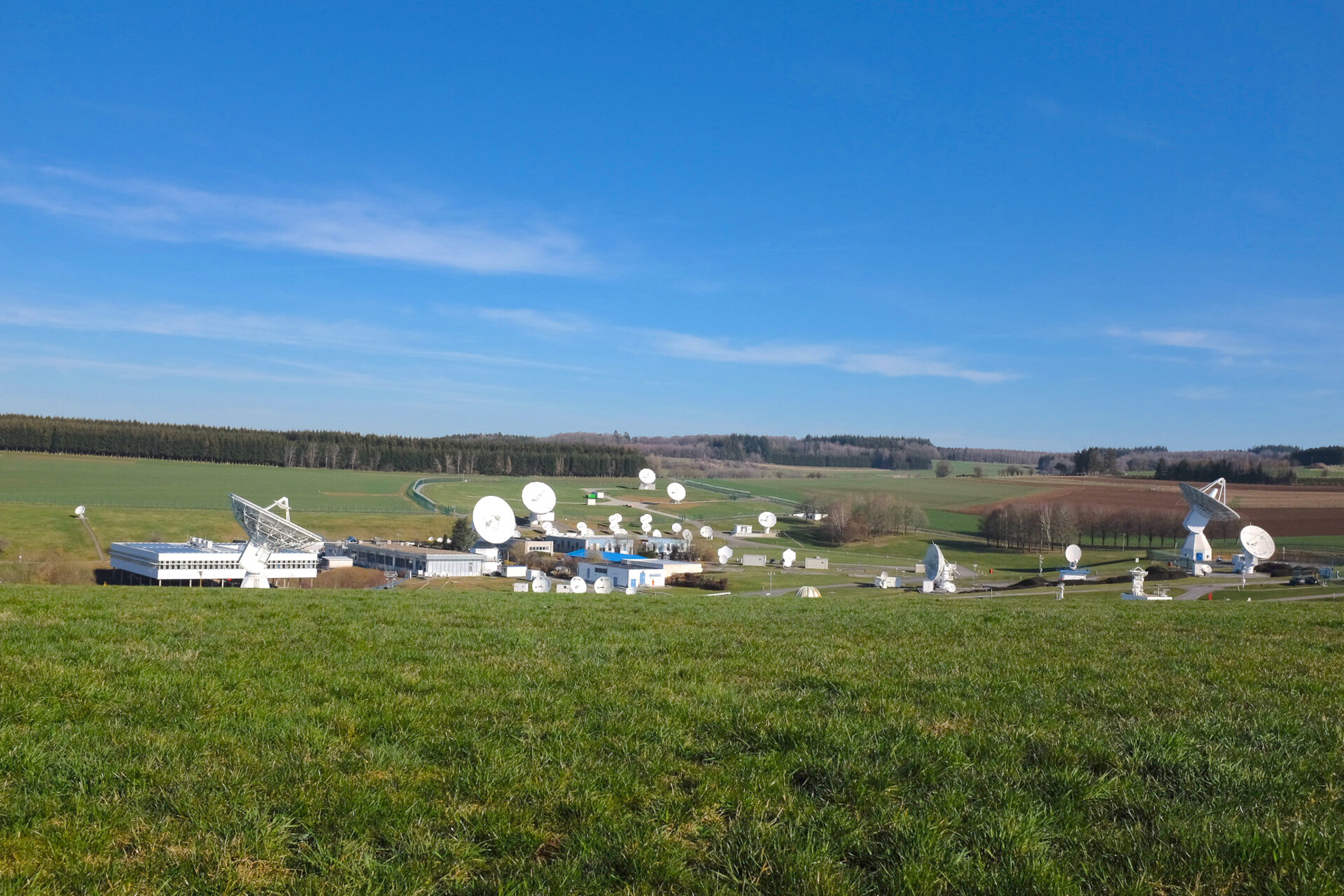
Redu station provides ESTRACK tracking capabilities in S- and Ka-band, and supports in-orbit testing (IOT) of telecommunication satellites. Redu supports ESA's Artemis and Integral missions as well as Proba. The site hosts multiple tracking antennas operating in a variety of frequency bands, and is located in the Ardennes region of Belgium.
 
Location
 
The coordinates of the REDU-1 antenna are +50° 00' 01.64", +5° 08' 43.24". This reference point is 386.6 metres above sea level with respect to the WGS-84 reference ellipsoid, a mathematically-defined reference surface that approximates the Earth's geoid surface.

Redu station is sited about 1 km from the village of Redu, in the Belgian province of Luxembourg.  
 
Facilities & technology
 
Redu hosts the following antennas:

  • REDU-1: 15m-diameter dish antenna with reception and transmission in S-band, used primarily to support Integral
  • REDU-2: 13.5m-diameter dish antenna with reception and transmission in Ka-band, used primarily to support Artemis
  • REDU-3: 2.4m-diameter dish antenna with reception and transmission in S-band, used to support Proba
The terminals provide facilities for tracking, telemetry, telecommand and radiometric measurements (ranging, Doppler, meteo - except REDU-3). The station has a frequency and timing system, a monitoring and control system and communications are enabled via the ESA Operations Network (OPSNET).

Redu station is equipped with its own emergency electrical power generator system and is connected to the Belgian communication network via fully redundant fibre-optic cables. The station is manned 24 hours a day.
 
 
ESA/Redu S-band antenna console
The REDU-3 2.5m S-band antenna is dedicated Proba (Project for On-Board Autonomy), which ESA launched in October 2001. During the periods when there is no visibility of Proba (which is in a polar orbit), the antenna can be used to support other satellites.

A Remote Ranging Terminal (RRT) is installed at Redu as part of the Artemis TTC (Telemetry, Tracking and Command) facilities. The RRT is remotely operated from the Artemis Operations Control Centre located at Fucino, Italy. This terminal operates in Ka-band.

Additionally, a 9m S-band antenna and six 3.8m Ku-band antennas were installed in 2001-02 on behalf of Eutelsat Communications. These terminals are used for TTC purposes for the Eutelsat fleet of satellites. They are linked to the Eutelsat Spacecraft Control Centre in Paris via satellite.

A 9.3m C-Band antenna was installed in 2003 to support G2-SAT.

Control and monitoring

A control centre was installed at Redu in the early 1980s. This centre was initially dedicated to the ECS-series of satellites, which were to be controlled on behalf of Eutelsat.

ECS
The ECS mission comprised five communication satellites, which would be used by Eutelsat to provide intra-European communications for television, telephony and specialised services; all were to be controlled from Redu. ECS-1 was launched in 1983 and ECS-2 in 1984. Unfortunately, ECS-3 was lost due to a launcher failure, but ECS-4 in 1987 and ECS-5 in 1988 were both successful. ECS-2 was retired in late 1993 after more than 9 years of service, ECS-1 in late 1996 after more than 13 years and ECS-5 in mid-2000. After almost 20 years of operations, the ECS mission was terminated in December 2002.
 
 
Artemis
ESA's Artemis mission was launched in July 2001, but unfortunately into an erroneous geostationary transfer. A recovery operation raised Artemis to its geostationary orbit using ion propulsion and Artemis reached operational orbit at the end of January 2003. The Artemis Mission Control Facility (AMCF) performs mission control of Artemis from Redu. Engineers use this facility to schedule the usage of the Artemis data relay payloads using optical, S-band and Ka-band.
 
 
ESA/Redu PASTEL
Redu - PASTEL Monitoring & Control Room
Pastel
The Pastel Mission Control System (PMCS) installed at Redu monitors and controls Pastel, an optical (laser) communications terminal mounted on France's SPOT-4 EO satellite and which communicates optically with a similar terminal, Opale, fitted on ESA's Artemis satellite. Control is achieved via the SPOT 4 control centre, in Toulouse, France.

Integral
Integral was launched on 17 October 2002. Routine communications for Integral are provided by the station at Redu.

Proba
Engineers also control and monitor ESA's Proba satellite from Redu using the SCOS-II mission control system.

Planetary missions
The Flight Operations Control Centre for XMM-Newton is at ESOC, but back-up control facilities are installed at Redu. The mission is based on different versions of the SCOS system.

Under a contract with Newskies Satellites, Redu hosts hot back-up control centres for their satellites and on-board communication payloads; these are the Alternate Satellite Operations Centre (ASOC) and Alternate Payload Operations Centre(APOC).
 
 
In-orbit testing for communication satellite payloads
 
The in-orbit test facilities, initially installed to check out and monitor the ECS communication payloads, were expanded with the addition of three new terminals for the Olympus satellite, which was launched in 1989.
 
 
ESA/Redu Payload Test Laboratory
Redu - In-orbit Payload Test Laboratory
Engineers have used these facilities to carry out tests not only on ESA satellites, but also for satellites from other organisations – in particular Eutelsat satellites of the Eutelsat II-, Hot B- and W-series.

In addition, engineers use the Redu facilities as reference terminals to check user terminals. The facilities have been upgraded and further expanded for use in the Artemis mission. Redu is able to offer a complete range of in-orbit testing in both Ku-band and Ka-band.
 
 
Data relay services
 
The 13.5m TMS-1 antenna has been modified to become a high-speed data-relay terminal for Artemis. Scientists can also use the antenna in the future for data relay services with ATV, the Columbus laboratory and with future Japanese missions (for example, OICETS, ALOS, JEM and so on).

As Japan has no visibility of Artemis, high-speed data from Japanese satellites will be routed to Artemis and then received at Redu. This data will then be transferred by conventional means to Japan.
 
 
GPS-TDAF
 
A GPS-TDAF (GPS Tracking and Data Analysis Facility) dual-frequency receiver system with geodetic accuracy is installed on the site, which delivers continuous measurements to the ESOC Navigation Facility.
 
 
Access & contact
 
The station is about 4 kms from the autoroute E411 between Brussels and Luxembourg. Leave the autoroute at Transinne (exit 24). Continue straight over the crossroads, following the signs to Redu. After about 1.5 kms, the station is signposted to the left. In the centre of Redu village take the Daverdisse road, then turn left following the ESA signs. The distance from ESOC is approximately 360 kms. The nearest railway station is at Libramont, about 25 kms away, and the nearest airports are at Luxembourg (110 kms), and Brussels (115 kms). Rental cars are available at all the airports, but reservation arrival is recommended.

The ESOC point of contact is:
Head of Ground Facilities Operations Div. (OPS-ON)
ESOC, Darmstadt
Tel: +49-6151-90-0

The local station contact is:
Daniel Galardini, ESA Redu Station Director
daniel.galardini [@] esa.int
Tel: +32-61-229512
Fax: +32-61-229515

The postal address of the station is:
Agence Spatiale Europeenne
Station de Redu
B-6890 Redu
Belgium


Track ESA satellitesTrack ESA Earth-orbiting missions live!
ESTRACK stations
Kiruna stationKourou stationMaspalomas stationPerth stationSanta Maria stationVillafranca stationNew Norcia - DSA 1Cebreros - DSA 2Malargüe - DSA 3
Augmented stations
Svalbard stationDongara stationTrollSat stationSantiago stationSouth Point station
ESTRACK gallery
ESTRACK ground stations Redu in winter (gallery)
Redu location
Artemis
More information
Proba-1 operationsIntegral operationsGPS Tracking & Data Analysis FacilityNew Opportunities for ESA’s Redu Ground Station
Related
EutelsatPastelJAXA (Japan Aerospace Exploration Agency)


   Copyright 2000 - 2012 © European Space Agency. All rights reserved.