ESASSASpace DebrisSpacecraft OperationsESOC
   
Background
FAQAbout usAgency debris team
About debris
History and backgroundAnalysis and prediction
Scanning & observing
Hypervelocity impactsInternational cooperation
Services
HelpSubscribe


Bookmark and Share


Scanning & observing
 
printer friendly page
Space debris measurements
 
EISCAT Svalbard
EISCAT Svalbard radar
 
Space object catalogues, as generated and maintained by space surveillance networks, are limited to larger objects, typically greater than 10cm in low Earth orbits and greater than 1m at geostationary altitudes. These sensitivity thresholds are a compromise between system cost and performance. Knowledge of the meteoroid and space debris environment at sub-catalogue sizes is normally acquired in a statistical manner through experimental sensors with higher sensitivities.
 
Ground-based telescopes can detect GEO debris down to 10cm in size, ground-based radars can detect LEO debris down to a few mm in size, and in-situ impact detectors can sense objects down to a few micrometres in size. And while telescopes are mainly suited for GEO and high-altitude debris observations, radars are advantageous in the low-Earth orbit (LEO) regime, below 2000 km.  
 
ESA - Bi-static radar scanning using TIRA and Effelsberg
Bi-static radar scanning using TIRA and Effelsberg
ESA collaborates with Germany's TIRA system
 
ESA collaborates primarily with the operators of the German TIRA system (Tracking and Imaging Radar), located at FGAN (Research Establishment for Applied Science), near Bonn, Germany. TIRA has a 34-metre dish antenna operating in L-band for debris detection and tracking (1.333 GHz, 0.45º beam width, at 1 MW peak power). Apart from tracking campaigns, the radar also conducts regular beam park experiments, where the radar beam is pointed in a fixed direction for 24 hours, so that the beam scans 360º in a narrow strip on the celestial sphere, during a full Earth rotation.

In such experiments, TIRA can detect debris and determine coarse orbit information for objects of diameters down to 2 cm at 1000 km range. In a bi-static mode, together with the 100m receiver antenna of the nearby Effelsberg radio telescope, the overall sensitivity increases toward 1-cm objects. A special seven-horn receiver, developed for the Effelsberg radio telescope, allows better resolution of object passages, permitting a reliable assessment of the object's radar cross-section.
 
 
EISCAT radar
 
In Tromsø, Norway, the EISCAT Scientific Association (European Incoherent Scatter Radar) is operating a 930-MHz UHF radar and a 225-MHz VHF radar. Furthermore, they own a 500-MHz radar system consisting of a steerable 32-metre dish and a fixed 42-metre dish in Longyearbyen, Svalbard.
 
 
EISCAT radar: increased debris after China a-sat test
ESA radar tracking: increase in debris after Chinese a-sat test
The primary mission of the EISCAT network is to perform ionospheric measurements. However, following the development of a dedicated space-debris computer to run at the back-end of the processing units, these radars are now capable of statistical observations of LEO debris down to 2 cm, without compromising the main EISCAT objectives.

The EISCAT radars now allow a continuous monitoring of the LEO debris population in a beam park-type configuration. As an example, EISCAT was able to monitor and characterise China's Feng-Yun 1C debris cloud, generated at 800-km altitude in January 2007, following the worst single fragmentation event in space history.
 
 
ESA's top-ranked telescope: detecting unknown objects
 
ESA operates a Zeiss telescope of 1-metre aperture that is used for the detection and survey of objects near the geostationary ring. The telescope is equipped with Ritchey-Crétien optics, with an FOV (field of view) of about 0.7º, and a liquid-nitrogen-cooled CCD camera with a 2 x 2 mosaic of 2k x 2k CCD chips.
 
 
ESA's space debris telescope detects previously unknown objects
ESA's 1-metre Zeiss space debris telescope
The telescope can detect and track near-GEO objects up to magnitudes of +19 to +21 (i.e. down to 15 cm in size). With this performance, the ESA telescope is top-ranked worldwide. During GEO observation campaigns, typically 75 percent of all detections are new objects that are not contained in the US Space Surveillance Catalogue.

The data provided by the telescope are a major input for space debris environment models, indicating a much larger number of GEO fragmentation events than confirmed so far (a Soviet Ekran 2 satellite explosion in 1978 and a US Titan Transtage break-up in 1992). Observations of highly eccentric orbits passing through GEO led to the discovery of a class of faint, lightweight objects with high area-to-mass ratios. Orbital characteristics indicate that they could be pieces of thermal blankets of satellites.
 
 
Retrieving hardware for hypervelocity impact studies
 
ESA also gains information on the small-size, sub-millimetre meteoroid-and-space-debris environment through the analysis of retrieved space hardware, such as the EURECA satellite, and the three solar arrays retrieved from the Hubble Space Telescope through the Space Shuttle.

The total exposed surface that was analysed exceeded 300 square metres. The samples contained several thousand impact craters from a few micrometres up to a 7 mm in diameter. An analysis of chemical residues in the craters allowed a discrimination of possible progenitors of the impacts.
 
 
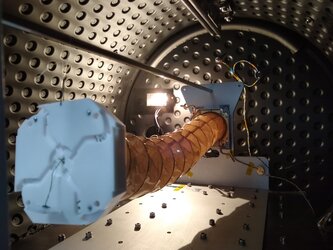
ESA-funded GORID space debris detector, 1996
ESA-funded Geostationary Orbit Impact Detector (GORID), 1996
Debris sensors in orbit
 
For orbits above 600 km, and for inclinations outside the Shuttle's reach, a retrieval of space hardware is not possible and active in-situ sensors are required to measure impact fluxes. In 1996, the ESA-funded Geostationary Orbit Impact Detector (GORID) was launched into GEO on board the Russian Ekspress-2 satellite. During five years of operation, an average of 2.4 impacts/day were detected, with peak counts of 50 per day.
 
 
Debie-2
DEBIE II in orbit with ESA's Columbus science lab
In 2001, a newly designed Debris in-Orbit Evaluator (DEBIE) was launched into LEO on ESA's PROBA-1 satellite. DEBIE used a combination of impact ionisation, momentum and foil penetration detection for the active monitoring of sub-millimetre particles impacting on the detector surfaces. In 2008, DEBIE II was launched together with the Columbus science module, now docked to the International Space Station (ISS). It is now operated via the EUTEF (European Technology Exposure Facility), one of the external Columbus payloads.
 
 
ESA's space debris telescope detects previously unknown objects
Objects in GEO orbit detected by ESA
Debris environment models require measurement data of well-defined regions in space - at specific observation times - to validate their predictions. On the other hand, the data return from measurement campaigns can be optimised with respect to search regions, observation times and sensor sensitivity if some a-priori information on the space debris population is available.

To support the planning of observation campaigns and the exploitation of data for improved debris environment models, ESA has sponsored the development of the PROOF software (Program for Radar and Optical Observations Forecasting).

PROOF simulates space debris observation campaigns for ground- and space-based sensors using available population data from the MASTER model. The simulation generates expected detection statistics and characteristics for given radar or telescope systems and for given campaign parameters. For catalogued objects, PROOF performs predictions with a level of accuracy that allows a clear correlation of recorded detections with catalogued objects.
 
 
Last update: 19 February 2009


   Copyright 2000 - 2012 © European Space Agency. All rights reserved.